

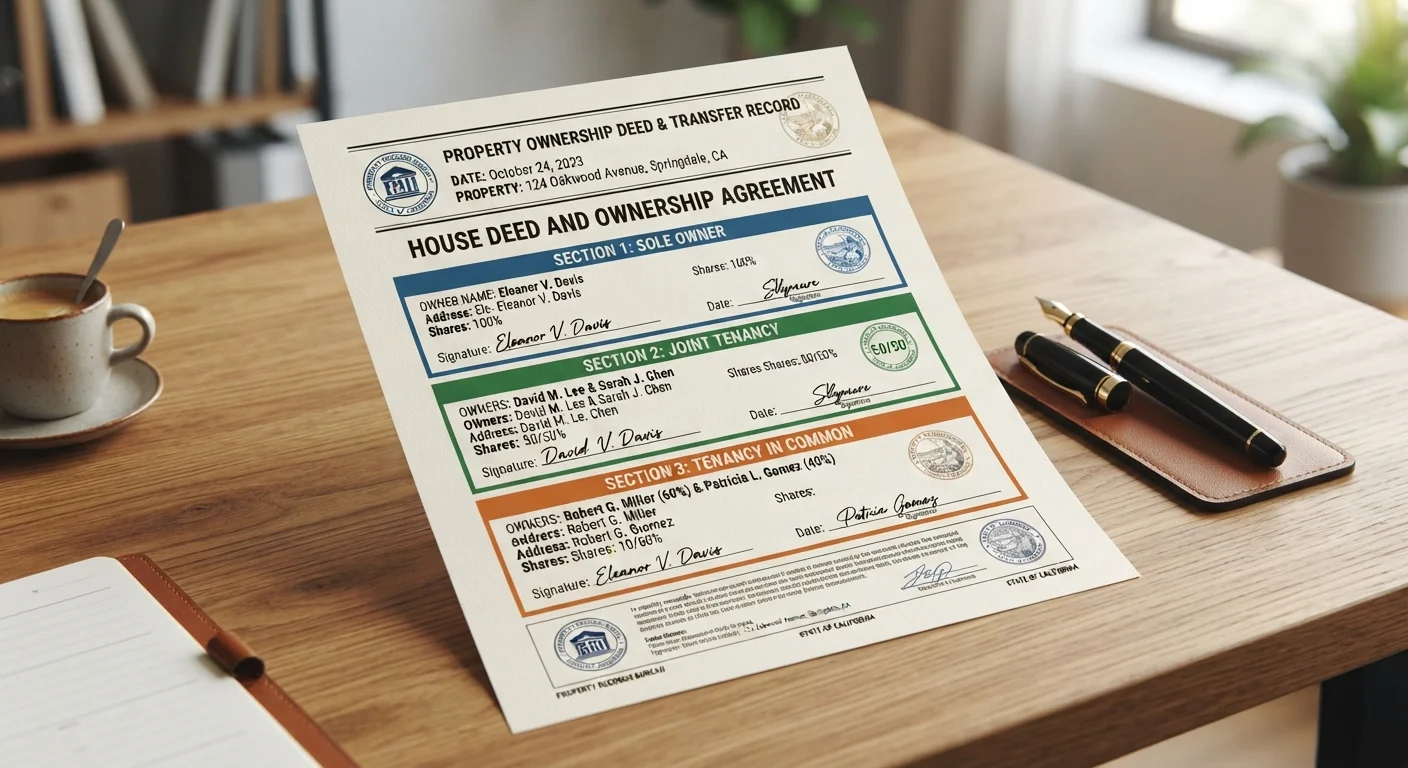
Our Verdict
No single ownership structure is universally better - the right choice depends on your relationship with co-owners, estate planning goals, and state law. Joint tenancy suits co-owners who want seamless transfer at death; tenancy in common suits those who need flexible shares or separate estate plans; sole ownership suits individual buyers who want uncomplicated control.
| Best for | Recommended |
|---|---|
| Married couples seeking simple inheritance without probate | Joint Tenancy (or community property with right of survivorship in eligible states) |
| Investors or unmarried co-buyers needing unequal or separate shares | Tenancy in Common |
| Individual buyers purchasing without a co-owner | Sole Ownership |
| Anyone with complex estate or asset-protection needs | Consult a real estate attorney to evaluate all options |
Why Vesting Matters More Than Most Buyers Realize
When you close on a home, one of the quieter decisions made is how your name - or names - appear on the deed. This is called vesting, and it determines far more than a technicality. Vesting governs who can sell or encumber the property, what happens to it when an owner dies, and how creditors can pursue claims against it.
Most buyers sign wherever instructed at closing without fully understanding their options. That's a meaningful gap, because changing how title is held after the fact requires a new deed and, depending on the structure, can trigger tax or financing complications. Understanding the three primary vesting options - sole ownership, joint tenancy, and tenancy in common - before closing puts you in a far stronger position.
For a broader look at what owning a home commits you to legally and financially, see what owning a home actually means legally and financially.
Sole Ownership: One Name, Full Control
Sole ownership means a single individual holds the entire interest in a property. This is common among single buyers and, in some cases, married individuals who purchase property in their name alone - though state laws, particularly in community property states, can complicate the latter scenario.
Advantages: The sole owner has unrestricted control. They can sell, refinance, lease, or make decisions about the property without another party's consent. There are no co-owner disputes to navigate.
Drawbacks: When a sole owner dies, the property must pass through probate - the court-supervised process of validating a will and distributing assets - unless it has been placed in a trust. Probate can be time-consuming and costly. There is also no built-in liability shield; creditors with judgments against the owner can potentially reach the property.
Consider a Trust Alongside Vesting
Sole ownership can be paired with estate planning tools such as a revocable living trust or a transfer-on-death (TOD) deed (where available) to avoid probate while retaining control during your lifetime. Availability of TOD deeds varies by state. An estate planning attorney can help you evaluate which tools work together in your jurisdiction.
Sole ownership can be paired with estate planning tools such as a revocable living trust or a transfer-on-death (TOD) deed (where available) to avoid probate while retaining control during your lifetime. Availability of TOD deeds varies by state.
Joint Tenancy: Equal Shares with a Survivorship Right
Joint tenancy is a form of co-ownership in which two or more people hold equal, undivided shares in a property. Its defining feature is the right of survivorship: when one joint tenant dies, their interest automatically transfers to the surviving joint tenant(s) - outside of probate.
To create a valid joint tenancy, most states require the four unities: the co-owners must acquire title at the same time, through the same document, with equal interests, and with identical rights to possess the whole property. A deed must typically state the intent to create joint tenancy explicitly.
Advantages: Automatic, probate-free transfer at death simplifies inheritance significantly. It is widely used by married couples for this reason.
Drawbacks: All owners must agree to sell or refinance. Any owner can unilaterally sever the joint tenancy by conveying their interest to a third party - converting it to a tenancy in common - without notifying the other owners, which can undermine estate plans. Equal shares cannot be adjusted.
Note that some states offer a related option called tenancy by the entirety, available only to married couples. It includes survivorship rights and typically stronger creditor protections. Check with a local attorney to see if your state recognizes it.
Tenancy in Common: Flexibility for Co-Owners with Different Needs
Tenancy in common (TIC) is the default form of co-ownership in most states when a deed does not specify otherwise. Unlike joint tenancy, TIC co-owners can hold unequal shares - one person might own 60% and another 40% - and each owner's interest passes through their estate at death rather than automatically to the surviving co-owner.
Advantages: TIC is highly flexible. Owners can hold different percentage interests reflecting their financial contributions. Each co-owner can will their share to anyone they choose - a spouse, child, or trust - independently of the other owners. New co-owners can be added without restructuring the entire arrangement.
Drawbacks: There is no right of survivorship. When a co-owner dies, their share goes through probate and can pass to heirs who are strangers to the other owners. Disagreements between TIC owners about selling or managing the property can escalate to a partition action - a court proceeding that can force a sale.
TIC arrangements are common in real estate investment partnerships and among family members who inherit property together. For guidance on moving property between family members, see transferring property to a family member without selling.
| Sole Ownership | Joint Tenancy | Tenancy in Common | |
|---|---|---|---|
| Number of owners | One | Two or more | Two or more |
| Equal shares required | N/A | Yes | No - shares can vary |
| Right of survivorship | No | Yes - automatic transfer | No - passes through estate |
| Probate at death | Yes (unless in trust) | No | Yes (for each owner's share) |
| Control over sale or refinance | Full - no consent needed | All owners must agree | All owners must agree |
| Estate planning flexibility | High with trust or TOD deed | Limited - share goes to survivor | High - each share willed separately |
| Common use case | Single buyers | Married couples | Investors, unmarried co-buyers, heirs |
Making the Decision: What to Consider
Choosing a vesting structure is not purely a real estate question - it intersects with estate planning, tax strategy, and relationship dynamics. A few practical considerations:
- Your relationship with co-owners: Spouses often prefer joint tenancy for its simplicity. Business partners or investors frequently choose TIC for its flexibility and separate estate planning.
- Estate planning goals: If leaving your share to someone other than a co-owner is important, TIC or sole ownership with a trust may serve you better than joint tenancy.
- State law: Community property states (including California, Texas, Arizona, and others) have distinct rules for married couples. Some states offer tenancy by the entirety. Rules around severance, creditor claims, and probate differ across jurisdictions.
- Financing implications: Lenders typically require all property owners to be on the mortgage. Changing vesting after closing can sometimes trigger a due-on-sale clause, so consult your lender and attorney before making changes.
Vesting is closely related to the broader question of what type of ownership interest you hold. For context on fee simple versus other ownership forms, see fee simple vs. leasehold ownership. And because title defects can affect any ownership structure, understanding what title insurance covers is a useful complement to this decision.
This article provides general real estate information and education. It is not legal or financial advice. Ownership structures, estate planning consequences, and applicable laws vary significantly by state and individual circumstance. Consult a licensed real estate attorney in your jurisdiction before making title decisions.
The content on this site is for informational purposes only and is not a substitute for professional advice. Always consult a qualified professional for guidance specific to your situation.