

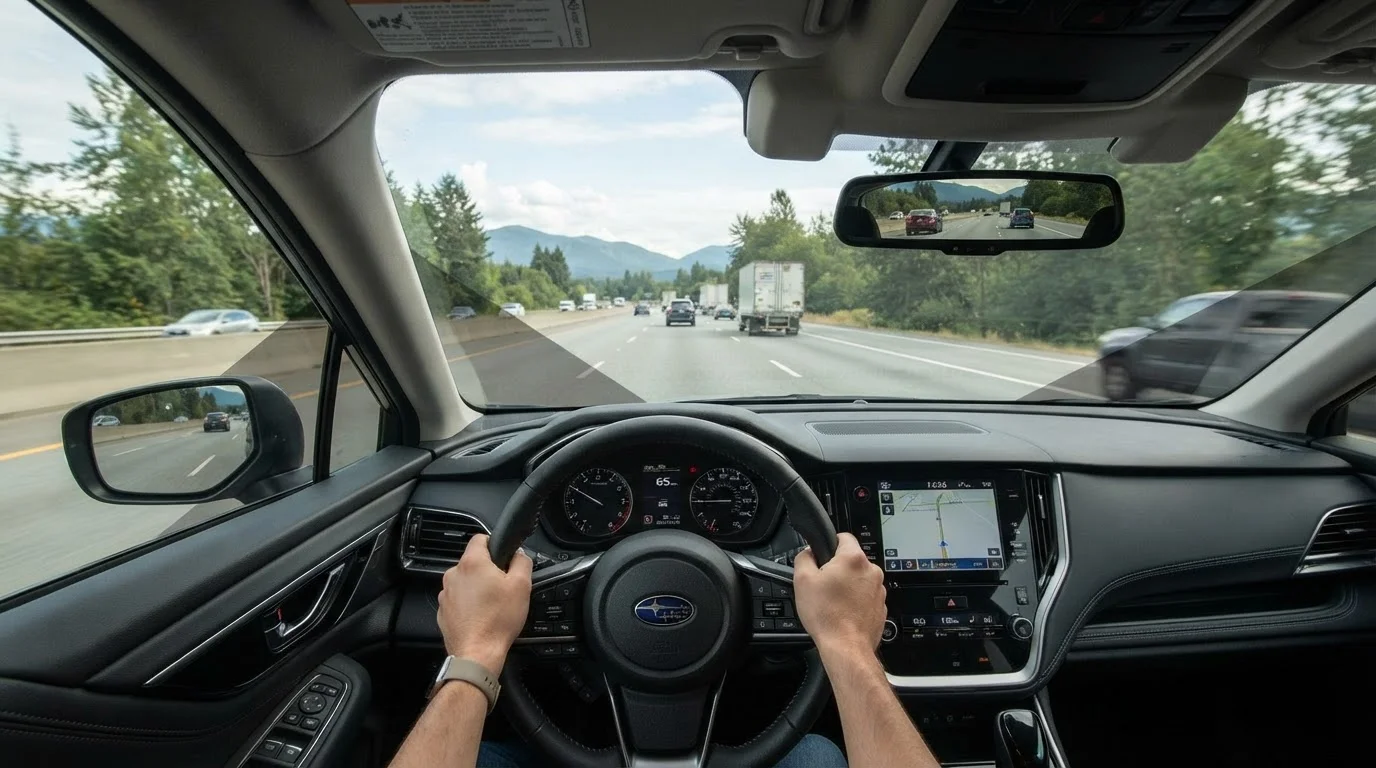
What Is a Blind Spot, Exactly?
A blind spot is any area surrounding your vehicle that falls outside the natural field of vision you have from the driver's seat - and outside what your mirrors reflect. Even when you're positioned correctly, adjusted your mirrors properly, and are paying full attention, these zones simply cannot be seen without physically turning your head.
Blind spots are not a sign of a poorly designed vehicle or an inattentive driver. They are a structural reality of every car, truck, SUV, and commercial vehicle on the road. Understanding where they are - and why they exist - is a core element of defensive driving.
Blind Spot
An area around a vehicle that the driver cannot see directly from the seat or through any mirror. Blind spots vary in size and location by vehicle type.
B-Pillar
The structural vertical column between a vehicle's front and rear side windows. It can block the driver's lateral sightline at certain angles, creating a narrow blind zone.
Convex Mirror
A curved, wide-angle mirror that captures a broader field of view than a flat mirror. Common on passenger-side side mirrors; objects appear smaller and farther than they actually are.
Blind Spot Monitoring
An electronic driver-assist system that uses radar or ultrasonic sensors to detect vehicles in adjacent lanes and alert the driver, typically via a warning light in or near the side mirror.
Head Check
A deliberate shoulder glance performed by the driver before changing lanes or merging, intended to visually confirm the blind spot zone is clear.
Where Blind Spots Actually Occur
The most dangerous blind spots for most passenger vehicles are located on both rear-diagonal sides of the car - roughly the areas just behind and to the left and right of the driver that the side mirrors fail to capture fully. A vehicle traveling alongside you in an adjacent lane can disappear entirely into this zone.
| Most Dangerous Blind Spot Location | Rear-diagonal zones on both sides of the vehicle (NHTSA vehicle safety research) |
| Vehicles Most Affected | Large SUVs, pickup trucks, vans, and commercial trucks |
| Leading Cause of Lane-Change Crashes | Failure to check blind spots before merging (Insurance Institute for Highway Safety (IIHS)) |
| Rear Blind Spot Coverage | Backup cameras help but do not cover all angles |
| Recommended Mirror Adjustment | Outward until your car just exits the mirror's edge (SAE International mirror adjustment research) |
Additional blind spots include:
- Rear blind spot: Directly behind the vehicle, most pronounced in sedans and SUVs with small rear windows or high trunk lines.
- Front blind spot: The area immediately in front of the hood, where low objects, children, or animals may not be visible from the seat.
- B-pillar blind spot: The structural column between the front and rear side windows creates a narrow but real obstruction at certain angles, particularly during turns.
- Right-side blind spot: In left-hand-drive vehicles (standard in the U.S.), the passenger side is inherently harder to monitor - it is farther from the driver and the mirror angle is more limited.
Large vehicles - pickup trucks, SUVs, vans, and commercial trucks - have substantially larger blind zones than compact cars, due to their height, length, and body design.
Why Mirrors Don't Solve the Problem
Mirrors reduce blind spots, but they do not eliminate them. The physics of flat mirrors means that any mirror positioned to show what's directly beside the car will lose part of the rear-diagonal zone, and vice versa. Even convex (wide-angle) side mirrors - which expand the field of view - distort distance perception, making objects appear farther away than they are.
Proper mirror adjustment helps significantly. A widely recommended technique involves adjusting side mirrors outward until your own vehicle just disappears from the mirror's edge - prioritizing coverage of adjacent lanes rather than your car's flanks. This does not eliminate blind spots but meaningfully reduces them. The pre-trip safety check is a good moment to verify mirror positions before every drive.
Technology Assists - It Doesn't Replace Awareness
Blind spot monitoring systems and backup cameras have become increasingly common on modern vehicles, but they have meaningful limitations. Sensors can be blocked by dirt, ice, or heavy rain. Some systems do not reliably detect motorcycles, cyclists, or pedestrians. Treating these features as a supplement to - not a substitute for - active mirror checks and head checks is the safest approach.
Backup cameras and blind spot monitoring systems (sensors that alert you when a vehicle enters a detected zone) provide additional coverage, but they have their own limitations - including sensor range, weather interference, and the fact that they may not detect cyclists or pedestrians at all angles. Technology supports good habits; it does not replace them.
Checking Blind Spots Effectively
The only reliable way to check a blind spot is a deliberate head check: a brief but purposeful shoulder glance toward the zone you are about to move into. Done correctly, this takes less than a second and gives you direct visual confirmation that the lane is clear.
An effective lane-change sequence looks like this:
- Signal your intended direction early - at least 3-5 seconds before moving.
- Check your rearview mirror for vehicles approaching from behind.
- Check the appropriate side mirror.
- Perform a shoulder check - turn your head toward the blind spot zone.
- If clear, begin the lane change smoothly while maintaining speed.
Rushing any step - especially the shoulder check - is where most lane-change collisions originate. Night driving compounds blind spot risk, because vehicles in adjacent lanes are harder to detect even when you do glance back.
840,000+
Annual U.S. blind spot-related crashes
According to estimates cited by the National Highway Traffic Safety Administration (NHTSA), hundreds of thousands of crashes each year involve driver blind zones.
~3 sec
Head check duration needed
A properly executed shoulder check takes approximately one to three seconds - a small investment relative to the hazard it addresses.
Awareness of your own vehicle's blind zones also makes you a safer road-sharer. Avoid lingering alongside large trucks - their rear-diagonal blind zones can span multiple car lengths. If you can't see the truck's side mirror, the driver cannot see you.
This article provides general driver education information. Always follow the traffic laws of your state and consult a certified driving instructor for personalized guidance.
The content on this site is for informational purposes only and is not a substitute for professional advice. Always consult a qualified professional for guidance specific to your situation.