

The Biology Behind the Struggle
The human eye is built with two types of light-sensing cells: cones and rods. During daylight, cone cells in the central retina handle your vision - delivering sharp detail, accurate color, and precise depth perception. When light drops, cones lose effectiveness and your visual system hands off to rod cells, which are distributed more toward the edges of your retina.
Rods are genuinely impressive low-light sensors - far more sensitive to dim light than cones. But they come with real trade-offs: they produce no color information, they resolve less detail, and they are concentrated away from the center of your visual field. This is why looking slightly to the side of a dim object - rather than directly at it - often makes it more visible at night. That technique, sometimes called off-center viewing, takes advantage of where your rods actually sit.
The transition between these two visual modes is not instant. Dark adaptation - the process of your eyes becoming maximally sensitive to low light - can take up to 30 minutes. Bright light exposure (like a gas station or oncoming high beams) partially reverses this process, forcing your eyes to re-adapt. This is one reason night driving demands sustained, active attention in ways that daytime driving simply does not.
Your Central Vision Is Less Reliable at Night
Most drivers instinctively stare directly at what they want to see. At night, this works against you: your cone cells - concentrated in the center of your visual field - are poorly suited to low-light conditions. Try scanning slightly to the side of objects you're trying to detect, rather than locking your gaze directly on them. This off-center approach puts the image on rod-rich areas of your retina where it's easier to resolve in darkness.
Glare, Halos, and the Contrast Problem
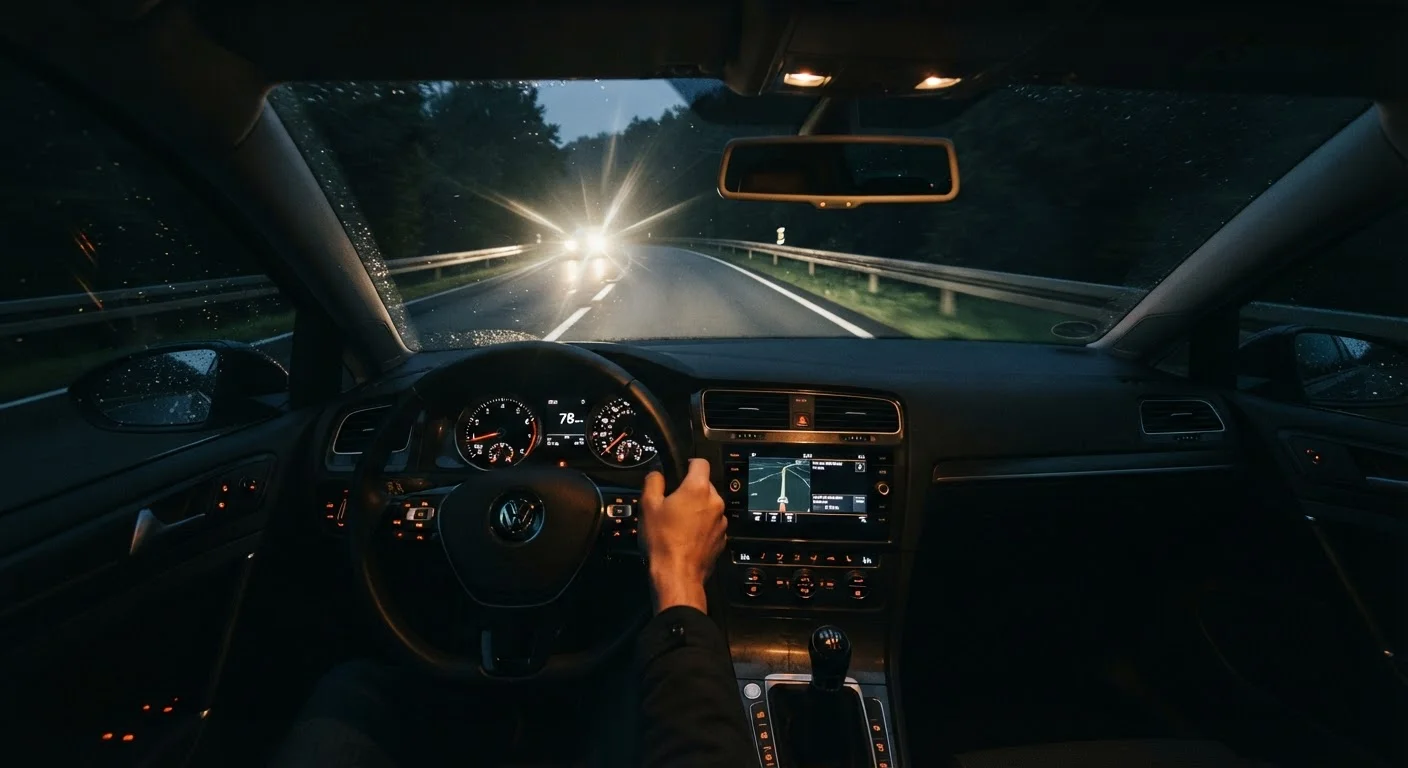
One of the most disorienting aspects of night driving is glare - the intense, disabling light produced by oncoming headlights or poorly aimed beams. When a bright light source enters the eye in a dark environment, the pupil - which has dilated to let in more light - is briefly overwhelmed. This creates a momentary loss of useful vision called disability glare, and it can last several seconds after the light source passes.
Older drivers are especially vulnerable. The aging lens inside the eye scatters light more than a younger lens does, increasing halos and starburst effects around light sources. Drivers with uncorrected refractive errors or early cataracts may also experience amplified glare effects. If you notice significant halos or glare when driving at night, an eye exam is worth scheduling - this is general guidance, not a diagnosis.
Beyond glare, nighttime also eliminates much of the contrast that makes objects readable during the day. A pedestrian in dark clothing, a deer at the road's edge, or a pothole on an unlit street can be nearly invisible until you're dangerously close. Your headlights illuminate a relatively narrow cone ahead - and that cone has hard limits.
~50%
Of traffic fatalities occur at night
According to the National Safety Council, roughly half of all traffic deaths in the U.S. occur during nighttime hours, despite far less traffic volume than daytime.
3x
Higher fatal crash risk after dark
The National Safety Council estimates the fatal crash rate at night is approximately three times higher per mile traveled compared to daytime driving.
30 min
Time for full dark adaptation
Vision researchers note that complete adaptation of rod cells to darkness can take up to 30 minutes, with partial adaptation occurring in the first 5-10 minutes.
What Smart Night Drivers Actually Do Differently
Understanding the biology gives you a practical edge. Compensating for your eyes' natural limitations at night isn't complicated - but it does require deliberate habit changes.
- Slow down to match your sight distance. Your low beams illuminate roughly 160-200 feet ahead. At highway speeds, you can cover that distance faster than you can react and stop. Reducing speed is not timidity - it's physics.
- Keep your windshield clean - inside and out. Even a thin film of dust or grease on the inside of a windshield dramatically worsens glare from oncoming lights. It's one of the simplest, most overlooked improvements a driver can make.
- Use high beams appropriately. On rural or unlit roads with no oncoming traffic, high beams extend your sight distance considerably. Switch back to low beams when approaching other vehicles - blinding another driver creates a hazard for everyone.
- Look to the right edge line when oncoming headlights approach. This reduces direct glare exposure and keeps your reference point on the road.
- Take fatigue seriously. Night driving and tiredness compound each other in dangerous ways. If you're yawning frequently or struggling to stay alert, pull over safely. The warning signs of driver fatigue can be subtle early on.
These strategies pair directly with broader defensive driving principles - always scanning ahead, maintaining extra following distance, and anticipating hazards before they're on top of you.
Clean Your Windshield Before Night Driving
A hazy or smudged windshield is barely noticeable during the day but can dramatically amplify glare from oncoming headlights after dark. Wipe the inside of your windshield with a microfiber cloth regularly - it takes two minutes and can make a meaningful difference in your nighttime visibility.
Night Driving in Context: Other Variables That Matter
Visual limitation is the central challenge of night driving, but it doesn't operate in isolation. Weather is a major compounding factor. Rain at night scatters headlight beams off wet pavement and multiplies glare from every reflective surface. The adjustments required for rain, ice, and snow become even more critical when visibility is already reduced by darkness.
Your vehicle's surroundings add another layer. Night driving in urban environments brings streetlights, neon signs, and heavy pedestrian traffic - a different visual load than dark rural highways. Your risk profile shifts meaningfully between urban and highway driving, and after dark, those differences are amplified. Additionally, the blind spots that exist around every vehicle during the day don't shrink at night - they become harder to monitor, especially when mirror checks compete with managing glare.
Good night driving is ultimately about honest self-assessment: knowing what your eyes can and cannot do in the dark, adjusting your speed and following distance to match that reality, and keeping your vehicle - particularly its lighting and glass surfaces - in good working order. The limits are real, but they're manageable with the right approach.
This article is for general informational purposes only and does not constitute medical or professional driving advice. If you have concerns about your vision or night driving ability, consult a qualified eye care professional.
Frequently Asked Questions
At night, your eyes rely on rod cells rather than cone cells. Rods are sensitive to low light but provide less detail and no color information, making it genuinely harder to resolve shapes, distances, and hazards clearly. This is a biological limitation, not a sign of poor eyesight.
Initial dark adaptation takes about 5-10 minutes for rod cells to begin functioning effectively. Full dark adaptation can take up to 30 minutes. Even brief exposure to bright light - such as oncoming headlights - can reset this process significantly.
Yes, significantly. The pupil's ability to dilate decreases with age, reducing the amount of light reaching the retina. Older drivers often need substantially more light to see as clearly as younger drivers. An eye care professional can assess how age-related changes may be affecting your night vision.
Anti-reflective lens coatings can reduce glare from headlights for prescription eyeglass wearers. However, yellow-tinted 'night driving' glasses are not clinically proven to improve vision in darkness and may actually reduce overall light transmission. Consult an eye care professional for personalized guidance.
A common principle is to drive within your 'sight distance' - meaning you should be able to stop within the distance your headlights illuminate. On a standard road with low beams, that's roughly 160-200 feet, which supports lower speeds than most drivers assume are safe.
The content on this site is for informational purposes only and is not a substitute for professional advice. Always consult a qualified professional for guidance specific to your situation.