

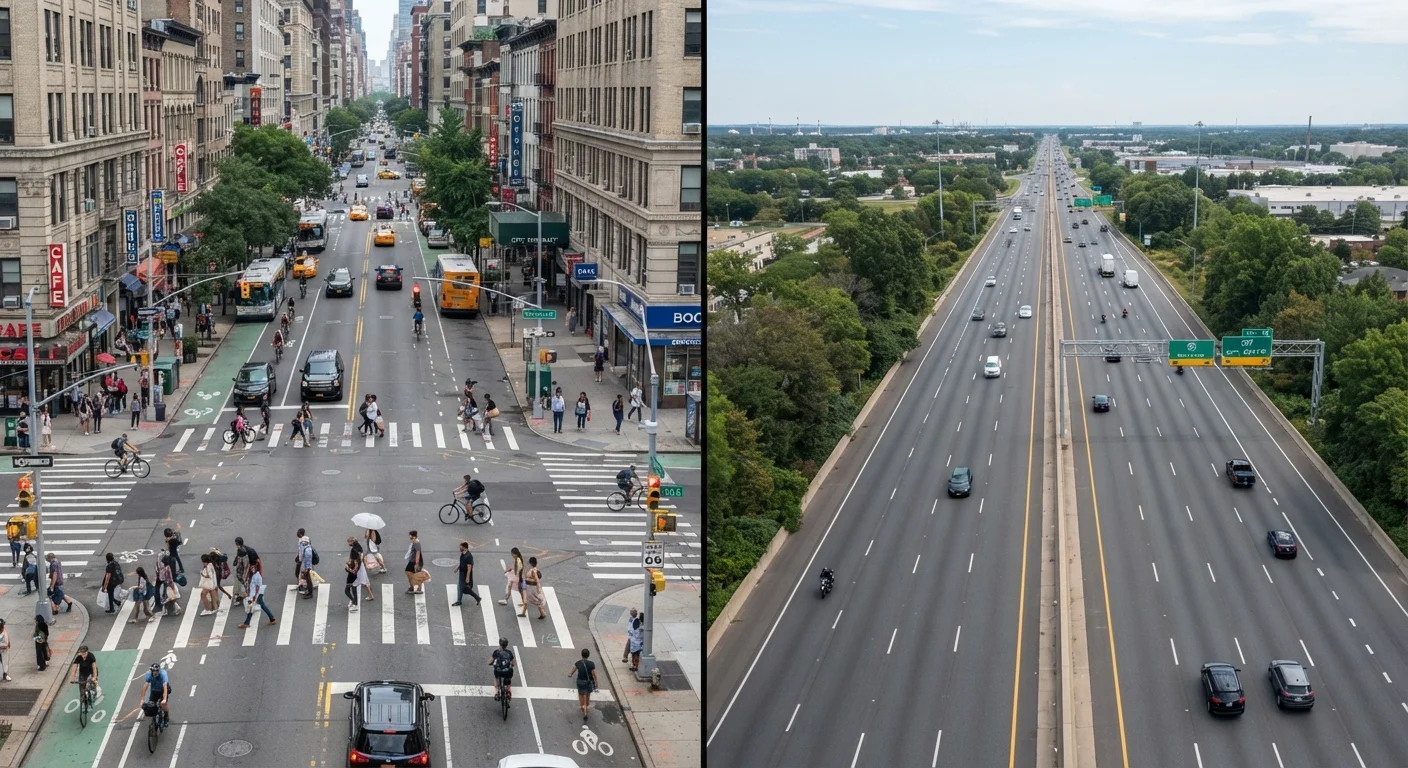
Option A
Urban Driving
High-stimulus, low-speed - but deceptively demanding.
Best for: Commuters and local errand-runners who navigate intersections, pedestrians, cyclists, and frequent stops daily.
Option B
Highway Driving
High-speed, lower complexity - but with outsized crash consequences.
Best for: Long-distance travelers and commuters covering significant mileage at sustained speeds on controlled-access roads.
The Core Difference: Frequency vs. Severity
Urban and highway driving aren't simply fast versus slow versions of the same task. They present structurally different risk environments - one defined by how often something can go wrong, the other by how badly it goes wrong when it does.
In cities, drivers encounter a relentless stream of decision points: traffic signals, crosswalks, cyclists, double-parked vehicles, and unpredictable pedestrian behavior. The sheer volume of interactions means the statistical probability of a minor collision - a fender bender at a stop sign or a sideswipe in stop-and-go traffic - is comparatively high. Speeds, however, are low, and that limits injury severity in most incidents.
On the highway, the calculus reverses. Controlled-access design eliminates many of the chaotic variables of city streets. Fewer intersections, no pedestrians, and a more predictable traffic flow reduce the frequency of collision opportunities. But when something goes wrong at 65-75 mph, stopping distances stretch dramatically and the physics of impact become far more destructive. Fatal crash rates per mile traveled are substantially higher on rural highways and interstates than in dense urban corridors, according to data published by the National Highway Traffic Safety Administration (NHTSA).
Understanding this distinction is the first step in adjusting your habits to fit the road you're actually on. See our foundational guide to defensive driving for the core principles that underpin safe behavior in both environments.
| Criterion | Urban Driving | Highway Driving |
|---|---|---|
| Typical speed range | 15-45 mph | 55-80 mph |
| Crash frequency | Higher per mile | Lower per mile |
| Crash severity | Generally lower | Significantly higher |
| Primary hazard type | Pedestrians, cyclists, intersections | Speed, fatigue, merge conflicts |
| Cognitive demand | High - frequent decisions | Moderate - sustained attention |
| Fatigue risk | Lower - stimuli keep drivers alert | Higher - monotony induces drowsiness |
| Weather impact on risk | Moderate - lower speeds limit severity | High - wet/ice extends stopping distance greatly |
Urban Hazards: Attention Overload and the Intersection Problem
City driving is cognitively expensive. Research in traffic psychology consistently shows that urban environments demand more rapid, frequent decisions per mile than any other road type. Drivers must simultaneously track moving pedestrians, cyclists filtering through traffic, changing signal phases, and vehicles merging from side streets - often in a compressed visual field where sightlines are blocked by buildings, parked trucks, or buses.
Intersections are the single highest-risk location in urban driving. The majority of urban crashes - including those involving pedestrians and cyclists - occur at or near intersections, whether signalized or not. Left turns present a particular hazard because they require crossing oncoming traffic while also scanning for pedestrians in the crosswalk. For a closer look at how intersection design itself affects safety outcomes, see our article on roundabouts vs. traditional intersections.
Distraction is also amplified in cities. The abundance of visual stimuli - storefronts, signage, other road users - competes for cognitive bandwidth. Even briefly looking at a phone while navigating a busy corridor can mean missing a pedestrian stepping off the curb. Urban drivers who default to defensive habits - scanning ahead, covering the brake before intersections, leaving a buffer around cyclists - substantially reduce their exposure to these micro-risks.
~40%
Urban share of all U.S. traffic fatalities
NHTSA data consistently shows that while urban areas generate a large share of crashes, a disproportionate number of fatalities occur on rural and highway roads.
4-5x
Increase in stopping distance from 30 to 60 mph
Basic physics: stopping distance grows with the square of speed, so doubling speed more than quadruples the distance needed to stop on dry pavement.
~1 in 25
Drivers report falling asleep at wheel in past 30 days
According to CDC research on drowsy driving, a significant proportion of drivers admit to recent episodes of nodding off - most commonly on highway routes.
Highway Hazards: Speed, Fatigue, and the Merge Zone
Highway driving trades cognitive overload for a subtler, more insidious set of risks. The relative monotony of sustained highway travel lowers arousal levels over time, making driver fatigue one of the most significant hazards on long-distance routes. Drowsy driving impairs reaction time in ways that closely parallel alcohol impairment - and unlike urban driving, where frequent stops and stimuli interrupt fatigue, highway travel offers few natural breaks in the rhythm. If you regularly drive extended distances, our guide on recognizing driver fatigue on long trips covers the warning signs and evidence-based strategies for managing alertness.
Speed perception is another underappreciated highway hazard. Human visual systems are surprisingly poor at judging velocity in open, featureless environments. Drivers who have been traveling at 75 mph for an extended period often perceive themselves as moving more slowly than they are - a phenomenon explored in depth in our piece on why drivers underestimate speed. This misjudgment shortens the following distance drivers maintain and delays braking initiation.
Merge zones - where on-ramps join the main travel lanes - are the highway equivalent of urban intersections. Drivers accelerating to match highway speed while scanning for gaps require split-attention processing that is particularly demanding for less experienced drivers. Maintaining consistent speed, signaling early, and yielding predictably all reduce merge-zone conflict.
Weather compounds all of these factors. Wet or icy pavement dramatically extends stopping distances at highway speeds, a topic covered in detail in our guide on adjusting your driving for rain, ice, and snow.
Following Distance Changes With Speed
The traditional 'two-second rule' for following distance was designed for lower speeds. At highway velocities - 65 mph or above - many traffic safety experts recommend extending that buffer to three or four seconds. This gives your brain adequate time to perceive a hazard and initiate braking before closing on the vehicle ahead. In poor weather or low visibility, increase the gap further.
Adapting Your Approach When the Environment Changes
Many drivers apply a single, undifferentiated driving style regardless of environment - a habit that leaves them either over-stimulated on the highway or under-prepared in the city. Conscious environment-switching is a skill worth developing deliberately.
When transitioning from highway to urban driving, allow time for your perception to recalibrate. After sustained highway travel, city speeds can feel deceptively slow, causing drivers to move through intersections faster than conditions warrant. Reduce speed before entering populated areas, not at the first traffic signal.
Moving from city to highway, the adjustment runs in the opposite direction. Drivers accustomed to frequent visual stimulation may find themselves seeking distractions - checking phones or adjusting audio - to compensate for the relative monotony. Build in planned rest stops on trips exceeding two hours, and be deliberate about night driving conditions; our article on why night driving feels harder explains the visual science behind reduced nighttime performance.
For newer drivers still building foundational experience, both environments deserve dedicated practice. Urban routes build hazard-perception speed; highway routes develop speed management and fatigue awareness. See our guidance on graduated licensing for teen drivers for how licensing programs structure this progression.
Ultimately, knowing which environment you're entering - and what it specifically demands - is itself a safety behavior. Drivers who consciously shift their attention strategies at the transition point between city and highway are practicing a form of situational awareness that reduces risk in both directions.
The content on this site is for informational purposes only and is not a substitute for professional advice. Always consult a qualified professional for guidance specific to your situation.