

The Gap Between Feeling and Fact
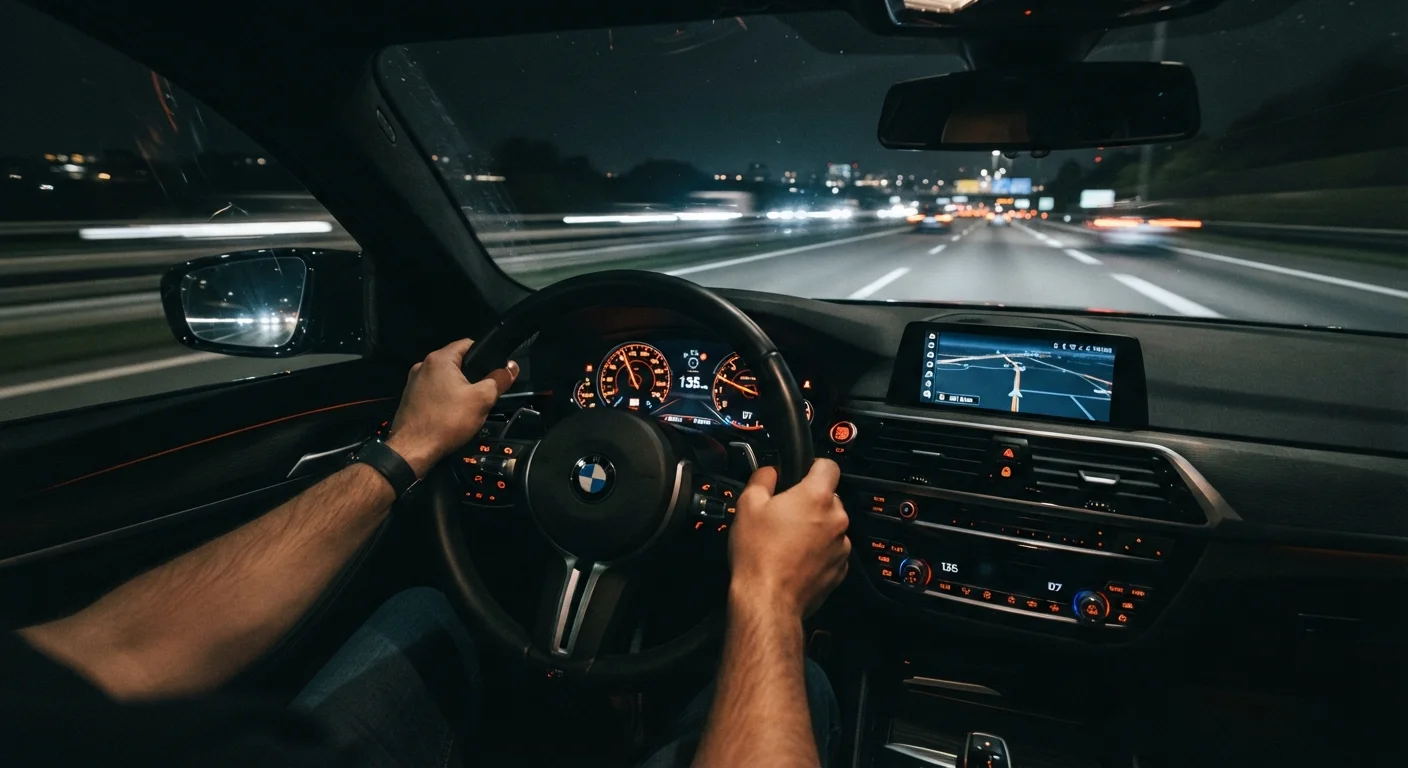
Most drivers believe they have a reasonably accurate sense of how fast they're traveling. Research on human perception consistently tells a different story. Speed is not something the brain measures directly - it is inferred from a combination of visual cues, sound, vibration, and prior experience. When any of those inputs are muted or misleading, the estimate drifts.
Modern vehicles are engineered to be quiet and stable at high speeds. Well-maintained roads reduce feedback from the tires and suspension. Taken together, these comforts systematically suppress the sensory signals that would otherwise register speed as genuinely fast. The result: drivers routinely travel faster than they consciously perceive.
This isn't a matter of recklessness or bad intent. It's a predictable outcome of how human perception works under real driving conditions - and understanding it is the first step to correcting it. For a deeper look at how velocity translates to stopping distance, see our guide to speedometer numbers and following distance.
~29%
Fatal crashes involving speeding
According to the National Highway Traffic Safety Administration (NHTSA), speeding is consistently a factor in roughly 29% of all traffic fatalities in the United States each year.
2x
Increased fatality risk at 65 vs. 55 mph
Research published in transportation safety literature indicates that the risk of a fatal crash roughly doubles when impact speed increases from 55 mph to 65 mph, due to exponential increases in kinetic energy.
Common Speed-Perception Mistakes - and How to Avoid Them
The following mistakes represent the most consistent patterns identified in driving safety research. Each one reflects a genuine perceptual or behavioral tendency, not a character flaw. Recognizing them is what allows drivers to compensate effectively.
Relying on 'feel' rather than the speedometer in familiar environments.
Why it happens: On well-known routes, the brain switches to autopilot mode, reducing active processing of speed-related cues. Familiarity breeds perceptual complacency.
Failing to recalibrate speed perception after extended highway driving.
Why it happens: After sustained driving at 65-75 mph, the nervous system adapts so that lower speeds - like a 35 mph residential street - feel almost stationary. This is often called 'speed adaptation' or 'highway hypnosis' effect.
Assuming that light traffic means it's safe to travel faster than posted limits.
Why it happens: An open road reduces the visual density of nearby objects passing in the peripheral field - one of the brain's primary cues for speed. The road feels slower because it looks emptier.
Misjudging speed in poor visibility conditions such as fog, rain, or darkness.
Why it happens: Reduced visual range compresses the cues the brain uses to estimate motion. Drivers often slow down somewhat in these conditions but not nearly as much as the hazard requires.
Underestimating speed while distracted by passengers, audio, or a device.
Why it happens: Cognitive load from secondary tasks draws attention away from environmental cues. The brain can't accurately process speed when its resources are divided.
Speed misestimation doesn't happen in isolation - it interacts with different risk profiles on urban streets versus open highways. The same perceptual blind spots behave differently depending on the environment.
Speed Limits Reflect Road Design, Not Just Law
Speed limits are not arbitrary numbers - they are derived from engineering studies that account for road geometry, pedestrian presence, sight-line distances, and crash history. Traveling even 10 mph above a posted limit can dramatically shorten the window available to react to a hazard. In school zones or near crosswalks, that margin can be the difference between a near-miss and a tragedy.
Building Habits That Override Faulty Perception
Awareness alone doesn't fix a perception problem - habits do. The speedometer is the single most reliable tool available to every driver, yet studies suggest many drivers glance at it far less frequently than is optimal, particularly in familiar environments or during low-traffic periods when vigilance naturally drops.
A practical discipline: treat each new road segment - after a highway exit, a school zone entry, or a transition from a rural to a residential street - as a trigger for a deliberate speedometer check. Do not wait until something feels fast. By the time the environment signals urgency, the vehicle is often already well above the posted limit.
Fatigue also plays a direct role in speed misestimation. A tired brain processes environmental cues more slowly and is more likely to rely on habit rather than active attention. If you're on a long drive, review the warning signs of driver fatigue before departure - it directly affects how accurately you'll perceive your own speed.
Your Perception of Speed Is Not a Reliable Safety Tool
No matter how experienced a driver you are, human perception of speed under real-world conditions is measurably imprecise. Overconfidence in your internal sense of velocity - particularly on familiar routes or after long highway stretches - is itself a crash risk factor. The speedometer exists precisely because perception fails. Use it actively, not just when something feels wrong.
The content on this site is for informational purposes only and is not a substitute for professional advice. Always consult a qualified professional for guidance specific to your situation.