

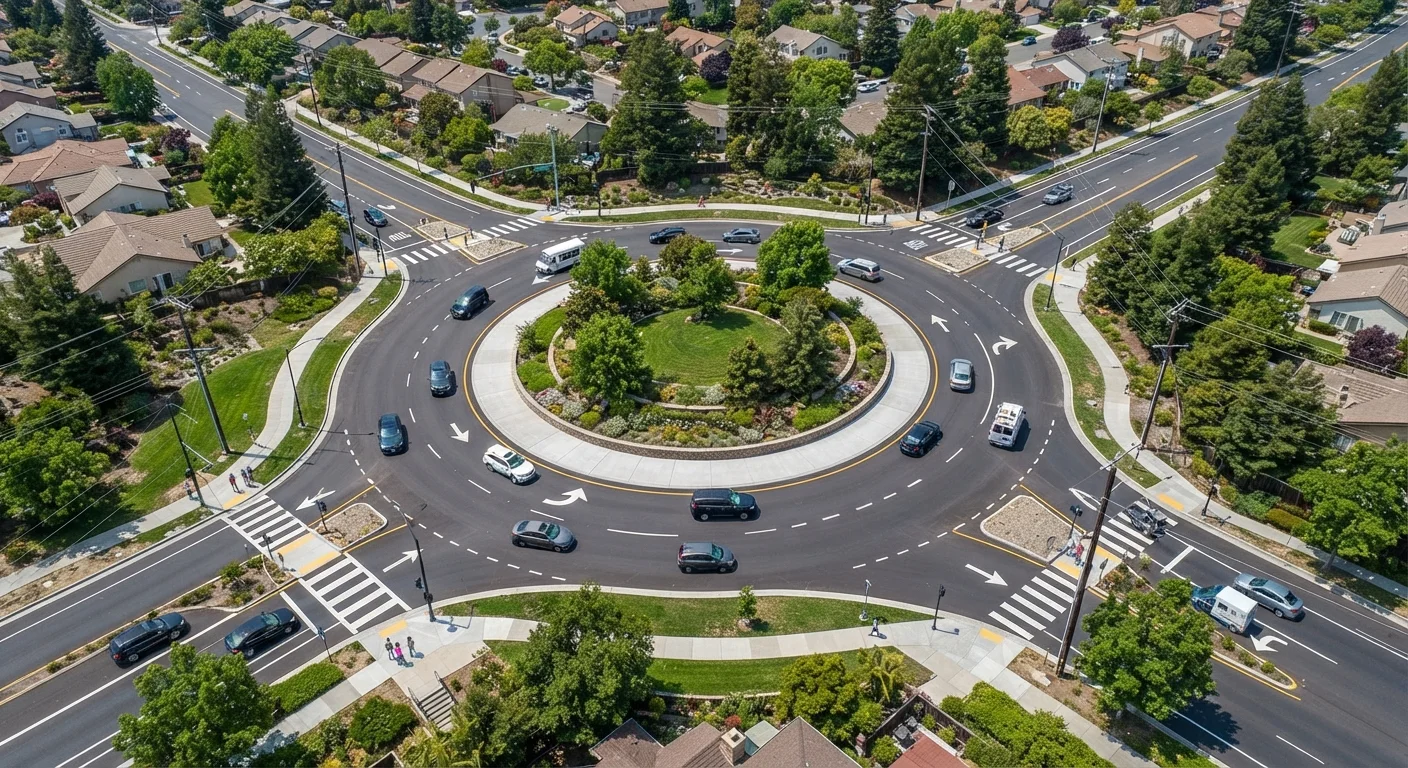
Option A
Roundabouts
The modern, continuously flowing alternative to stop-and-go intersections.
Best for: High-traffic areas where reducing severe crash severity and improving traffic flow are priorities.
Option B
Traditional Intersections
The familiar, signal- or sign-controlled standard at most U.S. road crossings.
Best for: Drivers and planners in areas where predictable, familiar traffic control patterns are preferred or required.
The Core Safety Difference: Conflict Points
The primary safety advantage of roundabouts comes down to geometry. A standard four-way signalized intersection creates up to 32 potential vehicle conflict points - places where paths cross, merge, or diverge. A comparable roundabout reduces that number to roughly 8. Fewer conflict points mean fewer opportunities for collisions.
More importantly, roundabouts eliminate the two crash types most likely to cause serious injury or death: right-angle (T-bone) collisions and head-on crashes. At a traditional intersection, a driver running a red light at speed can strike another vehicle broadside. At a roundabout, vehicles travel in the same circular direction and at lower speeds, so even when a crash does occur, the impact forces are substantially lower.
According to the Federal Highway Administration (FHWA), converting a traditional intersection to a roundabout can reduce fatal and injury crashes by roughly 75-90% and overall crashes by around 35-40%. These are significant figures, though outcomes vary by location, design quality, and driver behavior.
| Criterion | Roundabouts | Traditional Intersections |
|---|---|---|
| Fatal crash reduction | Up to ~90% fewer (FHWA data) | Baseline reference point |
| Vehicle conflict points | ~8 points | Up to 32 points |
| Right-angle crash risk | Largely eliminated | Significant risk at high speeds |
| Traffic delay | Often lower, continuous flow | Higher during red phases |
| Driver familiarity (U.S.) | Lower - still uncommon in many areas | High - universal experience |
| Pedestrian accessibility | Generally good; some audible signal gaps | Well-established pedestrian signal systems |
| Space required | More - needs circular geometry | Less - fits existing grid layouts |
Traffic Flow: Moving Cars More Efficiently
One of the most counterintuitive findings about roundabouts is that they often move traffic faster than signalized intersections, despite appearing less orderly. Traditional intersections force vehicles to stop completely during red phases, including when cross-traffic is light or absent. Roundabouts use a yield-on-entry system, meaning drivers slow but often don't stop entirely when the roundabout is clear.
This continuous-flow design reduces cumulative delay, especially during off-peak hours when signal timing can mismatch actual traffic volume. Studies cited by the Insurance Institute for Highway Safety (IIHS) suggest that roundabouts can reduce vehicle delay by 13-23% compared to traditional stop-controlled intersections, and in some cases more.
There's an important caveat: very high-volume intersections with complex turning demands - such as those feeding highway on-ramps or serving large freight corridors - may still benefit from precision signal coordination that roundabouts can't replicate. Road engineers consider traffic volume, turning ratios, and peak-hour demand when recommending intersection type. For everyday suburban and rural roads, roundabouts typically perform well on flow efficiency.
Understanding how intersection design shapes your risk connects to broader driving environment awareness. If you regularly navigate both city streets and open roads, see how those environments differ in our look at urban vs. highway driving risk profiles.
~90%
Reduction in fatal crashes at converted intersections
The Federal Highway Administration estimates roundabout conversions can reduce fatal crashes by approximately 75-90% depending on design and location.
32 vs. 8
Vehicle conflict points: traditional vs. roundabout
A standard four-way intersection generates up to 32 vehicle conflict points; a comparable roundabout reduces this to roughly 8.
13-23%
Average vehicle delay reduction at roundabouts
Research cited by the Insurance Institute for Highway Safety suggests roundabouts reduce vehicle delay by 13-23% compared to stop-controlled intersections.
Driver Familiarity and the Learning Curve
Despite their safety record, roundabouts face consistent resistance from American drivers. The U.S. built its road network largely around grid systems and signal-controlled intersections, so many drivers - particularly older adults or those in rural areas where roundabouts remain rare - find them disorienting at first.
Common points of confusion include understanding yield rules (you yield to traffic already in the roundabout, not to traffic entering), choosing the correct lane before entering a multi-lane roundabout, and knowing when to signal an exit. These are learnable behaviors, but they require adjustment if you've never navigated one regularly.
Pedestrian and cyclist accommodation also deserves attention. Roundabouts typically include splitter islands and crosswalks positioned away from the circle's main flow, giving pedestrians a refuge and reducing the speed at which they must cross. For most able-bodied pedestrians, this is manageable. However, for individuals with visual impairments, the absence of audible pedestrian signals at many roundabout crossings has been cited as a real accessibility challenge - one that transportation engineers continue to address with improved design standards.
Multi-Lane Roundabouts Require Extra Care
Single-lane roundabouts are generally straightforward, but multi-lane roundabouts present more complexity. Drivers should determine their intended exit and select the appropriate lane before entering - typically the right lane for nearby exits and the left lane for exits further around the circle. Changing lanes while inside a roundabout is dangerous and should be avoided. If you miss your exit, continue around rather than reversing or cutting across lanes.
Which Design Is Right for a Given Road?
Neither roundabouts nor traditional intersections are universally superior. Road engineers evaluate several factors before recommending a design: intersection geometry, available right-of-way, traffic volume, speed limits on approaching roads, and community context.
Roundabouts work particularly well at rural crossroads where high-speed right-angle crashes are a documented risk, at suburban arterials where traffic volumes are moderate and space is available, and at intersections with unusual angles where signal phasing is complex. Traditional signalized intersections remain appropriate for dense urban corridors with heavy pedestrian demand, locations where signal coordination across multiple intersections is critical, and sites where physical constraints make circular geometry impractical.
For drivers, the practical takeaway is this: when approaching a roundabout, slow down as you reach the yield line, watch for vehicles already circulating, and choose your lane based on your intended exit before you enter - not while you're in it. These habits make roundabouts safer for everyone on the road.
This article provides general road safety information for educational purposes. Always follow posted traffic signs and signals, and consult your state's driver handbook for jurisdiction-specific rules on roundabout navigation.
The content on this site is for informational purposes only and is not a substitute for professional advice. Always consult a qualified professional for guidance specific to your situation.