

What Is Graduated Driver Licensing?
Graduated Driver Licensing - commonly abbreviated as GDL - is a framework that introduces new teen drivers to road privileges in stages rather than all at once. Instead of granting full driving freedom the moment a teenager passes a written test, GDL programs require young drivers to accumulate supervised experience, demonstrate responsible habits, and advance through defined milestones before earning unrestricted driving privileges.
The goal is straightforward: new drivers lack the experience to handle the full range of situations on the road, and crash risk is highest in the earliest months behind the wheel. Research consistently supports this approach - according to the Insurance Institute for Highway Safety (IIHS), GDL programs have been associated with meaningful reductions in crash deaths among 16-year-old drivers in states with stronger laws.
~50%
Reduction in crash deaths at age 16
The IIHS reports that strong GDL laws have been associated with substantial declines in fatal crash rates among 16-year-old drivers compared to pre-GDL baselines.
3x
Higher crash risk with teen passengers
Research cited by the CDC indicates that crash risk roughly triples for teen drivers when carrying multiple teenage passengers compared to driving alone.
All 50
States with some form of GDL law
Every U.S. state has enacted graduated licensing legislation, though the strength and specifics of those laws vary significantly.
GDL is not a single national law. Every state administers its own version, which means the specific ages, required hours, and restrictions can differ considerably depending on where you live.
The Three Stages of a GDL Program
While details differ by state, most GDL frameworks share a common three-stage structure:
Stage 1: Learner Permit
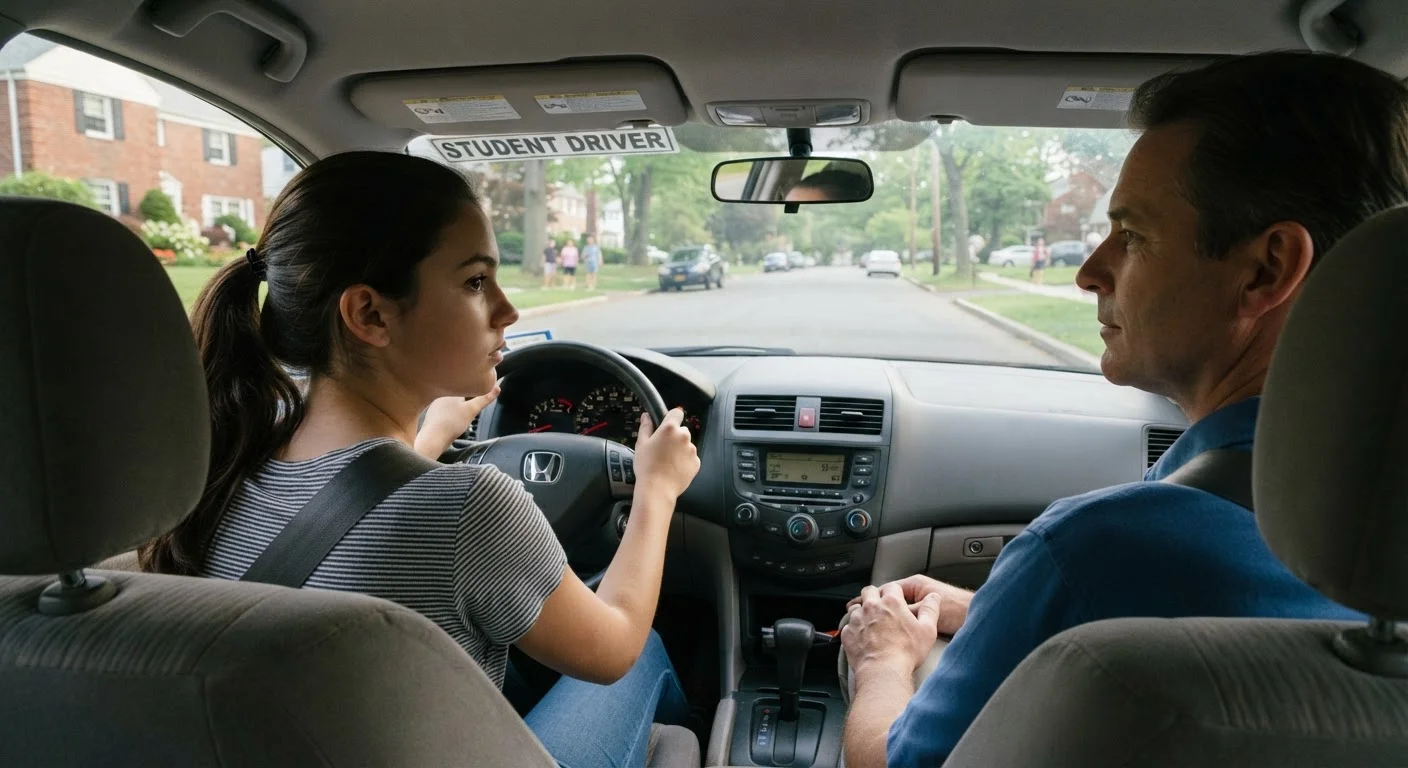
A teen typically applies for a learner permit after reaching a minimum age (often 15 or 16) and passing a knowledge test covering traffic laws and road signs. During this stage, the young driver must always be supervised by a licensed adult - usually a parent or guardian who meets a minimum age requirement set by the state. Many states require a minimum number of practice hours, often ranging from 30 to 60 hours, with a portion required at night.
Stage 2: Restricted (Provisional) License
After holding the learner permit for a set period and meeting practice-hour requirements, the teen may apply for a provisional or intermediate license. This allows unsupervised driving, but with specific restrictions - most commonly, nighttime curfews and limits on the number of teenage passengers allowed in the vehicle.
Stage 3: Full Unrestricted License
Once the teen has held the provisional license without serious violations for a required period (often six months to a year), they become eligible for a full license with no GDL-specific restrictions. Age minimums for a full license vary - many states set this at 17 or 18.
Track Practice Hours From Day One
Many states require parents or guardians to certify supervised hours on permit applications. Keep a simple driving log from the very first session - date, duration, and road conditions. Starting this habit early means you won't be scrambling to reconstruct records later, and it helps ensure your teen gets varied experience across different driving environments.
Common Restrictions Teen Drivers Face
Restrictions during the provisional stage exist because data shows these specific circumstances contribute disproportionately to teen crashes. Here are the most widely applied:
- Nighttime driving curfews: Most states prohibit unsupervised driving between certain late-night and early-morning hours - often midnight to 5 a.m., though some states start as early as 9 or 10 p.m.
- Passenger limits: Carrying teenage passengers dramatically increases distraction risk. Many states limit provisional license holders to zero or one non-family teen passenger for the first several months.
- Cell phone and device bans: Nearly all states prohibit any handheld device use for teen drivers, and many ban even hands-free use during the provisional period.
- Seat belt requirements: All passengers must be buckled - a condition often enforced more strictly for new drivers under provisional licenses.
Violations of GDL restrictions can result in fines, extended provisional periods, or license suspension. Understanding these rules upfront prevents consequences that can set a new driver back significantly.
GDL Violations Can Set Teens Back
Breaking a restriction - such as driving past curfew or carrying unauthorized passengers - isn't just a minor infraction. Many states respond by extending the provisional period, suspending the license, or resetting the clock on requirements. Make sure both teens and parents understand that GDL restrictions carry real consequences and are actively enforced.
How State Laws Differ
Because GDL is administered at the state level, the specifics vary considerably. A teen living in one state may face a stricter nighttime curfew than a peer in another, or a longer mandatory holding period before advancing stages.
Some factors that commonly differ between states include:
- Minimum permit age
- Ranges from 14 (in some rural states with agricultural exemptions) to 16 in others.
- Required supervised hours
- Some states require as few as 20 hours; others mandate 65 or more.
- Curfew start times
- Nighttime restrictions can begin anywhere from 9 p.m. to midnight depending on the state.
- Passenger restrictions
- Some states allow one non-family passenger; others allow none for the first six months.
- Minimum age for full license
- Several states require drivers to be 18 for unrestricted privileges; others allow it at 17.
The IIHS and your state's Department of Motor Vehicles (DMV) are the most reliable sources for current, state-specific GDL requirements. Always verify rules directly with official sources, as laws are periodically updated. New teen drivers should also become familiar with the broader responsibilities of vehicle ownership, including registration and insurance obligations.
GDL Laws Change - Verify Directly
State legislatures periodically update GDL requirements, sometimes tightening curfews or adding new restrictions. Information in any third-party summary - including this one - may not reflect the most recent amendments. Before applying for a permit or advancing stages, confirm current rules directly with your state's DMV website.
What Parents Can Do to Support Safe Driving
Parents play a critical role that extends well beyond logging supervised practice hours. Here's how families can make the most of the GDL period:
- Structure practice deliberately: Don't just accumulate hours - vary the conditions. Practice on highways, in rain, in unfamiliar areas, and during dusk. See our guide to driving in rain, ice, and snow for how road surfaces affect handling.
- Set a family driving agreement: Put expectations in writing before the teen gets the provisional license. Include curfew rules, passenger limits, phone policies, and consequences for violations - even if the teen's state allows certain things.
- Model the behavior you expect: Research suggests teens emulate their parents' driving habits. Consistent seatbelt use, avoiding phone use while driving, and calm behavior in traffic all matter.
- Discuss costs openly: A license comes with real financial responsibilities. Walk through what to expect with resources like car ownership costs new drivers often underestimate.
Prioritize nighttime and highway practice early, even when it's not yet required - these are the highest-risk conditions for new drivers, and familiarity built under supervision pays dividends once restrictions lift.
The provisional license removes supervision precisely when teens begin encountering these conditions independently. Early, structured exposure under low-pressure circumstances is one of the most effective ways to close the experience gap.
Use the learner permit period to discuss what to do when something goes wrong - a tire blowout, a sudden stop, or getting lost - not just how to follow traffic rules on a normal day.
Crash risk spikes not in routine situations but in moments when an inexperienced driver encounters the unexpected. Rehearsing responses verbally and in low-risk environments builds the decision-making muscle needed in high-stress moments.
Beyond the License: Building Long-Term Safe Habits
Earning a full license doesn't end the learning process - it simply removes the formal guardrails. Studies consistently show that crash risk for young drivers remains elevated through the early-to-mid 20s, not just the teen years. The habits formed during the GDL period have lasting impact.
Encourage new drivers to approach every trip with intentionality. The skills covered in a good defensive driving foundation - scanning ahead, maintaining following distance, anticipating other drivers' moves - are not just exam techniques. They are the habits that prevent crashes over a lifetime of driving.
Understanding how driving environments differ also matters as new drivers gain independence. Urban and highway driving each present distinct risks, as outlined in our piece on urban vs. highway driving risk profiles.
Finally, keep in mind that once a teen is fully licensed, vehicle registration and insurance obligations fall squarely into focus. Our state-by-state vehicle registration overview is a useful next step for new drivers navigating those requirements for the first time.
This article is for general informational purposes only. Driving laws and GDL requirements vary by state and are subject to change. Always consult your state's official Department of Motor Vehicles for current, authoritative rules in your jurisdiction.
The content on this site is for informational purposes only and is not a substitute for professional advice. Always consult a qualified professional for guidance specific to your situation.