

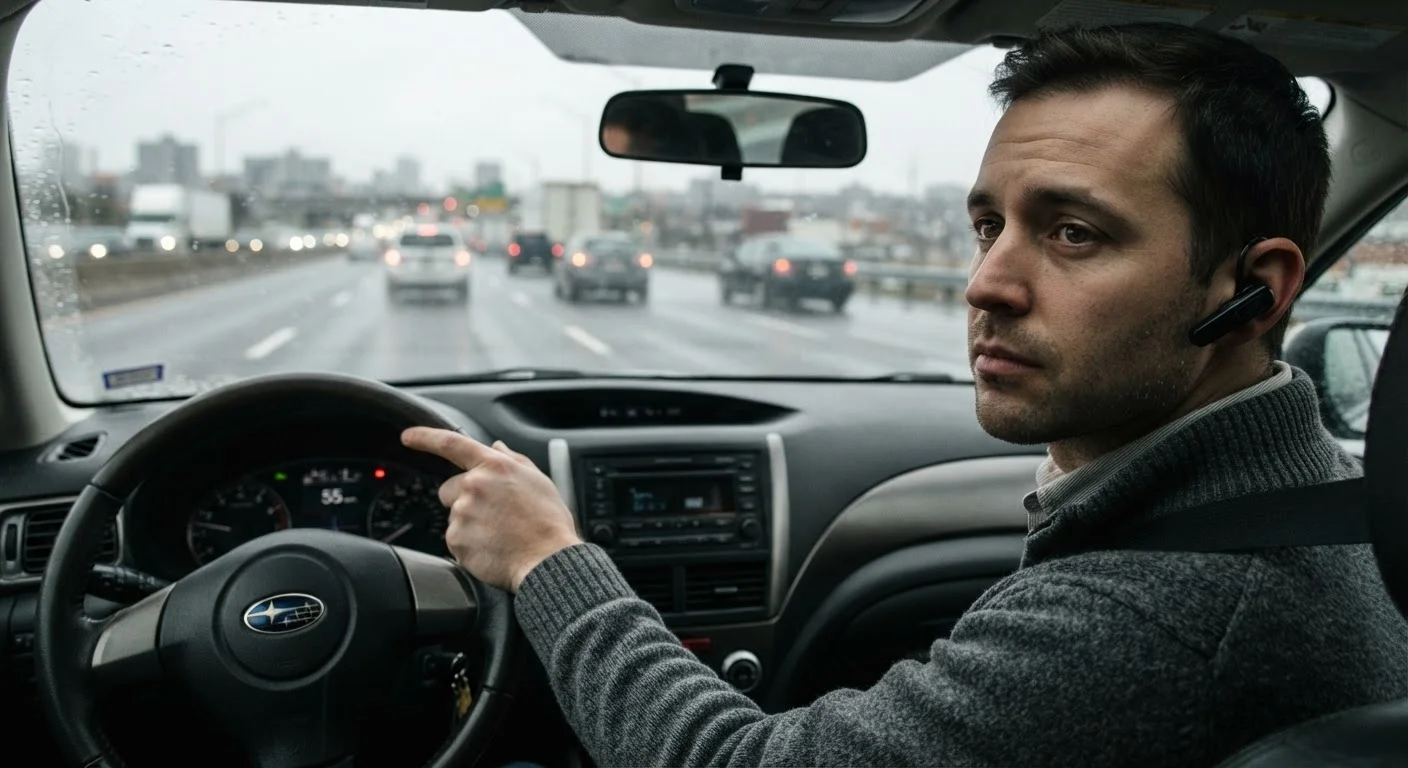
Why "Hands-Free" Became a Safety Shortcut
When hands-free calling became widely available, many drivers - and even some early policy discussions - framed it as a solution to distracted driving. The logic seemed intuitive: if the problem is a phone in your hand, remove the phone from the equation. Legislation in most U.S. states followed a similar rationale, banning handheld use while permitting hands-free alternatives.
The problem is that the research never fully supported that conclusion. Cognitive distraction - the mental burden of processing a conversation while simultaneously managing a vehicle - persists whether your phone is in your hand, mounted on a dash, or tucked in your pocket. The distinction between handheld and hands-free matters legally; its safety impact is far more limited than most drivers assume.
Myth
Using a Bluetooth headset or speakerphone is essentially safe because both hands stay on the wheel.
Fact
Keeping both hands on the wheel does not eliminate the cognitive distraction caused by phone conversations.
The danger of phone use while driving isn't primarily about physical dexterity - it's about where your brain's attention goes. Researchers at the University of Utah found that drivers using hands-free phones showed measurably slower reaction times and reduced awareness of road events compared to undistracted drivers. The hands-free setup removes only one layer of distraction; the mental engagement of an active conversation remains fully intact.
Myth
Talking on the phone while driving is no more dangerous than having a passenger in the car.
Fact
Phone conversations and passenger conversations impose different cognitive demands and carry different risk profiles.
Passengers naturally pause, reduce conversation complexity, or point out hazards during demanding driving situations. A caller on the other end of a phone, however, has no awareness of what's happening on the road - they keep talking through a merge, a sudden stop, or a complex intersection. Studies published in journals including Human Factors have found that phone conversations - hands-free included - are associated with greater crash risk than equivalent in-car passenger conversations.
Myth
Voice-to-text and virtual assistants are a distraction-free way to stay connected while driving.
Fact
Voice-activated features still demand cognitive resources and have been shown to increase mental workload.
Research conducted by the AAA Foundation for Traffic Safety evaluated dozens of voice-based systems and found that most imposed a moderate-to-high level of cognitive demand on drivers. Tasks like composing text messages by voice, interacting with navigation assistants, or managing music required sustained mental attention - even when the driver's eyes stayed forward. The perception that "voice is always safe" oversimplifies a genuinely complex cognitive challenge.
Myth
Experienced drivers can compensate for phone-related distraction through skill and habit.
Fact
Driver experience does not meaningfully offset the cognitive impairment caused by phone conversations.
Cognitive distraction operates largely below the level of conscious control. Even highly experienced drivers show degraded hazard detection and increased tunnel vision when engaged in phone conversations. The brain's attentional resources are finite; allocating more to a conversation means less is available for scanning mirrors, reading road signs, and anticipating the actions of other vehicles. Experience shapes habit and reflexes, but it cannot expand the brain's total processing capacity.
Myth
If you feel focused during a phone call while driving, you are probably driving safely.
Fact
Drivers routinely underestimate their own impairment during cognitively distracting tasks.
Feeling focused is not the same as being fully attentive. Research on inattention blindness - a phenomenon in which the brain fails to register visible objects when attention is directed elsewhere - shows that distracted drivers can look directly at hazards without consciously seeing them. Self-assessment of driving performance during distraction is notoriously unreliable; the more engaged someone is in conversation, the less accurately they tend to judge their own attentiveness.
What the Research Actually Shows
The body of evidence on distracted driving is substantial and consistent. Studies from institutions including the National Safety Council and academic transportation researchers have repeatedly demonstrated that phone conversations - regardless of how the call is conducted - create measurable impairment behind the wheel. Reaction times slow, hazard detection degrades, and drivers enter what researchers call a "looked but failed to see" state, where eyes point at the road but the brain isn't fully processing what it sees.
4x
Increased crash risk from phone use while driving
The National Safety Council estimates that cell phone use while driving is associated with approximately four times greater crash risk, including hands-free calls.
27%
Of crashes involve distracted driving
The National Safety Council has attributed roughly one in four U.S. motor vehicle crashes to cell phone use, based on analysis of crash data and research literature.
Drivers dealing with fatigue on longer journeys face compounded risk, since both cognitive load and drowsiness reduce the brain's available attentional resources. If you're planning extended travel, understanding fatigue warning signs is equally important - see our guide to driver fatigue on long road trips for practical context.
Voice Assistants Are Not a Zero-Risk Alternative
Interacting with in-vehicle voice assistants - whether to send a message, search for directions, or control media - has been shown in AAA Foundation research to create moderate to high cognitive distraction. Setting up navigation or playlists before departure, rather than during the drive, significantly reduces this risk. Even brief interactions with these systems can impair awareness for several seconds after the task is completed.
Reducing Distraction: Practical Approaches
The most straightforward approach is also the most evidence-supported: avoid phone conversations while driving, including hands-free ones, whenever possible. For many drivers, this means setting up a "do not disturb while driving" mode, letting calls go to voicemail, or pulling over safely before returning a call that can't wait.
If you use Bluetooth systems in your vehicle, it's worth understanding how they work and where their limitations lie - how Bluetooth connections behave can affect call quality, which in turn increases the cognitive effort needed to follow a conversation in noisy driving conditions.
For situations where in-car communication is genuinely necessary, keeping exchanges brief and deferring complex discussions until the vehicle is stopped reduces cognitive load substantially. The goal isn't to eliminate all communication - it's to make honest, informed choices about when the cognitive cost is worth taking on.
This article is for informational purposes only. Always follow applicable traffic laws in your state or jurisdiction regarding mobile device use while driving.
The content on this site is for informational purposes only and is not a substitute for professional advice. Always consult a qualified professional for guidance specific to your situation.