

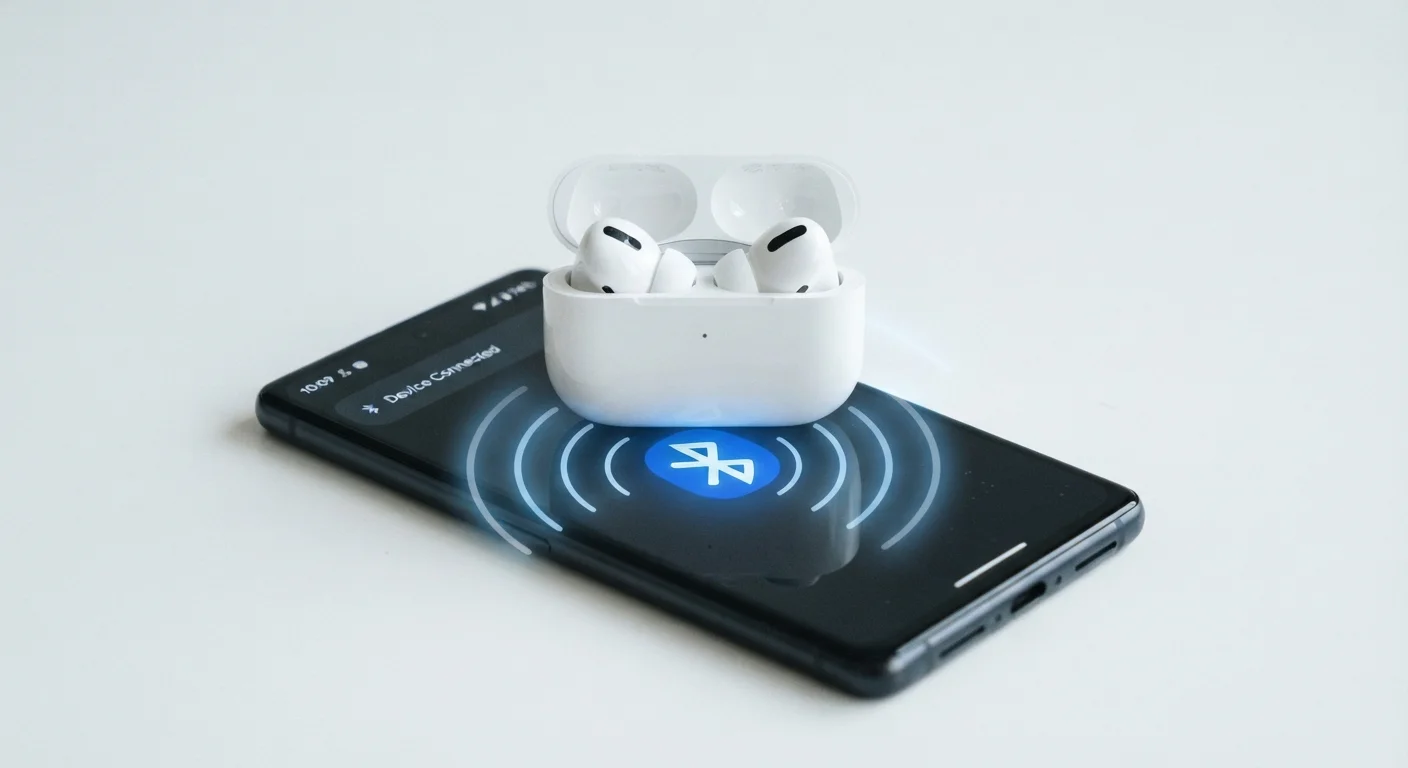
What Bluetooth Actually Is
Bluetooth is a short-range wireless communication standard that lets devices exchange data without cables. It operates on the 2.4 GHz radio frequency band - the same band used by Wi-Fi routers and microwave ovens - and uses a technique called frequency hopping to reduce interference. Rather than broadcasting on one fixed channel, Bluetooth rapidly switches among 79 channels up to 1,600 times per second.
The standard is maintained by the Bluetooth Special Interest Group (Bluetooth SIG), a nonprofit industry body. Every device that carries the Bluetooth name must meet its specifications. When two devices connect, they form a small network called a piconet, with one device acting as the controller and the other as a peripheral.
Frequency Hopping
A radio transmission technique where the signal rapidly switches between many different frequency channels. Bluetooth uses this to minimize interference from other wireless devices sharing the same band.
Piconet
A small, ad-hoc network formed when two or more Bluetooth devices connect. One device acts as the controller and the others as peripherals within that network.
Bluetooth Profile
A standardized set of capabilities that defines how Bluetooth devices use the connection for a specific purpose - such as streaming audio (A2DP) or hands-free calling (HFP). Both devices must support the same profile to use a feature.
Power Class
A classification that describes how much radio-frequency power a Bluetooth transmitter uses. Higher-class transmitters reach greater distances but consume more energy.
Bluetooth SIG
The Bluetooth Special Interest Group - the nonprofit industry body that develops and maintains the Bluetooth standard and certifies devices allowed to use the Bluetooth name.
Bluetooth Versions: What the Numbers Mean
Bluetooth has evolved significantly since its introduction in 1999. Each version number reflects improvements in speed, range, power consumption, or audio quality.
| Bluetooth 4.0 (2010) | Introduced Bluetooth Low Energy (BLE) - enabling small sensors and wearables with multi-year battery life (Bluetooth SIG) |
| Bluetooth 5.0 (2016) | Quadrupled range and doubled speed compared to Bluetooth 4.2 under ideal conditions (Bluetooth SIG) |
| Bluetooth 5.2 (2020) | Introduced LE Audio and the LC3 codec, improving audio quality at lower data rates (Bluetooth SIG) |
| Bluetooth 5.4 (2023) | Added Periodic Advertising with Responses - enabling more efficient large-scale device networks (Bluetooth SIG) |
| Backward Compatibility | All Bluetooth versions are backward compatible - a 5.x device can connect to a 4.x device |
The version number on a product spec sheet matters - but only to a point. Two devices must share a common supported profile (a standardized set of capabilities) to use a feature. A device with Bluetooth 5.3 won't automatically deliver better audio than one running 5.0 unless both ends support the relevant audio profiles. Backward compatibility is maintained: newer devices can still connect to older ones, though they operate at the capabilities of the older version.
Range: What Affects How Far Your Signal Reaches
Bluetooth range is often advertised as a single number - commonly "up to 33 feet" or "up to 800 feet." Those figures come from standardized power classes and assume ideal, open-air conditions. In practice, range is shaped by several real-world factors.
- Obstructions: Walls, furniture, and the human body absorb and scatter radio signals. A concrete wall can reduce effective range by half or more.
- Interference: Neighboring Wi-Fi networks, baby monitors, and other 2.4 GHz devices compete for bandwidth and degrade signal quality.
- Device power class: Bluetooth transmitters are grouped into classes. Class 1 devices transmit at up to 100 mW and can reach 300+ feet in open air. Class 2 (most consumer headphones and earbuds) operate at 2.5 mW with a practical range closer to 30-33 feet.
- Antenna design: A well-engineered antenna in a compact device makes a measurable difference in real-world performance.
Advertised Range vs. Real-World Range
Manufacturers test range in open, unobstructed environments - conditions that rarely match everyday use. In a typical home or office, walls, appliances, and other wireless signals can reduce effective Bluetooth range to a fraction of the advertised figure. Treat any range specification as a maximum under perfect conditions, not a typical expectation.
For wireless audio specifically, the gap between advertised and experienced range is often significant. A quoted "33-foot range" assumes no walls, no competing signals, and ideal antenna alignment - conditions that rarely exist in a typical American home.
Why Connections Drop - and What You Can Do
Dropped connections are among the most common Bluetooth frustrations. Understanding their causes makes troubleshooting less guesswork.
Common causes of drops:
- Distance and obstructions - Moving out of reliable range, even briefly, can cause a dropout. Your body blocking the signal path between your phone in a pocket and an earbud is a frequent culprit.
- Interference spikes - A microwave running or a crowded Wi-Fi environment (such as an apartment building or busy office) can briefly overwhelm the 2.4 GHz band.
- Pairing conflicts - Many devices remember multiple paired hosts. A laptop that previously connected to your headphones may try to reclaim them automatically.
- Firmware and driver issues - Outdated firmware on headphones or a stale Bluetooth driver on a laptop can cause instability. Manufacturers periodically release updates that address connectivity bugs.
- Low battery - Transmit power is often reduced when a device's battery falls below a certain threshold, shortening effective range.
Practical steps worth trying: clear the pairing history on devices you no longer use, keep firmware updated, and ensure the two connected devices are physically close during initial pairing. If you frequently use Bluetooth in your car, note that hands-free calling over Bluetooth involves its own set of considerations - cognitive distraction while driving is a documented concern even when your hands are on the wheel.
4-6 billion
Bluetooth-enabled devices shipped annually
According to Bluetooth SIG market reports, Bluetooth shipments have consistently exceeded 4 billion units per year in recent years.
2.4 GHz
Shared frequency band for Bluetooth and Wi-Fi
Both technologies compete for spectrum in the same band, which is a primary cause of real-world interference and dropped connections.
The content on this site is for informational purposes only and is not a substitute for professional advice. Always consult a qualified professional for guidance specific to your situation.