

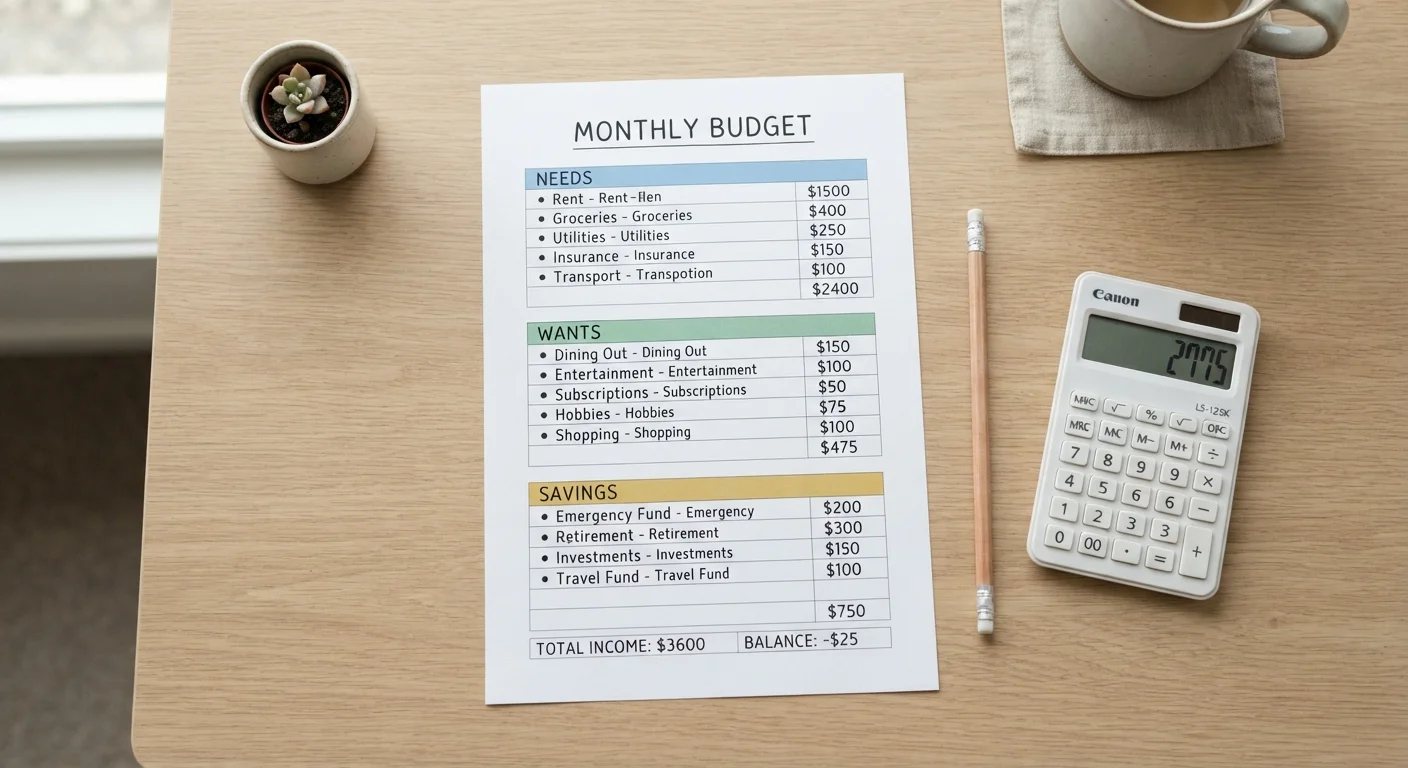
How the Three Categories Work
The 50/30/20 rule creates a straightforward architecture for your monthly budget. Once you know your take-home pay, you apply three percentage targets to decide how much flows into each area of your financial life.
Needs - 50%
Needs are expenses you cannot reasonably live without. This category includes rent or mortgage payments, utilities, groceries, transportation to work, health insurance premiums, and minimum payments on any debts. The key test: if skipping it would cause serious harm or legal consequence, it's a need.
Wants - 30%
Wants are the spending choices that make life enjoyable but aren't strictly required. Dining out, streaming services, gym memberships, travel, and new clothing beyond the basics all fall here. The distinction between needs and wants isn't always clean - a basic phone plan is a need, but an upgraded data plan is a want.
Savings and Debt Payoff - 20%
This category is your financial foundation. It covers contributions to an emergency fund, retirement accounts such as a 401(k) or IRA, and any debt payments beyond the required minimums. Building this habit consistently over time is what creates long-term financial resilience.
Start With a One-Month Spending Audit
Before adjusting anything, pull three months of bank and credit card statements and categorize every expense as a need, want, or savings contribution. This baseline reveals patterns that estimates miss and gives you an honest starting point for the 50/30/20 framework.
Putting the Rule Into Practice
Start by calculating your monthly net income - the actual amount deposited into your account after taxes. If your take-home pay is $4,000 per month, the 50/30/20 split looks like this:
- Needs: $2,000 (50%)
- Wants: $1,200 (30%)
- Savings / Debt payoff: $800 (20%)
Track one month of existing spending and assign each expense to a category. Most people find that their initial numbers don't align with the targets - and that's normal. The exercise reveals where adjustments are possible.
~37%
Americans with no retirement savings
A Federal Reserve survey found that a significant share of American adults have no retirement savings at all, underscoring the importance of the 20% savings habit.
$6,329
Average American household monthly spending
According to the U.S. Bureau of Labor Statistics Consumer Expenditure Survey, the average household spends more than $6,300 per month across all categories.
34%
Adults who do not budget monthly
Research from various consumer finance organizations consistently finds that roughly a third of U.S. adults do not follow any formal monthly budget.
Use a simple spreadsheet or a budgeting app to monitor ongoing spending. At the end of each month, compare actual spending to your targets and recalibrate as needed. Our monthly budget review checklist walks through exactly how to do this efficiently.
When the Rule Needs to Be Adapted
The 50/30/20 rule works best when your income comfortably covers essential expenses within that 50% threshold. For millions of American households - particularly those in expensive metro areas, those earning near or below median wage, or those with significant medical debt - needs routinely consume more than half of take-home pay.
If this resonates, adjusting the percentages isn't failure - it's realistic planning. You might start with a 60/20/20 split and work toward shifting more into savings over time as income grows or fixed expenses decrease. Freelancers and gig workers face the added complexity of income variability; our guide to saving on a variable income offers strategies suited to non-traditional pay structures.
For those weighing whether to prioritize an emergency fund or pay down debt within the 20% category, it isn't always straightforward. Explore the trade-offs in our article on emergency fund vs. debt payoff. If you want to compare the 50/30/20 approach against a more granular method, zero-based budgeting vs. the 50/30/20 rule lays out the differences clearly.
The Rule Is a Framework, Not a Formula
The 50/30/20 rule is intended as a guideline to help households build awareness and structure around their spending - not a mathematically precise prescription. Your income level, family size, geographic cost of living, and financial goals all affect what percentages make sense for you. Treat the rule as a compass, not a fixed destination.
This article is for general informational and educational purposes only and does not constitute personalized financial advice. Please consult a qualified, licensed financial professional for guidance specific to your circumstances.
Frequently Asked Questions
The rule is designed around net income - the amount you take home after federal and state taxes, Social Security, and Medicare are withheld. Using gross income would inflate your budget categories beyond what you actually have available to spend or save.
Minimum required debt payments - such as the minimum on a credit card or a student loan payment - are generally counted as needs in the 50% category. Any extra payments you choose to make beyond the minimum fall under the 20% savings and debt payoff bucket.
The rule assumes enough income to comfortably cover essentials within 50%, which isn't realistic for everyone. For lower or irregular incomes, the percentages may need to be adjusted significantly. See our article on <a href="/finance/saving-and-debt/the-503020-rule-and-why-it-doesnt-work-for-everyone">why the rule doesn't work for everyone</a> for guidance on adapting the framework.
Yes, but it requires an extra step. Self-employed individuals should estimate their monthly net income after setting aside money for self-employment taxes before applying the framework. Income variability can also make fixed percentage targets harder to maintain month to month.
Yes - pre-tax retirement contributions like a 401(k) are typically counted within the 20% category, even though they're deducted before your paycheck arrives. The spirit of the rule is that 20% of your earnings is working toward your future financial security.
This is common, especially in high cost-of-living areas. When needs regularly exceed 50%, it signals a need to either reduce fixed expenses where possible, increase income, or temporarily adjust the want and savings percentages. A licensed financial adviser can help you build a sustainable plan.
The content on this site is for informational purposes only and is not a substitute for professional advice. Always consult a qualified professional for guidance specific to your situation.