

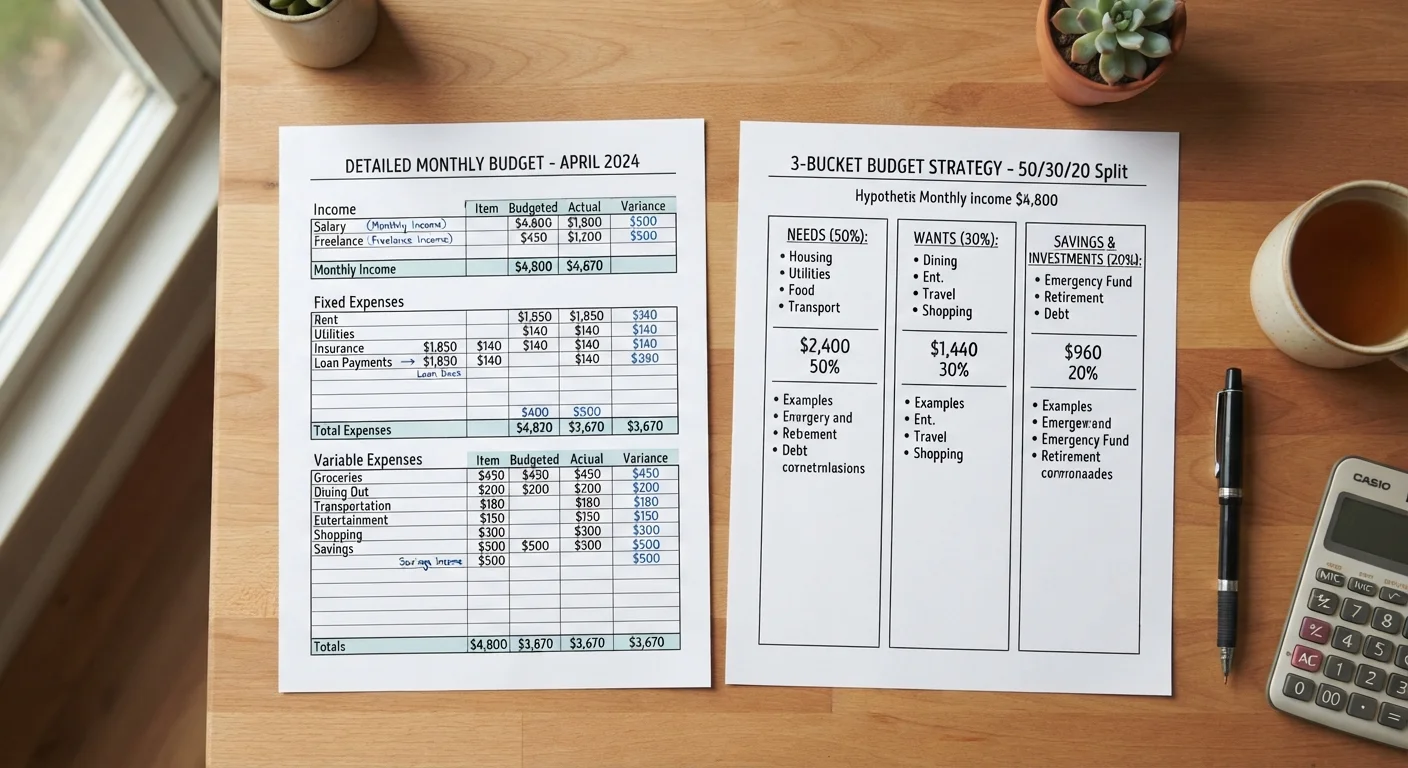
Option A
Zero-Based Budgeting
The detail-oriented, dollar-by-dollar approach.
Best for: People who want maximum control over every spending category and are comfortable tracking expenses closely each month.
Option B
The 50/30/20 Rule
The streamlined, percentage-based framework.
Best for: People new to budgeting or those who prefer a simple structure without tracking every individual transaction.
How Each Method Works
Both frameworks aim to give your income direction - they just do it differently. Understanding their mechanics is the clearest way to decide which fits your life. For a broader foundation, see our guide to personal budgeting from the ground up.
Zero-Based Budgeting
With zero-based budgeting, you start each month with your total expected income and assign every dollar to a category - housing, groceries, transportation, savings, debt payments, and so on - until the math reaches zero. "Zero" doesn't mean you spend everything; it means every dollar has a designated purpose, including savings and investments. If you earn $4,000 in a month, all $4,000 is allocated before the month begins. Any unspent money at month's end gets reassigned to another category - typically savings or debt repayment - rather than floating freely.
The 50/30/20 Rule
The 50/30/20 rule divides your after-tax income into three broad buckets: 50% toward needs (rent, utilities, groceries, minimum debt payments), 30% toward wants (dining out, entertainment, subscriptions), and 20% toward savings and additional debt repayment. For a detailed walkthrough, our 50/30/20 rule explainer covers every nuance. The appeal is its simplicity - you don't need to categorize every purchase, only distinguish between needs, wants, and financial goals.
| Criterion | Zero-Based Budgeting | The 50/30/20 Rule |
|---|---|---|
| Core concept | Every dollar assigned a purpose | Income split into three percentage buckets |
| Setup time | High - rebuilt each month | Low - set once, reviewed occasionally |
| Ongoing effort | High - detailed tracking required | Low - broad category awareness only |
| Spending visibility | Very high - line-item level | Moderate - category-level only |
| Adaptability to irregular income | Strong - rebuilt from real numbers | Moderate - percentages shift with income |
| Best for beginners | Less so - steeper learning curve | Yes - simple and intuitive |
| Works on tight budgets | Yes - highly customizable | Not always - percentages may not fit reality |
The Real-World Trade-Offs
Each method carries practical advantages and meaningful drawbacks that show up in everyday use.
Time and Effort
Zero-based budgeting is time-intensive. You build a fresh budget each month, track spending against each category, and adjust when life doesn't go as planned. That level of hands-on engagement suits people who enjoy detail - but it can feel burdensome for others. The 50/30/20 rule, by contrast, takes minutes to set up and requires only a rough awareness of which spending bucket a purchase falls into.
Precision vs. Flexibility
Zero-based budgeting's granularity is its strength - it's hard for spending to creep undetected when every category has a ceiling. The 50/30/20 rule's broad categories can obscure overspending within a bucket. Someone could stay "within the 30% wants" threshold while still making poor spending trade-offs they're not aware of.
Income Limitations
Both methods assume a level of income that covers essential expenses comfortably. For households where 50% of take-home pay doesn't cover necessities, the 50/30/20 rule needs significant modification. Our article on why the 50/30/20 rule doesn't work for everyone explores this honestly. Zero-based budgeting is generally more adaptable in tight-income situations because it starts from real numbers rather than prescribed percentages.
Hybrid Approaches Are Valid
Many personal finance practitioners recommend starting with the 50/30/20 rule to build the habit of budgeting, then layering in zero-based detail once you're comfortable. There's no rule requiring you to choose only one framework. The goal is financial clarity, not methodological purity. Experiment with both and adapt as your circumstances evolve.
Which Should You Choose?
The right budgeting method is the one you'll actually stick with. If granular control motivates you and you're comfortable with monthly upkeep, zero-based budgeting can be a powerful tool - particularly when paying down debt or building an emergency fund on a tight timeline. If you're earlier in your financial journey and need a gentle on-ramp, the 50/30/20 rule provides a workable structure without demanding spreadsheet-level commitment.
It's also worth knowing that these approaches aren't mutually exclusive. Some people use the 50/30/20 rule's percentages as a high-level check while applying zero-based logic inside each category. You can also explore how different tracking methods complement any budgeting framework - our comparison of envelope budgeting and digital tracking apps shows how the execution layer matters as much as the framework itself.
Whatever approach you choose, revisit it periodically. Income changes, family circumstances shift, and the budget that worked at 28 may need rethinking at 35. Budgeting isn't a one-time event - it's an ongoing practice. For a reality check on common stumbling blocks, our look at budgeting myths is a useful companion read.
~75%
Americans living paycheck to paycheck
Various surveys from financial services research organizations have found that a significant majority of U.S. adults report limited financial cushion between paychecks, underscoring the importance of a budgeting framework that fits real income constraints.
1 in 3
Adults with no written budget
Consumer financial literacy research consistently finds that a large share of American adults manage money without any formal budgeting system, which is linked to lower savings rates and higher debt levels.
This article is for general informational and educational purposes only and does not constitute personalized financial advice. Consider consulting a licensed financial professional about decisions specific to your situation.
The content on this site is for informational purposes only and is not a substitute for professional advice. Always consult a qualified professional for guidance specific to your situation.