

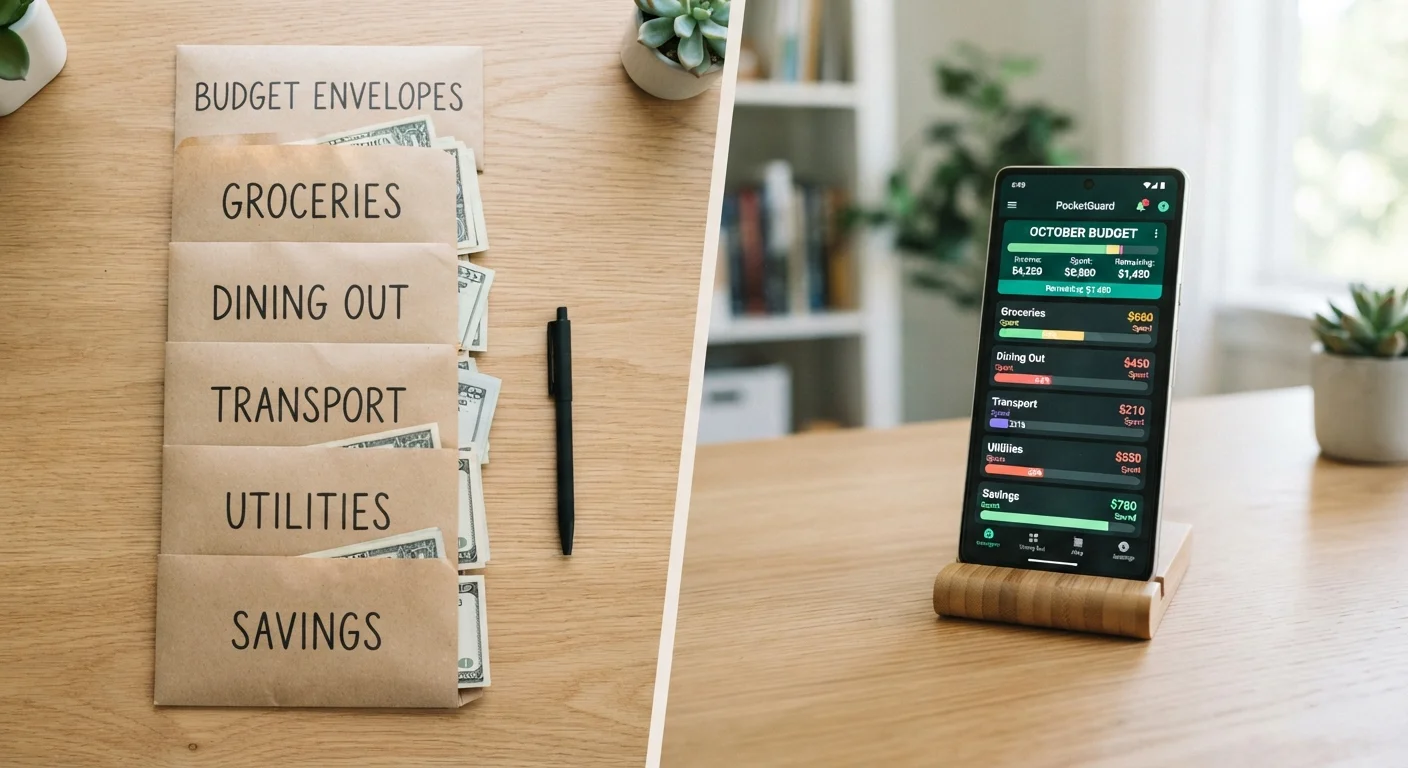
Option A
Envelope Budgeting
The tactile, cash-first method for hands-on spenders.
Best for: People who overspend on cards and benefit from physical spending limits they can see and feel.
Option B
Digital Tracking Apps
The automated, data-driven approach for tech-comfortable users.
Best for: People who want real-time spending visibility, automatic categorization, and minimal cash handling.
How Each Method Actually Works
If you're building a budget for the first time, understanding how a method operates is just as important as knowing its pros and cons. See our introduction to personal budgeting for a foundation before choosing a system.
Envelope Budgeting
At the start of each pay period, you withdraw your budgeted spending money in cash and divide it into physical envelopes - one for groceries, one for gas, one for dining out, and so on. You spend only what's in each envelope. When an envelope runs dry, that category is done for the month. The method is rooted in the behavioral reality that spending physical cash feels more tangible and psychologically costly than swiping a card.
Digital Tracking Apps
Budgeting apps connect to your bank accounts and credit cards, then automatically pull in and categorize transactions. You set spending limits by category, and the app shows you how much you've used versus how much remains. Some apps use a zero-based framework - meaning every dollar of income is assigned a purpose - while others take a looser monitoring approach. For a deeper look at zero-based frameworks, see our comparison of zero-based budgeting vs. the 50/30/20 rule.
| Criterion | Envelope Budgeting | Digital Tracking Apps |
|---|---|---|
| Setup effort | Low - cash, envelopes, a pen | Moderate - account linking, category setup |
| Works with cards/online payments | No - cash only | Yes - syncs with cards and accounts |
| Spending enforcement | Hard limit (empty envelope = stop) | Soft limit (alerts, no physical barrier) |
| Spending history & reporting | None - manual record keeping required | Automatic - months of trend data |
| Cost | Free | Free to paid (varies by app) |
| Privacy risk | Low - no third-party data sharing | Higher - financial data shared with app provider |
| Ideal for irregular expenses | Requires manual planning | Strong - tracks and flags patterns |
| Learning curve | Minimal | Low to moderate |
Where Each Method Wins - and Where It Struggles
No budgeting method is perfect. Each has a genuine sweet spot and a clear limitation.
Envelope Budgeting: Strengths
- Behavioral friction works in your favor. Research in behavioral economics consistently supports the idea that people spend less when using cash versus cards, because loss feels more immediate.
- No technology required. No app subscription, no syncing errors, no privacy concerns about linking bank accounts.
- Simple accountability. The envelope is either full or empty - there's no ambiguity.
Envelope Budgeting: Weaknesses
- Impractical for digital life. Online purchases, auto-pay bills, and card-only merchants make all-cash living difficult for most Americans.
- Security and logistics. Carrying large amounts of cash or storing it at home carries risk.
- No data trail. Envelopes don't automatically record spending history or surface trends over time.
Digital Apps: Strengths
- Comprehensive visibility. Apps can show every transaction across all accounts in one place.
- Trend analysis. You can see seasonal shifts in spending - useful for planning around irregular expenses most budgets miss.
- Goal tracking. Many apps include savings and debt payoff tools alongside spending categories.
Digital Apps: Weaknesses
- Passive monitoring can breed complacency. An alert that you've overspent doesn't stop the overspending.
- Setup and maintenance. Syncing errors, miscategorized transactions, and subscription costs require ongoing attention.
- Privacy considerations. Linking financial accounts to third-party apps involves sharing sensitive data - review each app's privacy and security practices carefully.
~40%
Americans with a written or formal budget
Surveys consistently find fewer than half of American households follow a formal budget, underscoring how much room both methods have to help.
~18%
More spent when paying by card vs. cash
Behavioral research, including studies cited by the American Psychological Association, suggests card payment reduces the psychological 'pain of paying,' leading to higher spending.
~60%
Adults who live paycheck to paycheck
According to LendingClub's Paycheck to Paycheck report, a significant share of U.S. adults report spending all or nearly all of their monthly income regardless of earnings level.
Choosing the Right Approach for Your Life
The most effective budget is the one you will actually maintain. A few honest questions can guide your decision:
- Do you primarily use cash or cards? If nearly all your spending is card-based, envelopes alone won't cover your whole financial picture.
- Where do you most often overspend? If it's a specific category like restaurants or clothing, a dedicated envelope for that category may outperform an app alert you'll dismiss.
- How comfortable are you with technology? Apps require setup, periodic maintenance, and comfort connecting financial accounts. Envelopes require only a trip to the ATM.
- Do you need historical data? If you're trying to diagnose a spending problem or plan for the long term, an app's reporting features offer something envelopes cannot.
Many households land on a hybrid: they use an app to track all spending and plan monthly limits, then pull cash envelopes for the one or two categories where self-control is hardest. This approach combines the data power of apps with the behavioral guardrails of cash. Whatever system you adopt, consider building it into a larger financial plan - the complete personal budgeting playbook covers how to structure income tracking, expense categories, and savings goals together. For readers working to reduce debt while budgeting, our saving and debt hub offers additional practical guidance.
This article is for general informational and educational purposes only and does not constitute personalized financial advice. Please consult a qualified financial professional regarding decisions specific to your circumstances.
Thinking About a Hybrid Approach?
A common starting point is to use an app for tracking all fixed expenses and bills, while pulling cash envelopes only for variable, discretionary categories where overspending tends to occur. This limits the logistical burden of all-cash living while retaining the behavioral benefit of physical spending limits where they matter most. If you travel frequently and need to manage spending away from home, our guide to building and sticking to a travel budget applies these same principles on the road.
The content on this site is for informational purposes only and is not a substitute for professional advice. Always consult a qualified professional for guidance specific to your situation.