

Option A
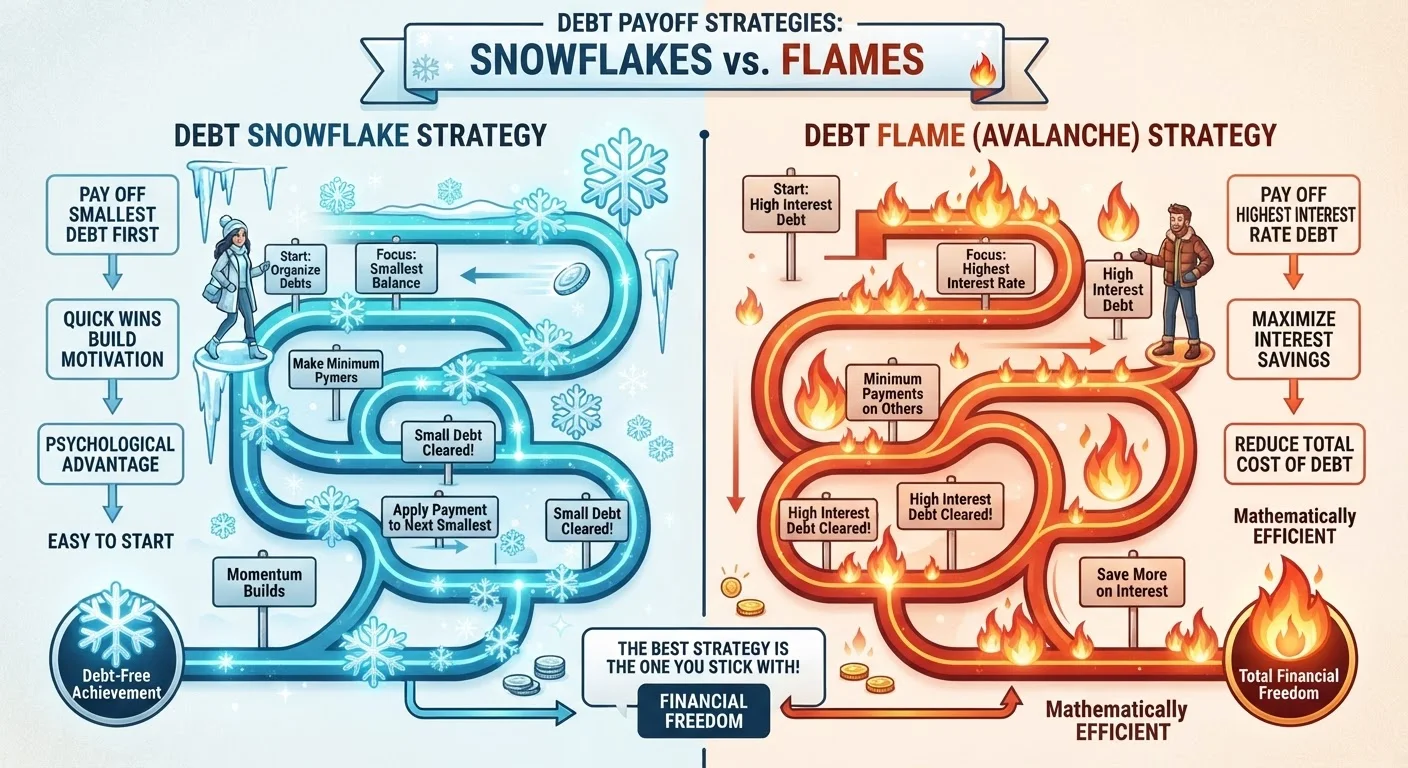
Debt Avalanche
The mathematically optimal approach to eliminating interest costs.
Best for: People who are motivated by long-term savings and are comfortable delaying early wins.
Option B
Debt Snowball
The psychologically rewarding approach to building payoff momentum.
Best for: People who need visible progress to stay motivated and have several smaller debts to clear.
How Each Strategy Works
Both methods share a common foundation: you make the minimum required payment on every debt each month, then direct any additional money you can afford toward one specific account. The difference lies entirely in how you choose that priority account.
Debt Avalanche: You rank your debts by interest rate, from highest to lowest. You attack the highest-rate debt first. Once it is paid off, you roll that payment amount into the next-highest-rate debt, and so on. The "avalanche" name reflects how each eliminated debt adds momentum - and freed-up cash - to the next one down the list.
Debt Snowball: You rank your debts by outstanding balance, from smallest to largest. You pay off the smallest balance first, then roll that freed payment into the next-smallest, growing your payoff "snowball" as you go. The balance order, not the interest rate, drives the sequence.
For a practical overview of how these methods fit into a broader repayment plan, see A Beginner's Roadmap to Getting Out of Debt.
| Criterion | Debt Avalanche | Debt Snowball |
|---|---|---|
| Priority order | Highest interest rate first | Smallest balance first |
| Total interest paid | Generally lower over time | Generally higher over time |
| Time to first payoff | Potentially longer | Typically faster |
| Psychological reward | Delayed - progress is gradual | Quick - early wins are frequent |
| Best suited for | Disciplined, numbers-driven people | Motivation-driven, habit-building people |
| Complexity | Low - just sort by interest rate | Low - just sort by balance |
| Risk of dropout | Higher without strong discipline | Lower due to early momentum |
The Real-World Trade-Off: Cost vs. Momentum
The central tension between these two strategies is mathematical efficiency versus behavioral sustainability.
The avalanche method, when followed to completion, typically results in less total interest paid. If you carry a credit card balance at 22% APR and a personal loan at 9% APR, the credit card is costing you money much faster - so eliminating it first limits the damage. Over a multi-year repayment timeline, this difference can amount to a meaningful sum.
The snowball method, however, is designed around a documented behavioral reality: many people abandon debt repayment plans before completing them. Research published in peer-reviewed behavioral economics journals has found that paying off individual accounts - regardless of interest rate - can meaningfully improve follow-through. A cleared account is a tangible sign of progress, and that psychological reinforcement can be the difference between finishing and quitting.
~33%
U.S. adults carrying credit card debt month to month
According to Federal Reserve survey data, roughly a third of American adults carry revolving credit card balances, making interest rate management a significant household concern.
Higher completion
Snowball adherence vs. avalanche in behavioral studies
Peer-reviewed research in behavioral economics has found that paying off individual accounts - a core feature of the snowball method - is associated with improved debt repayment follow-through.
In practice, your choice may come down to an honest self-assessment. If you have strong financial discipline and your highest-interest debt is manageable in size, the avalanche is likely the more efficient path. If you have struggled to stick with payoff plans in the past, the snowball's quick wins may be worth the modest extra interest cost.
For a deeper look at how these strategies compare in specific scenarios, the Avalanche vs. Snowball: Two Debt Payoff Strategies, One Right Fit walks through side-by-side examples.
Factors That Influence the Right Fit
A few practical considerations can help you lean toward one method or the other:
- Number of accounts: If you have many small debts - medical bills, store cards, minor personal loans - the snowball can quickly reduce the number of accounts you're managing, which simplifies your monthly budget.
- Interest rate spread: If your interest rates are clustered closely together, the total-cost difference between the two methods may be small. In that case, motivation becomes the dominant factor, and the snowball often wins.
- Income stability: If your income is irregular, the avalanche demands discipline over a longer initial period before the first debt clears. The snowball may provide faster relief during lean stretches.
- Existing savings cushion: Whichever method you choose, maintaining even a small emergency fund alongside your payoff effort is generally advisable. An unexpected expense without any savings can force you into new debt, undoing progress. See Building an Emergency Fund While Also Paying Down Debt for a practical approach to doing both simultaneously.
What About Debt Consolidation?
Some borrowers consider consolidating multiple debts into a single loan before applying either strategy. Consolidation can simplify payments and may lower your overall interest rate - but it is not a replacement for a structured payoff method. For a clear-eyed view of what consolidation does and doesn't do, see Debt Consolidation: What It Actually Does (and What It Doesn't). You can also explore the broader question of how to allocate extra money at Emergency Fund or Debt Payoff: Where Should Your Extra Dollar Go First?.
It's also worth noting that neither strategy addresses the underlying spending patterns or income constraints that created the debt. Pairing either method with a reviewed budget - see Budgeting Basics for foundational guidance - strengthens your chances of long-term success.
This article is for general informational and educational purposes only and does not constitute personalized financial or legal advice. Your debt situation is unique. Consider speaking with a licensed financial adviser or credit counselor before selecting or implementing a repayment strategy.
The content on this site is for informational purposes only and is not a substitute for professional advice. Always consult a qualified professional for guidance specific to your situation.