

Start here
Start by Listing Everything You Owe
Next
Choose a Payoff Strategy That Fits You
Then
Free Up Money to Put Toward Debt
Finally
Build a Habit That Lasts
Start by Listing Everything You Owe
Before you can pay down debt, you need a complete picture of it. Many people avoid this step because the total feels overwhelming - but clarity is the foundation of every effective payoff plan.
Gather your most recent statements for every debt you carry: credit cards, personal loans, medical bills, student loans, and any money owed to family or friends you intend to repay formally. For each account, record:
- Current balance - what you owe today
- Interest rate (APR) - the annual percentage rate charged on the balance
- Minimum monthly payment - the lowest amount required to keep the account in good standing
- Due date - when each payment is expected
Organizing this into a simple spreadsheet or even a handwritten list gives you what's called a debt inventory. Once you can see the full picture, you can make deliberate decisions about where to focus your energy first.
APR (Annual Percentage Rate)
The yearly cost of borrowing money expressed as a percentage. A higher APR means you pay more in interest on the same balance.
Minimum payment
The smallest amount a lender requires you to pay each month. Paying only the minimum keeps your account current but maximizes the interest you pay over time.
Debt avalanche
A payoff strategy that targets the highest-interest debt first, minimizing total interest paid across all accounts.
Debt snowball
A payoff strategy that targets the smallest balance first to generate quick wins and build momentum.
Credit utilization
The percentage of your available revolving credit (like credit cards) that you're currently using. Lower utilization generally helps your credit score.
Debt inventory
A complete list of every debt you owe, including the balance, interest rate, minimum payment, and due date for each account.
Choose a Payoff Strategy That Fits You
Two approaches dominate personal finance guidance on debt repayment, and both work - the right choice depends on your personality as much as the math.
Debt Avalanche
With this method, you rank your debts from highest interest rate to lowest. You pay the minimum on everything except the top-ranked debt, which gets every extra dollar you can spare. Once it's paid off, you roll that payment into the next highest-rate balance. This approach minimizes total interest paid over time.
Debt Snowball
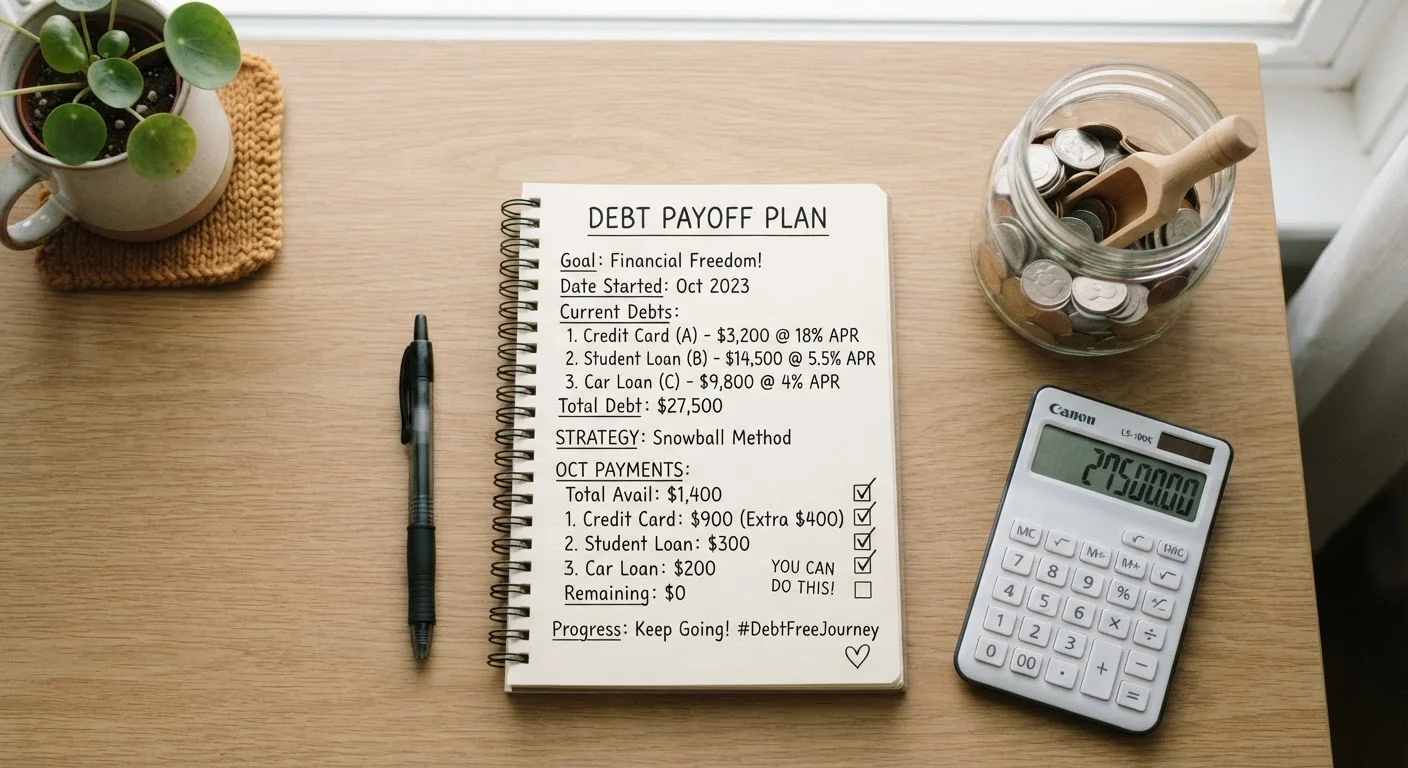
With this method, you rank debts from smallest balance to largest, regardless of interest rate. You pay off the smallest balance first, then roll that payment forward. The quick wins can be powerful for motivation - seeing an account reach zero reinforces the behavior.
Neither method works if you don't also have a budget that identifies where your money is going. See our guide to personal budgeting from the ground up for a step-by-step approach to building one. You may also want to explore how debt consolidation works if you're managing multiple high-interest accounts.
Automate the Minimum, Then Add Extra
Set up automatic payments for the minimum on every debt account so you never miss a due date. Then manually - or via a separate automatic transfer - add your extra payment to your priority debt. This two-layer approach protects your credit while keeping your payoff plan moving.
Free Up Money to Put Toward Debt
The gap between your income and your essential expenses is your working capital for debt payoff. Widening that gap - even modestly - can meaningfully shorten your timeline.
Start on the spending side. Review your last two or three months of bank and card statements and sort spending into needs and wants. Common areas where people find room include subscription services, dining out, and impulse purchases. You don't need to eliminate everything enjoyable; redirecting even $50-$100 per month adds up over a year.
On the income side, temporary increases - a second shift, freelance work, or selling items you no longer use - can accelerate payoff without permanently changing your lifestyle.
One often-overlooked piece: a small emergency fund. It may feel counterintuitive to save while carrying debt, but having a financial cushion prevents a car repair or medical bill from forcing you to reach for a credit card and undo progress. Our article on building an emergency fund while paying down debt explains how to balance both goals. If you're unsure where your extra dollar should go first, see this breakdown of the trade-offs.
Avoid Taking on New Debt While Paying Off Old
It can be tempting to use a credit card for convenience while paying down other balances. Even small new charges can offset months of progress if the interest rate is high. Try to pause new borrowing until existing balances are under control, or limit card use strictly to what you can pay in full each month.
Build a Habit That Lasts
Getting out of debt is not a one-time decision - it's a series of consistent choices made over months or years. The systems you put in place matter as much as the strategy you choose.
Consider automating your payments. Setting up automatic transfers to cover at least the minimum on every account protects your credit and removes decision fatigue. If your budget allows, automate a fixed extra payment to your priority debt each month.
Check in on your debt inventory monthly. Update the balances, celebrate accounts that close, and adjust your plan if your income or expenses change. Staying engaged with the numbers keeps the goal visible.
Finally, use your progress to build toward the next financial milestone. As debts disappear and cash flow improves, you can redirect those freed-up payments toward savings and, eventually, building wealth. Explore the Budgeting Basics hub and the Credit & Investing hub when you're ready for the next step.
This article is for general informational and educational purposes only and does not constitute personalized financial, tax, or legal advice. Consult a qualified financial professional before making decisions based on your individual circumstances.
Frequently Asked Questions
The debt avalanche method - paying off your highest-interest debt first - typically costs the least and finishes fastest in pure math. Speed also depends on how much extra money you can direct toward payments each month. Increasing income, cutting expenses, or both, accelerates the timeline.
Most financial educators suggest building a small emergency fund (around $500-$1,000) before aggressively tackling debt, so an unexpected expense doesn't force you to borrow again. After that, many people benefit from doing both simultaneously at a modest scale.
Paying down revolving debt like credit cards typically lowers your credit utilization ratio, which can improve your credit score. Paying off installment loans (car, student) may have a smaller immediate effect but demonstrates on-time payment history over time.
Debt consolidation combines multiple debts into a single loan, ideally at a lower interest rate, simplifying payments. It can help, but it does not erase debt - and extending the repayment term could increase total interest paid if you're not careful.
Tracking your progress visually - such as a payoff chart - helps many people stay consistent. Celebrating small milestones, like paying off a single account, reinforces the habit without derailing the plan.
Yes, especially if your debt feels unmanageable or you are considering options like bankruptcy or settlement. A nonprofit credit counselor or licensed financial adviser can help you evaluate your options without a sales agenda. Look for accredited nonprofit agencies through organizations such as the NFCC.
The content on this site is for informational purposes only and is not a substitute for professional advice. Always consult a qualified professional for guidance specific to your situation.