

Our Verdict
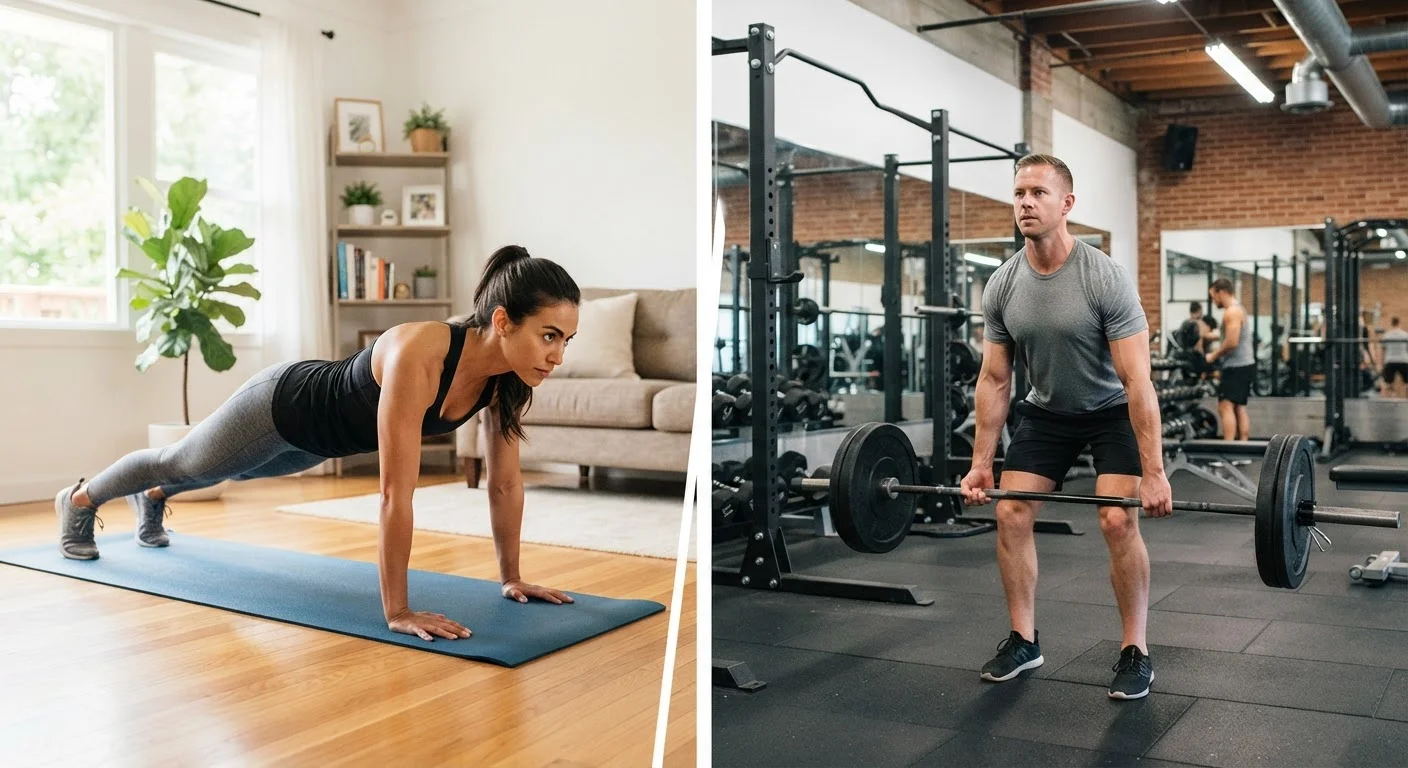
Neither home workouts nor gym sessions are objectively superior - each offers real benefits and genuine trade-offs. Home training wins on convenience and cost, while the gym wins on equipment variety and structured environment. The most effective workout is the one you'll do consistently, wherever that happens to be.
A hybrid approach suits most people best, but home workouts are ideal for those with tight schedules or limited budgets, while gym memberships serve those who benefit from equipment variety, group energy, or professional coaching.
Why the Home vs. Gym Question Actually Matters
For many Americans, the biggest obstacle to regular exercise isn't motivation - it's logistics. The decision between working out at home or joining a gym shapes how often you actually move, what kinds of exercise you can do, and whether your routine survives a busy week. There's no universally correct answer, but understanding what each environment genuinely supports helps you make a realistic choice for your life.
If you're just building a movement habit from scratch, see our guide for absolute beginners - it covers how to get started without any equipment at all.
The Case for Home Workouts
Home training has grown significantly in recent years, and for good reason. Removing the commute eliminates one of the most common excuses for skipping a session. Whether it's a 20-minute bodyweight circuit before work or a yoga session in your living room, the friction is low.
No commute - exercise whenever it fits your day
Eliminating travel time removes one of the most cited barriers to regular exercise, making it easier to stay consistent even on packed schedules.
Lower ongoing cost than a gym membership
A modest investment in resistance bands, a mat, or a set of dumbbells can cover most home training needs, often at a fraction of annual gym fees.
Private, judgment-free environment
Exercising at home allows people who feel self-conscious in public settings to focus on movement without social anxiety.
Flexible scheduling, including very short sessions
Home training makes it practical to do a 10-minute session between meetings or early in the morning - formats that are awkward with a gym commute factored in.
Home workouts also lend themselves well to shorter, more frequent sessions. Research into what's sometimes called exercise snacking suggests that brief bouts of movement spread across the day may carry meaningful health benefits - something easier to execute at home than at a gym across town.
Where Home Workouts Fall Short
Home training has real limitations. Without dedicated equipment, building significant muscular strength over time becomes harder. Bodyweight exercises can take you far, but progressive overload - gradually increasing the challenge to stimulate adaptation - requires either added resistance, creative programming, or both.
Limited equipment restricts exercise variety
Without barbells, cable machines, or a pull-up rig, certain movement patterns and progressive overload strategies are difficult to replicate at home.
Distractions can undermine focus and effort
Home environments come with competing demands - family, screens, chores - that can fragment workout quality in ways a gym visit typically avoids.
No built-in accountability or social support
For those who are motivated by community or external structure, working out alone at home can feel isolating and harder to sustain long-term.
Harder to access professional guidance
Without a trainer or qualified observer, form errors may go unnoticed, which can increase injury risk over time, particularly with strength exercises.
Motivation can also waver at home, where distractions are constant and the psychological "gym mode" cue is absent. For those who need external accountability or thrive in social environments, working out alone at home may feel isolating. Group fitness settings vs. solo training explores this dynamic in more depth.
What the Gym Actually Provides
A commercial gym offers infrastructure that most homes simply can't match: cable machines, free weight racks, barbells, cardio equipment, and often access to personal trainers or group classes. This variety is particularly valuable for balancing cardio and strength training, since you can move between modalities without improvising.
~50%
Adults who say convenience drives workout frequency
Surveys conducted by organizations including the American Council on Exercise consistently find that proximity and ease of access are among the top factors in whether people exercise regularly.
150 min
Weekly moderate activity recommended by health authorities
The U.S. Department of Health and Human Services Physical Activity Guidelines recommend at least 150 minutes of moderate-intensity activity per week - achievable in either a home or gym setting.
The gym environment also provides implicit structure. Showing up to a dedicated fitness space tends to signal to your brain that it's time to focus. For people who struggle to mentally separate "workout time" from home life, this context shift is a genuine advantage.
Access to qualified staff is another underappreciated benefit. If you're navigating common strength training myths or recovering from an injury, having a trainer available to correct form can reduce injury risk significantly.
A Note on Personal Training and Safety
If you're new to strength training or returning after a long break, working with a certified personal trainer - even for just a few sessions - can help you establish safe movement patterns. Many gyms offer introductory sessions, and some trainers now offer virtual coaching for home exercisers. Always consult a healthcare provider if you have an existing injury or chronic condition before beginning a new training program.
Making the Right Call for Your Situation
The honest answer is that the best workout environment is the one you'll consistently return to. Both settings can support cardiovascular health, muscle development, flexibility, and mental well-being - the science doesn't favor one location over the other when consistency is controlled for.
Consider your schedule, budget, personality, and goals. If commute time or membership costs create a real barrier, a well-planned home routine is entirely sufficient for most health objectives. If you've tried home workouts and found accountability elusive, a gym membership or structured class may be worth the investment. Many people find a hybrid model - gym two or three days a week, home sessions on other days - delivers the flexibility of both worlds without the downsides of either.
It's also worth considering movement beyond formal workouts. Non-exercise activity thermogenesis (NEAT) - the calories burned through everyday movement like walking, standing, and household tasks - plays a surprisingly large role in overall health, regardless of where you formally exercise. And if you're weighing lower-intensity options, our comparison of walking vs. running may help round out your thinking.
This article is for general informational purposes only and is not a substitute for professional medical or fitness advice. Consult a qualified healthcare provider before starting a new exercise program, especially if you have existing health conditions.
The content on this site is for informational purposes only and is not a substitute for professional advice. Always consult a qualified professional for guidance specific to your situation.