

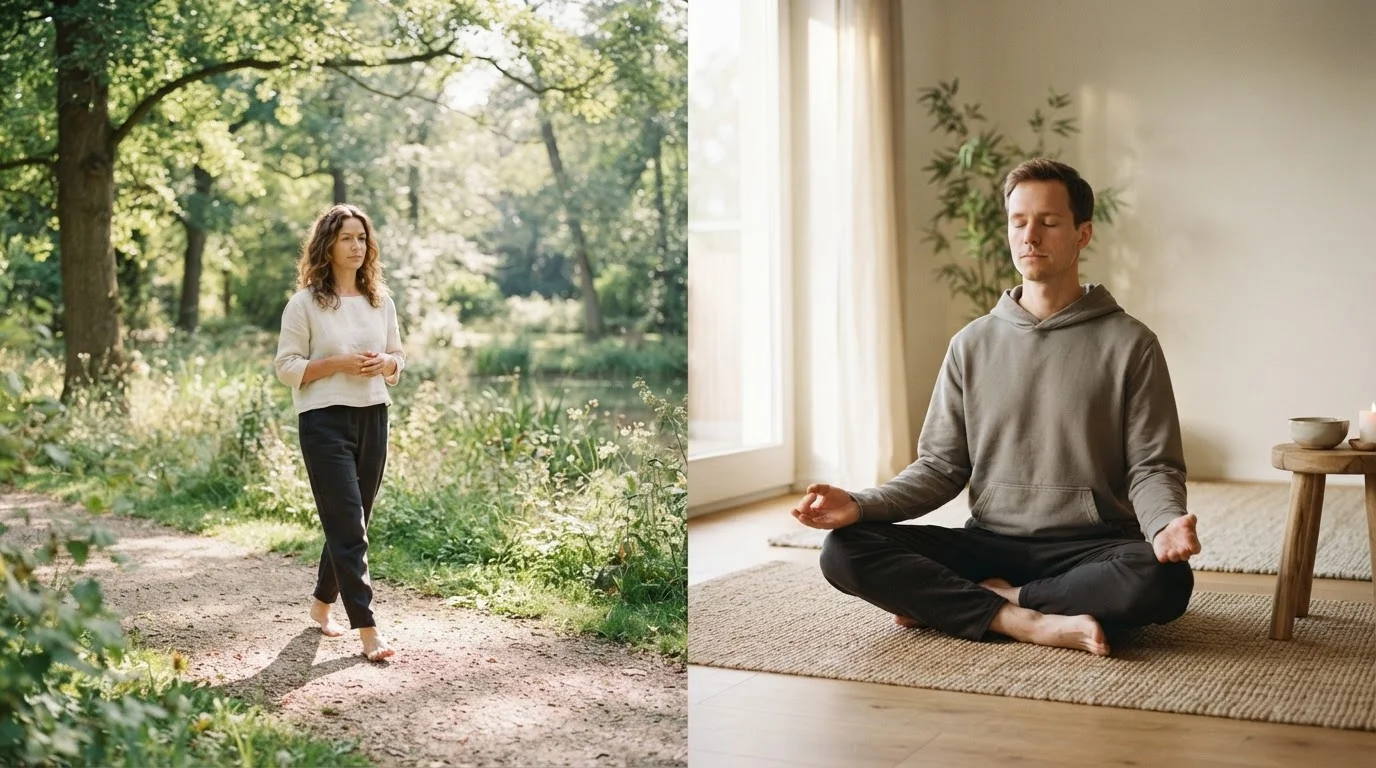
Option A
Mindfulness
The always-available, woven-into-daily-life awareness practice.
Best for: People who want to cultivate present-moment awareness without setting aside dedicated practice time.
Option B
Meditation
The structured, intentional training session for the mind.
Best for: People ready to commit to a regular, focused practice period to build deeper mental resilience.
Why the Confusion Exists
The terms mindfulness and meditation appear side by side so often that many people treat them as synonyms. They are not - but understanding the relationship between them is more useful than drawing a hard line. Think of it this way: mindfulness is a mental quality, and meditation is one of the most reliable methods for cultivating it.
Mindfulness, broadly defined, is the practice of paying deliberate, non-judgmental attention to the present moment. It is a state of awareness you can bring to any activity - a conversation, a meal, or a walk. Meditation, by contrast, refers to a set of formal exercises performed during a dedicated period of time, designed to train attention, emotional regulation, or other cognitive capacities.
Just as you can become physically stronger through many activities beyond the gym, you can become more mindful through means other than sitting meditation. However, structured meditation remains one of the most efficient and well-studied paths to building that capacity.
A Quick Clarification on Terminology
When researchers and clinicians use the word 'mindfulness,' they sometimes mean the trait (your baseline level of present-moment awareness), the practice (informal attention exercises), or a specific therapeutic program. Context matters. This article focuses on mindfulness as a day-to-day quality of attention, contrasted with structured meditation as a dedicated exercise.
How Each Practice Works in Practice
Mindfulness in daily life looks like pausing before responding in a difficult conversation, noticing the texture of food while eating, or consciously feeling your feet on the ground while standing in line. These micro-moments of awareness require no timer, no cushion, and no app. Research published in psychological journals suggests that even brief, informal mindfulness moments can interrupt automatic stress responses - though effects accumulate with consistency.
Formal meditation comes in several forms: focused-attention practices (concentrating on the breath or a mantra), open-monitoring practices (observing thoughts without attachment), and body-scan techniques, among others. Sessions can range from five minutes to an hour. Programs such as Mindfulness-Based Stress Reduction (MBSR), developed at the University of Massachusetts Medical School, typically involve eight weeks of structured meditation training and have been widely studied in clinical settings.
| Criterion | Mindfulness | Meditation |
|---|---|---|
| What it is | A quality of aware attention | A formal mental exercise |
| When it happens | Anytime, woven into daily life | Dedicated, scheduled sessions |
| Time requirement | Seconds to minutes per moment | Typically 5-45 minutes per session |
| Setup needed | None | Quiet space; optional guidance |
| Learning curve | Low - can begin immediately | Moderate - technique benefits from instruction |
| Primary research context | Trait and daily-life studies | Clinical programs (e.g., MBSR, MBCT) |
Just as flexibility and mobility are related but distinct movement concepts, mindfulness and meditation overlap without being interchangeable - knowing the difference helps you choose the right tool intentionally.
What the Evidence Suggests
Research on both practices has grown substantially over the past three decades. Meta-analyses published in journals such as JAMA Internal Medicine and Psychological Bulletin have found associations between mindfulness-based programs and reductions in self-reported anxiety, depression symptoms, and perceived stress. Effect sizes tend to be moderate, meaning these practices are meaningful complements - not replacements - for professional mental health care when it is needed.
~47%
Time minds wander from the present task
A Harvard University study using experience-sampling found people's minds wandered roughly 47% of waking hours, underscoring why intentional attention training matters.
8 weeks
Standard MBSR program length
The Mindfulness-Based Stress Reduction program developed at UMass Medical School runs eight weeks; most clinical trials showing stress-reduction benefits use programs of similar length.
Moderate
Evidence grade for anxiety reduction
A 2014 meta-analysis in JAMA Internal Medicine rated mindfulness meditation programs as having moderate evidence for improving anxiety and depression symptoms in adults.
It is important to distinguish established findings from emerging research. Claims that meditation rewires the brain in dramatic, permanent ways often outpace the available evidence. What is well-supported is that regular practice appears to improve attentional control and emotional regulation in many adults, with effects that seem to require sustained engagement rather than occasional sessions.
This article is for general informational purposes only and is not a substitute for professional medical or mental health advice. If you are managing a diagnosed condition, please consult a qualified healthcare provider before beginning any new wellness practice.
The content on this site is for informational purposes only and is not a substitute for professional advice. Always consult a qualified professional for guidance specific to your situation.