

Our Verdict
Organic and synthetic fertilizers each have a legitimate role in home gardening. Organic options build long-term soil health and support beneficial microbes, while synthetics offer fast, targeted nutrition for plants in immediate need. Most home gardeners benefit from understanding both rather than committing exclusively to one.
| Best for | Recommended |
|---|---|
| Gardeners focused on long-term soil improvement | Organic Fertilizer |
| Those needing fast correction of a specific nutrient deficiency | Synthetic Fertilizer |
| Vegetable gardeners wanting to minimize chemical inputs | Organic Fertilizer |
| Lawn care requiring quick greening results | Synthetic Fertilizer |
How Each Type Actually Works
Understanding fertilizers starts with understanding what plants need: the three primary nutrients are nitrogen (N), phosphorus (P), and potassium (K). Every fertilizer label shows these three numbers in that order - for example, 10-10-10.
Organic fertilizers are derived from natural sources - compost, bone meal, kelp, manure, and similar materials. They don't deliver nutrients directly to plant roots. Instead, soil microorganisms break down the organic matter over time, gradually releasing nutrients in a form plants can absorb. This process feeds the soil ecosystem as much as it feeds the plants themselves.
Synthetic fertilizers are manufactured using chemical processes and are formulated to make nutrients immediately available to plant roots. There's no waiting for microbial activity - the plant can begin absorbing nutrients within days of application. This speed is one of synthetic fertilizers' most cited advantages, especially for correcting acute deficiencies quickly.
To understand why soil biology matters so much in this equation, see our guide to soil health - it's the foundation everything else builds on.
What Each Approach Does to Your Soil Over Time
This is where the two approaches diverge most meaningfully for home gardeners.
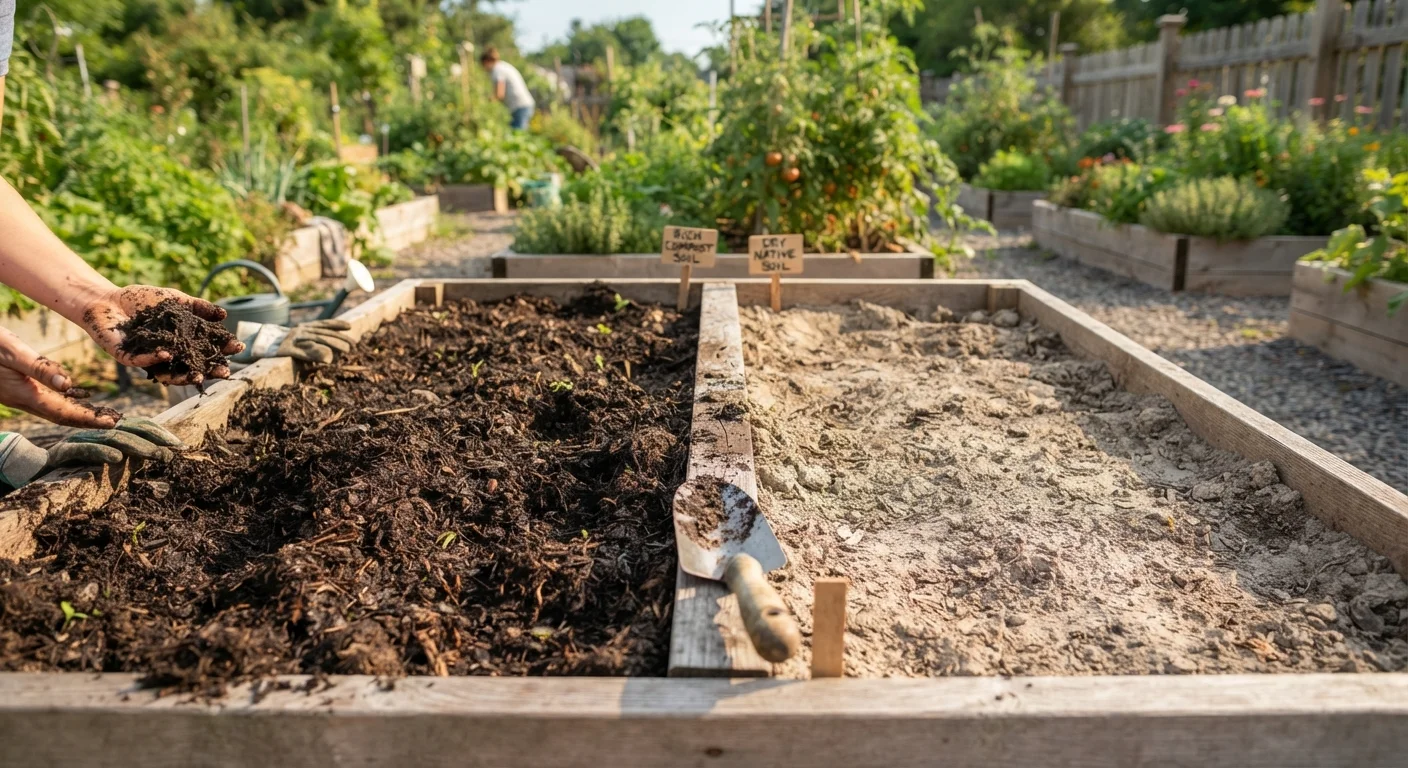
Organic fertilizers contribute organic matter, which improves soil structure - helping sandy soils hold moisture and helping clay soils drain more effectively. They support populations of beneficial bacteria, fungi, and earthworms that are essential to a productive garden. Over seasons of consistent use, organically managed soil tends to become easier to work and more resilient to drought and compaction.
Synthetic fertilizers, used in moderation and with attention to application rates, won't automatically harm your soil. However, heavy or repeated use without adding organic matter can gradually reduce microbial activity, lower organic matter content, and make soil more dependent on external inputs. Salt-based synthetics can also raise soil salinity over time if not managed carefully.
| Organic Fertilizer | Synthetic Fertilizer | |
|---|---|---|
| Nutrient availability | Slow release via microbial breakdown | Fast release, immediately plant-available |
| Soil biology impact | Feeds and supports microbial life | Minimal to neutral effect on microbes |
| Soil structure over time | Builds organic matter and structure | Little structural benefit; can degrade with overuse |
| Nutrient precision | Variable; depends on source and batch | Exact ratios stated on label |
| Risk of plant burn | Low - nutrients release gradually | Higher if over-applied |
| Runoff and leaching risk | Lower due to slow release | Higher, especially for nitrogen |
| Typical cost | Higher per unit of nutrient | Lower per unit of nutrient |
The key takeaway: organic options tend to improve the soil itself as a growing medium, while synthetics primarily target the plant's immediate nutritional needs without the same soil-building effect.
Practical Considerations for Home Gardeners
Beyond biology, there are practical factors every gardener weighs.
Test Before You Fertilize
A soil test is the single most reliable way to decide which nutrients - and which type of fertilizer - your garden actually needs. Many university cooperative extension programs offer soil testing kits for a modest fee. Results typically tell you your soil's pH, nutrient levels, and organic matter content, giving you a clear starting point rather than a guess.
Speed: If your tomatoes are yellowing from nitrogen deficiency mid-season, a synthetic fertilizer can address that faster than a compost application. Organic options require patience - and that's fine when you're planning ahead, but less ideal in a crisis.
Cost and availability: Synthetic fertilizers are widely available and typically less expensive per pound of nutrient. Organic fertilizers and quality compost can cost more upfront, though producing your own compost reduces that gap significantly.
Application precision: Synthetic fertilizers list exact nutrient percentages, making it easier to apply a specific amount. Organic fertilizers vary in nutrient content depending on source and batch, which makes precise dosing harder but also makes accidental over-application less likely to burn plants.
Environmental considerations: Synthetic fertilizers, particularly nitrogen, can leach into waterways if overapplied or applied before heavy rain. Organic fertilizers release nutrients more slowly, reducing - though not eliminating - runoff risk.
Making a Decision That Fits Your Garden
There's no single right answer for every garden. A raised vegetable bed you've been improving for years may thrive with organic-only inputs. A struggling patch of lawn in early spring might benefit from a targeted synthetic application. Many experienced home gardeners use a combined approach: organic inputs to build long-term soil health, with occasional synthetic applications to address specific, time-sensitive needs.
Before reaching for either type, consider getting a basic soil test. Local cooperative extension offices often offer affordable testing that tells you exactly which nutrients your soil is lacking - so you're not guessing and potentially over-fertilizing. Over-application wastes money, can harm plants, and contributes to runoff regardless of which product type you use.
~30%
Of U.S. topsoil lost since widespread farming began
The USDA estimates significant topsoil loss over decades of intensive land use, underscoring the importance of soil-building practices in home gardens.
1 tsp
Healthy soil microbes in a teaspoon of garden soil
Soil scientists estimate a single teaspoon of healthy garden soil can contain up to one billion bacteria, illustrating how rich the underground ecosystem can be.
Whatever you choose, the goal is the same: a garden that produces well and a soil that gets better with each passing season, not worse.
The content on this site is for informational purposes only and is not a substitute for professional advice. Always consult a qualified professional for guidance specific to your situation.