

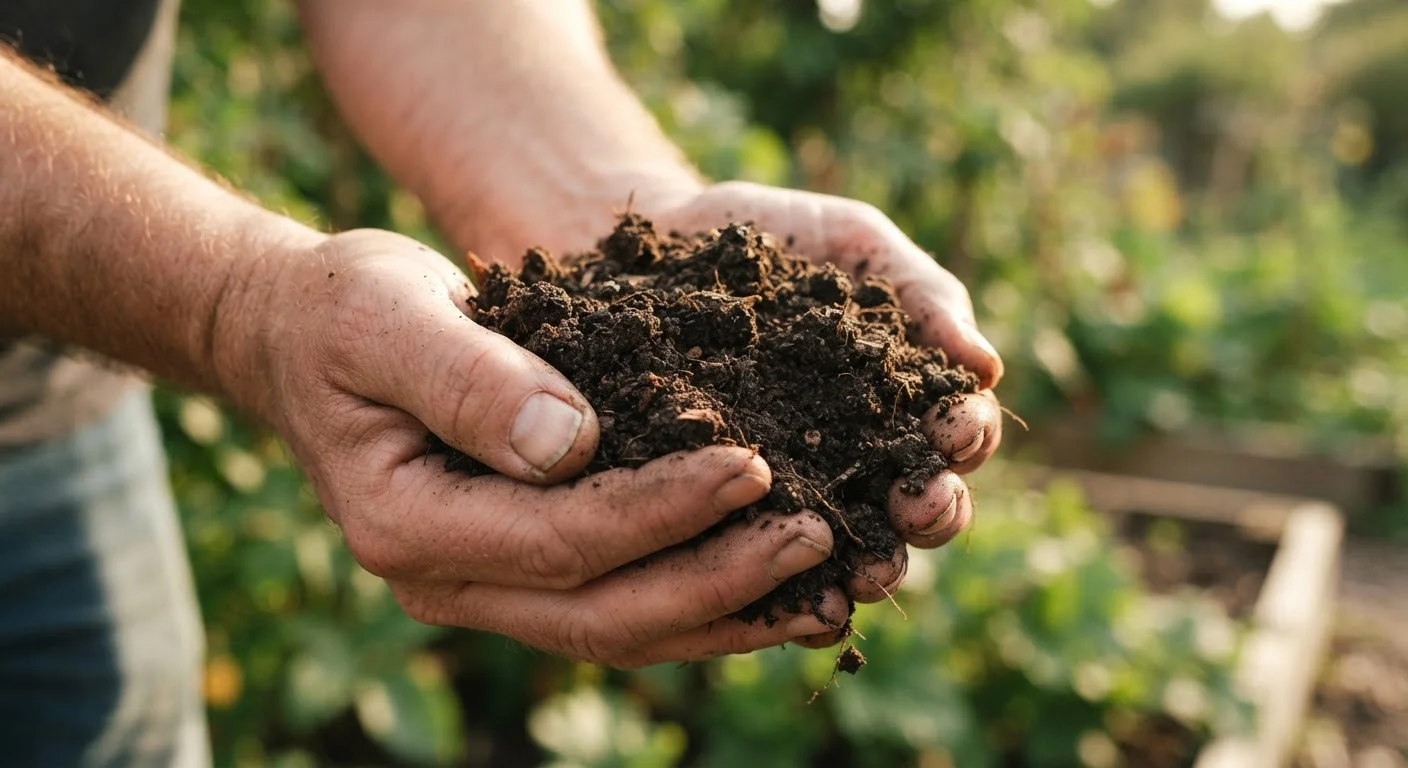
What Soil Is Actually Made Of
Most people think of soil as an inert background for plants. In reality, a single tablespoon of healthy garden soil contains more microorganisms than there are people on Earth. Soil is a complex mixture of minerals, water, air, organic matter, and living organisms - all interacting constantly.
The mineral component comes from weathered rock and determines soil texture - whether it's sand (coarse, fast-draining), clay (fine, compaction-prone), or silt (somewhere between). Most productive garden soils are loam: a balanced mix of sand, silt, and clay that drains well while retaining enough moisture and nutrients to feed plants reliably.
Organic matter - decomposed plant and animal material - is the fraction you can most easily influence. It feeds soil organisms, improves structure in both sandy and clay soils, and acts as a slow-release nutrient reservoir. Raising organic matter by even a small percentage can meaningfully improve how your soil performs. If you're starting a garden from scratch, building organic matter from day one sets you up for years of easier growing.
~95%
Of plant nutrients sourced from soil
According to the USDA Natural Resources Conservation Service, soil provides approximately 95% of the food humans eat, either directly or as feed for animals.
1 billion+
Microorganisms per teaspoon of healthy soil
Soil scientists estimate that a single teaspoon of productive garden soil contains between 100 million and 1 billion bacteria alone, alongside fungi, protozoa, and other organisms.
1 inch
Of natural topsoil takes centuries to form
The USDA estimates it takes roughly 500 years for nature to build one inch of topsoil, underscoring why protecting existing soil structure matters for every gardener.
Why pH and Nutrients Matter More Than You Think
Soil pH - the measure of acidity or alkalinity on a scale of 0 to 14 - controls whether plant roots can access the nutrients already present in your soil. A pH that's too high or too low essentially locks nutrients away, leaving plants deficient even when the nutrients are physically there.
Most vegetables and common garden plants prefer a pH of 6.0-7.0. Blueberries are a well-known exception, thriving in more acidic conditions around 4.5-5.5. A soil test - available inexpensively through your local cooperative extension service - tells you exactly where your pH lands and which major nutrients (nitrogen, phosphorus, potassium) are in short supply.
Rather than guessing and applying amendments blindly, test first. Over-applying lime (which raises pH) or sulfur (which lowers it) can cause new problems. Test results translate directly into a targeted action plan, saving both money and effort. See our pre-season garden checklist for guidance on when and how to get testing done before planting begins.
Soil Varies Significantly Across Your Yard
Don't assume all areas of your property have the same soil. Raised beds, shaded corners, slopes, and areas near the house foundation can have very different pH, drainage, and organic matter levels. When in doubt, test a sample from each distinct growing area separately rather than treating the whole yard as uniform.
How to Build and Protect Soil Health
The most broadly effective tool a gardener has is compost. Adding 1-2 inches of finished compost each season improves drainage in clay soils, increases water retention in sandy soils, feeds microbial life, and supplies a gentle, balanced nutrient boost. You can make your own from kitchen scraps and yard waste, or use bagged compost as a supplement.
Beyond compost, a few habits protect the soil structure you've worked to build:
- Keep soil covered. Bare soil erodes, dries out, and loses organic matter rapidly. Mulching between plants maintains moisture and temperature while feeding the soil as it breaks down. Our guide on mulching and its garden benefits explains how to choose and apply it correctly.
- Avoid compaction. Never walk on planting beds. Use permanent pathways so foot traffic stays off growing areas. Compacted soil squeezes out the air pockets roots and soil organisms need.
- Water deeply and less often. Shallow, frequent watering encourages shallow roots and can disrupt soil structure over time. Watering deeply and less frequently trains roots to grow downward and supports better overall soil biology.
- Minimize unnecessary tilling. Repeated deep tilling breaks up beneficial fungal networks and can accelerate organic matter loss. Work amendments into the top few inches only when necessary.
Start With a Soil Test Before Amending
Before purchasing lime, sulfur, or any nutrient amendment, get a basic soil test. Your local cooperative extension service typically offers tests for a small fee and provides region-specific recommendations based on your results. Amending blindly risks over-correcting and creating new imbalances - the test takes the guesswork out entirely.
Healthy soil also makes plants more resistant to pests and disease - a well-fed, well-structured root zone produces stronger plants that are harder for problems to take hold. This connects directly with how you approach identifying and managing common garden pests.
Frequently Asked Questions
Signs of healthy soil include a dark color, crumbly texture, earthy smell, and visible earthworms when you dig. Plants in healthy soil establish quickly, show vibrant color, and resist stress better. A formal soil test from your local cooperative extension office gives you precise data on pH, nutrients, and organic matter levels.
Most vegetables grow best in soil with a pH between 6.0 and 7.0, which is slightly acidic to neutral. Within this range, essential nutrients are most available to plant roots. Outside it, even nutrient-rich soil can leave plants struggling because they simply can't absorb what's there.
Most gardeners benefit from adding 1-2 inches of compost each growing season, worked into the top few inches of soil or used as a top dressing. Over time, consistent compost applications build organic matter and reduce the need for other inputs.
Yes - no-till or low-till approaches are increasingly popular because they preserve soil structure and protect beneficial fungi and microbial networks. Layering compost on the surface, using cover crops, and minimizing foot traffic in beds can all improve soil without digging.
Compaction from foot traffic or heavy equipment, leaving soil bare and exposed to erosion, overusing synthetic fertilizers, and repeated shallow watering are among the fastest ways to degrade soil. Each of these disrupts the physical structure and living communities that make soil productive.
No. Bagged potting mixes are formulated for containers - they're lightweight and drain quickly, which is ideal in pots but can be problematic in ground beds. In-ground garden soil benefits from a different approach: building organic matter and structure over time rather than relying on a pre-mixed medium.
The content on this site is for informational purposes only and is not a substitute for professional advice. Always consult a qualified professional for guidance specific to your situation.