

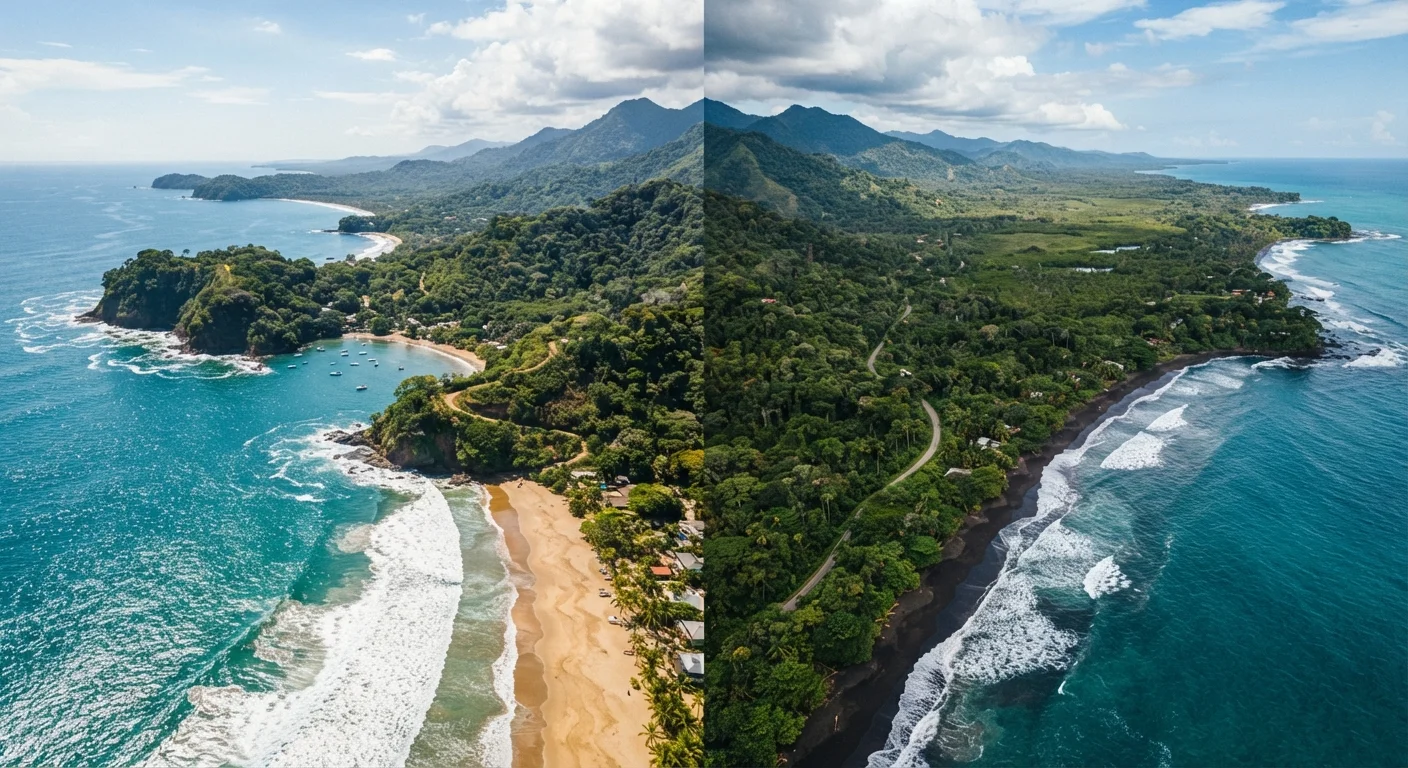
Option A
Pacific Coast
The polished, infrastructure-rich side of Costa Rica.
Best for: Travelers who want reliable dry seasons, surf-ready beaches, and a well-developed tourism scene with easy logistics.
Option B
Caribbean Coast
The wild, culturally distinct side most visitors never see.
Best for: Adventurous travelers drawn to Afro-Caribbean culture, rainforest wildlife, and a more off-the-beaten-path experience.
Weather: Two Climates, One Country
Costa Rica is roughly the size of West Virginia, yet crossing the central mountain range separating its two coasts means entering a completely different climate zone. The Pacific coast experiences a pronounced dry season from December through April - long a primary draw for American snowbirds and vacationers. Guanacaste in particular can feel almost arid during these months, with brilliant sunshine and low humidity.
The Caribbean coast operates on its own meteorological clock. Rain arrives throughout the year, though September and October bring a relative lull that locals sometimes call a mini dry season. Travelers who prize consistent sunshine should plan accordingly - but those who don't mind occasional downpours are rewarded with dramatically lush landscapes and far thinner crowds year-round.
| Criterion | Pacific Coast | Caribbean Coast |
|---|---|---|
| Dry Season | December-April (reliable) | No true dry season |
| Cultural Identity | Traditional Tico / international mix | Afro-Caribbean heritage |
| Road Infrastructure | Well-developed | Variable; can be rough |
| Nearest Major Airport | Liberia (LIR) or San José (SJO) | San José (SJO) |
| Signature Wildlife | Monkeys, scarlet macaws, whales | Sea turtles, sloths, poison dart frogs |
| Tourism Development | High - many options | Lower - more independent travel |
| Water Conditions | Calmer bays; surf breaks in north | Rougher surf; strong currents common |
Culture and Community: More Than a Geographic Line
The divide between Costa Rica's coasts isn't just ecological - it's cultural. The Caribbean coast's history is shaped by Afro-Caribbean communities descended from Jamaican laborers who arrived in the 19th century to build the country's railway. This heritage permeates daily life in towns like Puerto Viejo de Talamanca: the food leans toward rice and beans cooked in coconut milk (distinct from the Pacific's gallo pinto), reggae rhythms float through open-air bars, and Spanish is sometimes the second language after English-inflected Creole.
The Pacific side is home to Costa Rica's more tourist-oriented infrastructure, with a cultural experience that blends traditional Tico (Costa Rican) identity with a long-established international travel scene. Neither experience is more authentic - they're simply different countries layered within one.
Wildlife: Different Stars on Each Stage
Costa Rica is world-renowned for biodiversity, and both coasts deliver - just with different headline species. On the Pacific side, the Osa Peninsula's Corcovado National Park is considered by many naturalists to be among the most biologically intense places on Earth, home to tapirs, scarlet macaws, and all four species of Costa Rican monkeys. Seasonal humpback whale watching (peak months vary by migration pattern) adds another dimension to the Gulf of Dulce area.
The Caribbean coast is synonymous with sea turtle nesting. Tortuguero National Park - accessible only by boat or small aircraft - hosts massive green turtle nesting seasons between July and October. Sloths, poison dart frogs, and caimans are reliably spotted in the park's canal system. For birders, the Caribbean lowlands also harbor species rarely encountered on the Pacific side.
500,000+
Sea turtles nest at Tortuguero annually
Tortuguero National Park is recognized as one of the most important green sea turtle nesting sites in the Western Hemisphere, according to the Sea Turtle Conservancy.
~5%
Of Earth's biodiversity found in Costa Rica
Costa Rica contains an estimated 5% of the world's total biodiversity despite covering less than 0.03% of the planet's surface area, according to the Costa Rican Tourism Board (ICT).
25%+
Of land area protected as national parks or reserves
More than a quarter of Costa Rica's territory falls under some form of environmental protection, benefiting wildlife corridors on both coasts.
Getting There and Getting Around
Most American travelers land at one of two international airports: Juan Santamaría International (San José) or Daniel Oduber Quirós International (Liberia). Liberia is a gateway built for the Pacific - it puts Tamarindo, Nosara, and the Nicoya Peninsula within easy reach. San José sits closer to the center and serves both coasts, though driving to the Caribbean typically means navigating the challenging Route 32 through the mountains, a roughly two-to-three-hour drive in good conditions.
Road quality is a real consideration. Pacific highways are comparatively well-maintained, while Caribbean-side routes can deteriorate significantly after heavy rain. Rental vehicles with higher clearance are often advisable for remote Caribbean destinations. Puerto Viejo and the southern Caribbean are accessible by road from San José, but Tortuguero requires a boat transfer - plan that into your itinerary and budget.
If you're weighing a broader island-and-coast adventure, our comparison of Hawaii and the Caribbean can help you think through what kind of coastal experience fits your travel style.
Check Entry and Safety Requirements Before You Go
Entry requirements, health advisories, and local safety conditions can change. Before traveling to either coast of Costa Rica, verify current visa policies, vaccination recommendations, and travel advisories through the US Department of State (travel.state.gov) and the Centers for Disease Control and Prevention (cdc.gov/travel). Conditions can vary significantly between regions - and what applies in San José may differ from remote Caribbean communities.
The content on this site is for informational purposes only and is not a substitute for professional advice. Always consult a qualified professional for guidance specific to your situation.