

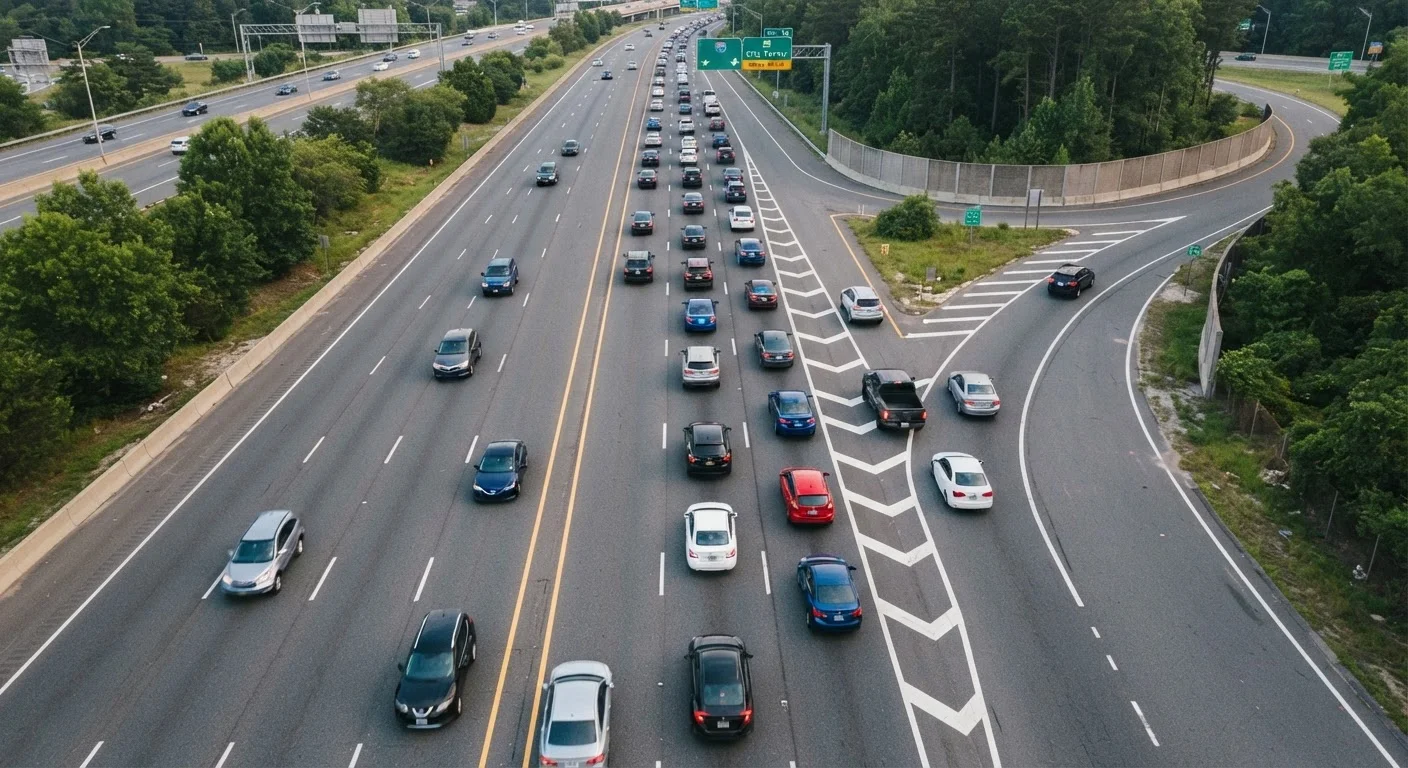
Why Merging Feels So Fraught
Few driving situations generate more frustration - and more horn-honking - than a lane closure on a busy highway. One lane ends, drivers scramble to move over, and a familiar social tension emerges: who stayed in the closing lane too long, and who is being a pushover by letting them in? That emotional charge is partly why the zipper merge remains so misunderstood, despite being the approach traffic engineers have championed for decades.
The confusion runs deep enough that many drivers genuinely don't know whether staying in a closing lane until the end is legal, courteous, or reckless. It's none of those things in isolation - context is everything. Understanding the zipper merge means separating what feels polite from what actually moves traffic safely and efficiently. As you'll see, those two things often point in the same direction.
For a broader look at how highway driving demands a different set of skills than city streets, see our guide to how your risk profile shifts between urban and highway driving.
How the Zipper Merge Actually Works
The zipper merge has two equally important halves, and both drivers - the one merging and the one yielding - must understand their role.
The merging driver stays in the closing lane, traveling at the same speed as surrounding traffic, all the way to the designated merge point (typically marked with signage or painted road markings). At that point, the driver signals and smoothly slots into a gap in the continuing lane.
The yielding driver in the continuing lane maintains a consistent speed and leaves roughly one car-length of space near the merge point. This isn't charity - it's the mechanical requirement for the system to function. Accelerating to close the gap defeats the purpose entirely.
~40%
Potential reduction in queue length with zipper merging
Minnesota DOT research found late merging can reduce traffic backups by up to 40% compared with early merging in heavy-congestion scenarios.
50%
Of drivers unfamiliar with the zipper merge concept
Surveys conducted by state transportation departments have found that roughly half of drivers are unaware that late merging is the recommended approach in high-traffic lane closures.
1 car length
Gap needed in the continuing lane at merge point
Traffic engineers consistently identify a single car-length gap as the practical minimum for a smooth one-for-one alternating merge without disrupting flow.
The one-for-one alternating pattern is what gives the technique its name. Just as zipper teeth engage alternately, vehicles from each lane take turns. When drivers on both sides understand and expect this rhythm, the transition is fluid. When only one side knows the plan, it degenerates into the honking standoff most of us have experienced.
The Traffic Science Behind Late Merging
Early merging - the instinct to move over as soon as you see the "Lane Ends" sign - feels considerate. But in heavy congestion it creates a paradox: by abandoning the closing lane prematurely, drivers concentrate all traffic into a single lane much earlier than necessary. This produces a longer backup, more stop-and-go cycling, and greater risk of rear-end collisions.
Late merging, by contrast, treats both lanes as usable road until their natural endpoint. Studies by state transportation departments have found that in high-traffic conditions, the zipper merge can cut queue length roughly in half and measurably reduce the speed differential between the merging lane and the continuing lane - a key factor in crash risk.
“When used correctly, the late merge - or zipper merge - is one of the simplest, most effective tools we have to reduce congestion at lane closures. The barrier isn't engineering; it's driver education.”
— Minnesota Department of Transportation, State transportation agency and pioneer of U.S. zipper merge public awareness campaigns
It's worth noting that the calculus changes in light traffic. When the closing lane is largely empty, merging early is simply the path of least resistance and causes no harm. The engineering recommendation for late merging is specifically calibrated to congested conditions where the closing lane still holds significant unused capacity.
Common Mistakes Drivers Make at the Merge Point
Even drivers who intellectually accept the zipper merge often execute it poorly. The most common errors include:
- Blocking the closing lane: Some drivers position their vehicle diagonally or edge into the closing lane to prevent others from using it. This is both counterproductive and potentially illegal in some states.
- Merging too fast or at an angle: A smooth merge requires matching the speed of the continuing lane before moving over - not cutting across at an angle or braking sharply.
- Refusing to yield one space: Drivers in the continuing lane who close the gap aggressively prevent the alternating rhythm from working, creating a bottleneck at the very point it should be resolving.
- Merging multiple cars at once: The zipper works on a strict one-for-one basis. Two or three cars attempting to slip in together breaks the pattern and stalls the continuing lane.
Signal Early, Merge Smoothly
Turn on your signal at least two to three seconds before you intend to merge - not at the last possible moment. Early signaling gives the driver in the continuing lane time to hold their speed steady and leave a gap, making the alternating rhythm work as intended. A late or absent signal is the fastest way to turn a cooperative zipper into a confrontation.
Road etiquette doesn't end at the merge point. The same spirit of predictable, cooperative behavior applies throughout shared roads - as explored in our article on what drivers often get wrong around cyclists and pedestrians.
Putting It Into Practice
The next time you approach a lane closure sign on the highway, run through a quick mental checklist: Is traffic heavy or light? If the closing lane still has room and traffic is congested, stay in it and use it fully. If traffic is light, move over when convenient - no need to optimize.
As you approach the merge point, match the speed of the continuing lane, signal early, and look for a natural one-car gap. Don't force your way in; wait one beat for the alternating rhythm to open a space. If you're in the continuing lane, resist the urge to close the gap on the vehicle ahead. Leave the space, let one vehicle in, and proceed.
That's the whole technique. It requires no special skill - only an understanding that what feels like cutting in line is, in fact, the engineering-endorsed way to keep everyone moving safely. Knowing the difference is the kind of informed decision that makes you a genuinely safer driver, not just a faster one.
Frequently Asked Questions
Yes, in virtually all U.S. states, drivers are permitted to use a closing lane up to the point where it ends. Many state DOTs explicitly encourage late merging in heavy traffic. Always check your state's specific traffic statutes for certainty.
Not when done correctly. Research consistently shows that late merging is more efficient and fair than early merging. The key is to alternate politely at the merge point rather than forcing your way in. The frustration other drivers feel often stems from misunderstanding the technique.
In light or free-flowing traffic, merging early is perfectly sensible and causes no disruption. Late merging provides its biggest benefit during heavy congestion when the closing lane has significant capacity that would otherwise go unused.
The driver in the continuing lane should maintain a consistent speed and leave one car-length of space near the merge point, allowing the adjacent vehicle to slot in smoothly. Speeding up to close the gap or brake-checking are both unsafe behaviors.
Not all states have published a formal policy, but the practice is broadly legal and increasingly promoted through signage in construction and lane-reduction zones. States like Minnesota, Washington, and Colorado have active public awareness campaigns around late merging.
The content on this site is for informational purposes only and is not a substitute for professional advice. Always consult a qualified professional for guidance specific to your situation.