

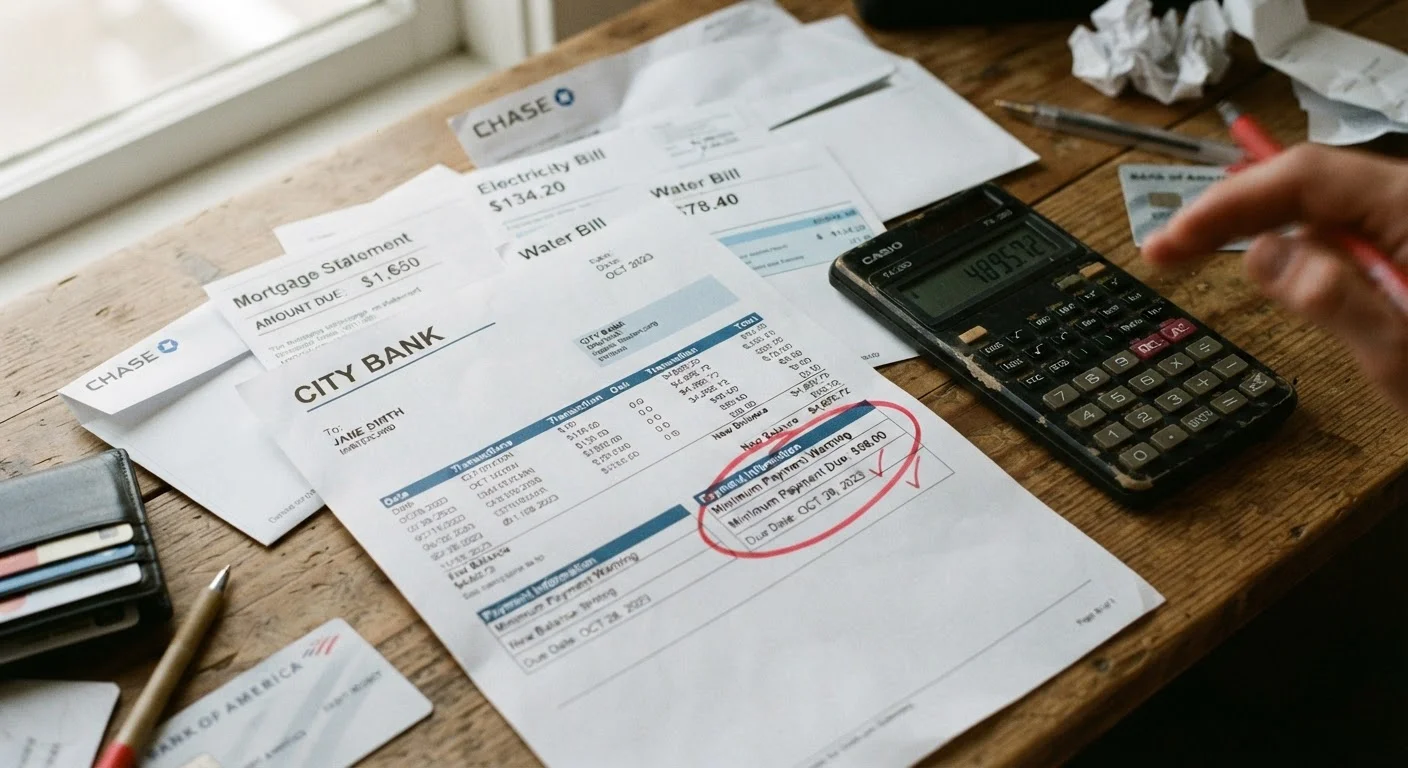
Why Short-Term Debt Rarely Stays Short-Term
Most debt doesn't start as a long-term problem. A medical bill, a car repair, a few months of tight cash flow - these feel manageable in the moment. But certain patterns quietly transform temporary borrowing into years-long financial drag. The mechanics aren't always obvious, and that's exactly why so many Americans find themselves still paying for purchases made half a decade ago.
Understanding where things go wrong is the first step toward changing the outcome. The mistakes below are among the most common - and the most costly. For a plain-language breakdown of key terms like APR, principal, and charge-off, see our Personal Finance Terms Every Debt-Carrier Should Know.
Paying only the minimum balance each month.
Why it happens: Minimum payments are designed to feel affordable, and card issuers set them low - often 1-2% of the balance - which obscures how slowly the principal actually shrinks.
Misunderstanding deferred interest promotions.
Why it happens: "0% interest for 12 months" sounds like a true interest-free deal, but many offers use deferred interest - meaning all the interest accrued during the promotional period gets charged retroactively if any balance remains at the end.
Missing or skipping payments, even occasionally.
Why it happens: A tough month leads to one skipped payment, which feels recoverable. But a single late payment can trigger a penalty APR - sometimes significantly higher than your existing rate - and late fees that add directly to your balance.
Consolidating debt without changing the underlying spending pattern.
Why it happens: Debt consolidation can genuinely reduce interest costs when done thoughtfully, but borrowers often treat a consolidation loan as breathing room rather than a reset - and run up the original accounts again.
Ignoring fee structures - especially on store cards and cash advance products.
Why it happens: Annual fees, cash advance fees, and balance transfer fees are buried in account agreements and easy to overlook, but they add real dollars to the amount you owe before interest even begins accruing.
How to Recognize When These Traps Are Already at Work
Sometimes the damage is already underway before a borrower notices. If your monthly payment barely moves your balance, if a promotional rate has expired without warning, or if a consolidation loan hasn't reduced your total interest burden - you may be inside one of these traps right now.
~$6,500
Average American credit card balance
According to Federal Reserve data, the average revolving credit card balance carried by U.S. households has remained in this range in recent years, with many cardholders carrying balances month to month.
20%+
Average credit card APR in the U.S.
Federal Reserve consumer credit data has shown average credit card interest rates climbing above 20% annually, making high balances increasingly costly to carry.
Over 10 years
Time to pay off $5,000 at minimum payments
Consumer finance education tools consistently demonstrate that paying only the minimum on a $5,000 balance at a typical APR can extend repayment well beyond a decade.
A key signal is your debt-to-income ratio, which measures how much of your gross monthly income goes toward debt payments. When that number climbs above manageable levels, the risk compounds. Our article on signs your debt load has become a financial risk walks through concrete indicators worth checking.
If you're ready to move from recognition to action, A Beginner's Roadmap to Getting Out of Debt offers a structured starting point - even if you've never tackled a formal repayment plan before. And if you want to understand the deeper mechanics of why escaping debt is so difficult, The Debt Cycle Explained covers exactly that.
Penalty APRs Can Lock In Higher Rates Permanently
A single missed payment on many credit cards can trigger a penalty APR - sometimes exceeding 29% - that applies to your entire existing balance, not just future purchases. Unlike an introductory rate, penalty APRs often persist indefinitely unless the issuer agrees to restore your original rate. If you've missed payments, contact your issuer directly to understand your current rate and whether a hardship program is available.
This article is for general informational and educational purposes only. It does not constitute personalized financial, legal, or tax advice. Consult a licensed financial professional for guidance specific to your situation.
The content on this site is for informational purposes only and is not a substitute for professional advice. Always consult a qualified professional for guidance specific to your situation.