

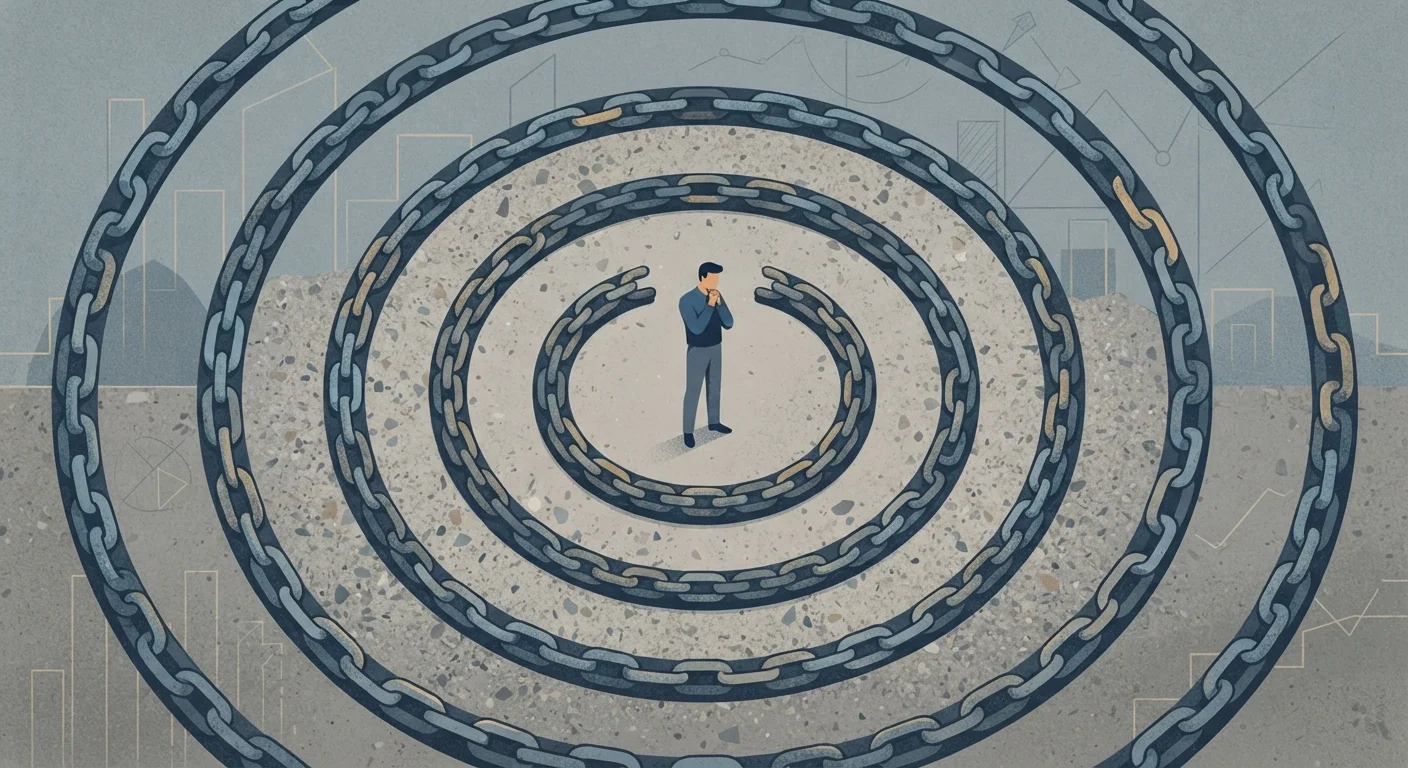
How People Enter the Debt Cycle
The debt cycle rarely begins with a spending spree. More often, it starts with a single disruption - an unexpected medical bill, a car repair that can't wait, a job loss that cuts income for a few months. Without an emergency fund to absorb the shock, a credit card or personal loan fills the gap. That borrowing is the entry point.
Once the borrowed money is spent on the original emergency, the borrower now faces their normal monthly expenses plus a new debt payment. If income hasn't increased, something else has to give - often savings, or another round of borrowing. The cycle is established before most people recognize it.
Entry Points Are Often Structural, Not Behavioral
Unexpected medical costs, job loss, and income volatility are among the most frequently cited causes of debt cycle entry in household finance research. Having even a small emergency fund - typically three to six months of essential expenses - is one of the most effective buffers against entering the cycle. Building that fund, even while carrying debt, is a widely recommended goal among nonprofit financial counselors.
Common entry points also include predatory short-term lending products - payday loans and certain installment loans - which are structured with extremely high interest rates that make even a small initial loan difficult to repay in a single payment cycle. For a closer look at the specific traps that extend debt, see traps that turn short-term debt into long-term burden.
The Mechanics That Keep the Cycle Spinning
Understanding why the cycle is hard to break requires understanding compound interest. When you carry a balance on a high-interest debt, interest is calculated on the total outstanding balance - including previously accrued interest. Every month you don't pay the balance in full, the amount you owe grows, and next month's interest is calculated on that larger number.
$1.17T
Total U.S. credit card debt outstanding
According to Federal Reserve data, American households collectively carried over one trillion dollars in credit card balances, reflecting the scale of revolving debt in the country.
~22%
Average credit card APR in recent years
The Consumer Financial Protection Bureau has noted that average credit card interest rates have risen substantially, making the cost of carrying a balance significantly higher than in past decades.
40%
Americans who cannot cover a $400 emergency
Federal Reserve survey data has consistently found that a large share of U.S. adults would struggle to cover an unexpected $400 expense without borrowing - a key entry point into the debt cycle.
Minimum payments make this worse. Credit card issuers typically set minimum payments at around 1-2% of the balance, or a small flat amount - whichever is greater. At that pace, a $5,000 balance at 22% APR (annual percentage rate) can take over a decade to repay and cost more than the original balance in interest alone.
The result: even a disciplined borrower making every payment on time can feel like they are treading water, because a large portion of each payment disappears into interest charges rather than reducing what they owe. For a full breakdown of popular methods to tackle this, see the debt avalanche and debt snowball explained side by side.
Why Willpower Alone Isn't Enough
The debt cycle is often framed as a motivation problem - as though people simply need to try harder. But the mechanics show otherwise. When your minimum payments consume a significant share of take-home pay, there may be genuinely no margin left to make larger payments, even with perfect discipline. The math doesn't care about intentions.
“Debt is not merely a financial condition - it is a time condition. It consumes future income before it is earned, narrowing every choice a household can make.”
— Finance Editorial Team, Editorial perspective based on widely documented research into household debt dynamics
Structural factors compound the difficulty. Stagnant wages, unpredictable income from gig or hourly work, and the absence of employer-sponsored benefits all reduce the buffers that prevent a single setback from becoming a cycle. Households without savings have no choice but to borrow when emergencies arise - and they arise for everyone eventually.
This is why the conversation needs to shift from "why can't you just stop spending" to "what structural changes would give you enough margin to make real progress." If you're unsure whether your current debt level has crossed into financial risk, signs your debt load has become a financial risk is a useful reference point.
Breaking the Cycle: What Actually Works
Escaping the debt cycle requires attacking it from two directions at once: reducing the cost of the debt you carry and widening the gap between income and expenses. Neither alone is usually sufficient.
Start With More Than the Minimum
Even adding $25-$50 above your minimum payment each month can shorten your payoff timeline by months or years, depending on the balance and interest rate. Use a debt payoff calculator - many are available free through nonprofit financial organizations - to see the concrete difference extra payments make before committing to a plan.
On the debt side, paying more than the minimum - even a modest amount more - meaningfully accelerates payoff because the extra payment goes directly toward principal, reducing the base on which interest compounds. Strategies like the debt avalanche (targeting highest interest rates first) and the debt snowball (targeting smallest balances first) both work, and research suggests the best method is the one you'll actually stick with.
On the cash-flow side, the goal is to create a reliable surplus each month, however small. That might come from reducing a specific expense, increasing income through additional hours or a side arrangement, or renegotiating terms through a nonprofit credit counseling agency. If you're ready to start building a plan, a beginner's roadmap to getting out of debt walks through the fundamentals step by step.
This article is for general informational purposes only and does not constitute personalized financial, legal, or tax advice. For guidance specific to your situation, consult a qualified financial professional.
Frequently Asked Questions
The debt cycle is when you borrow money, can't fully repay it, and interest charges cause the balance to grow - forcing you to borrow again. It repeats because each cycle leaves you with less money to cover expenses, making new borrowing feel necessary.
Yes, though it is harder on a lower income. The key levers are reducing interest costs where possible, identifying even small cash-flow surpluses to put toward principal, and avoiding new high-interest debt. A nonprofit credit counselor can help create a realistic plan tailored to your situation.
Minimum payments are typically set at a low percentage of your balance - often 1-2% plus interest. This means most of your payment covers interest charges rather than principal, so the balance shrinks very slowly. Paying more than the minimum is essential to escaping the cycle.
Debt consolidation can lower your interest rate and simplify payments, which helps - but it does not automatically break the cycle. If the spending or income pattern that created the debt remains unchanged, the cycle can restart. See our article on <a href="/finance/saving-and-debt/debt-consolidation-what-it-actually-does-and-what-it-doesnt">what debt consolidation actually does</a> for a fuller picture.
Start by listing every debt with its balance, interest rate, and minimum payment. Then identify any cash-flow gap - the difference between what comes in and what goes out each month. From there, you can choose a payoff strategy and look for ways to widen your margin.
Not usually. Research consistently shows that medical bills, job loss, divorce, and stagnant wages are among the most common triggers. The cycle is a structural problem that can catch almost anyone without adequate savings or at the wrong moment financially.
The content on this site is for informational purposes only and is not a substitute for professional advice. Always consult a qualified professional for guidance specific to your situation.