

Option A
Fiber Internet
The high-performance, symmetrical speed leader.
Best for: Households with heavy simultaneous usage - remote workers, streamers, gamers, and multi-device homes that demand consistent upload and download speeds.
Option B
Cable Internet
The widely available, proven broadband workhorse.
Best for: Consumers who need reliable, fast download speeds and live in areas where fiber hasn't yet been deployed.
How Each Technology Actually Works
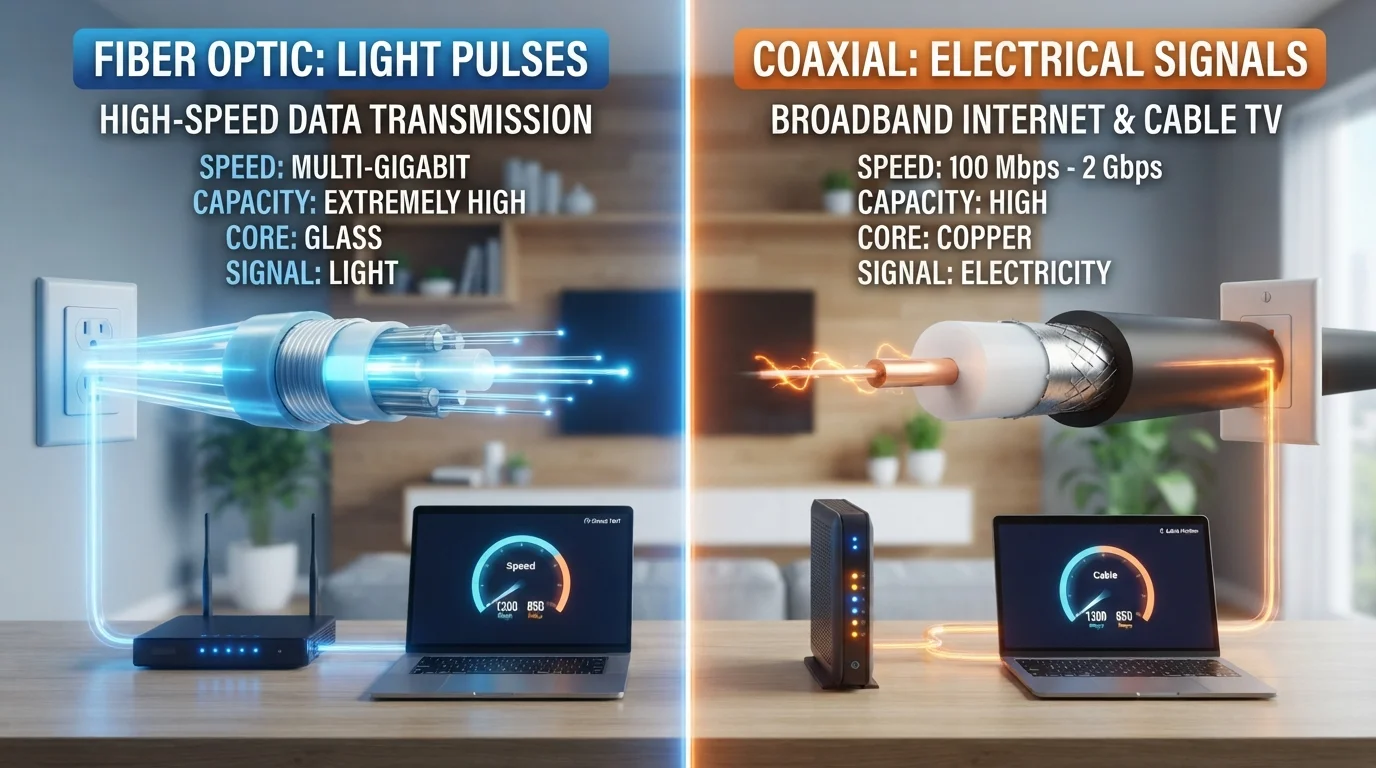
Understanding what separates fiber from cable starts with the physical infrastructure carrying your data. Fiber internet transmits information as pulses of light through thin strands of glass or plastic - a technology called fiber optic. Because light travels with minimal signal degradation over long distances, fiber connections can maintain full speed across the entire run from a provider's network to your home.
Cable internet, by contrast, uses the same coaxial copper cables originally built for cable television. Data travels as electrical signals, which are more susceptible to interference and signal loss over distance. A technology called DOCSIS governs how cable providers deliver internet over these lines, with newer DOCSIS 3.1 and 3.1+ versions significantly improving capacity.
For a broader look at how these and other residential technologies compare, see how each internet technology delivers your connection.
| Criterion | Fiber Internet | Cable Internet |
|---|---|---|
| Transmission medium | Light through glass/plastic strands | Electrical signals through coaxial copper |
| Download speeds | Up to 1-10 Gbps depending on plan | Typically 100 Mbps-2 Gbps |
| Upload speeds | Symmetrical - matches download speed | Often 10-50% of download speed |
| Typical latency | ~5-15 ms | ~15-35 ms |
| Network congestion risk | Lower - dedicated to home (FTTH) | Higher - shared neighborhood node |
| U.S. household availability | Expanding - still limited in many areas | Widely available across most markets |
| Infrastructure age | Newer deployments | Established, often upgraded cable plant |
Speed, Latency, and Congestion: The Real Differences
Raw speed numbers don't tell the whole story. One of the most practically significant differences is upload speed. Fiber plans are typically symmetrical - meaning upload and download speeds are equal. Cable networks are engineered to prioritize downloads, so upload speeds are often a fraction of the advertised download rate. For a household with one video conferencing participant and a teenager uploading gaming clips simultaneously, that asymmetry matters.
Latency - the time it takes a data packet to travel from your device to a server and back - is another area where fiber holds an edge. Fiber connections commonly deliver latency in the 5-15 millisecond range, while cable typically falls in the 15-35 ms range. For casual browsing this difference is imperceptible, but for real-time gaming or video calls, lower latency reduces lag noticeably.
Cable networks are also shared infrastructure: neighbors in the same node draw from the same bandwidth pool. During peak evening hours, this can produce slowdowns. Fiber connections, particularly those running fiber all the way to the home (called FTTH), are generally less affected by neighborhood-level congestion. To understand why advertised speeds don't always match real-world performance, our guide on common myths about home internet speed is worth reading.
~43%
U.S. homes with fiber access
The FCC's 2023 Broadband Data Collection indicates roughly 43% of U.S. locations have access to fiber internet service.
~5-15 ms
Typical fiber latency
Industry benchmarking data from providers and testing platforms consistently places fiber round-trip latency in this range under normal conditions.
~90%+
U.S. homes with cable broadband access
FCC coverage data shows cable broadband reaches the substantial majority of U.S. residential locations, far outpacing fiber's current footprint.
Availability and What to Expect When Choosing
Availability remains the single biggest practical constraint. According to the FCC's broadband data, cable internet is accessible to the large majority of U.S. households, while fiber availability - though growing rapidly - still lags in many rural and some suburban markets. If fiber isn't offered at your address, cable is often the most capable wired alternative before considering DSL or fixed wireless options.
When fiber is available, the infrastructure investment required to deploy it means fewer providers may compete in a given market. Cable markets often have at least one established provider, giving consumers a known baseline option. Neither technology automatically guarantees better customer service or pricing - those factors vary significantly by provider and region.
For households weighing all their options from scratch, our complete home internet primer walks through how to assess your needs before committing to a plan. And if you live in a rural area where neither fiber nor cable reaches, satellite internet's trade-offs are worth understanding before signing up.
Once you've chosen a connection type, your in-home equipment matters too. See how modems and routers differ - many households don't realize they serve entirely separate functions.
Fiber Terminology Can Be Misleading
Not all "fiber" plans are the same. FTTH (or FTTP - Fiber to the Premises) runs fiber cable all the way to your residence, delivering the full benefits of fiber. Some plans marketed as fiber only run fiber to a neighborhood node, with coaxial or copper completing the final stretch - a setup called FTTN. The type of connection matters for real-world performance, so it's worth asking your provider exactly where the fiber run ends.
The content on this site is for informational purposes only and is not a substitute for professional advice. Always consult a qualified professional for guidance specific to your situation.