

Why 100,000 Miles Is a Real Threshold
Reaching 100,000 miles doesn't mean your vehicle is worn out - but it does mean the original factory tolerances on many components are being tested. Rubber degrades, seals shrink, and metal surfaces develop microscopic wear patterns that accumulate over years of heat cycling and friction. Engineers design most major service intervals with this general mileage range in mind.
What changes at this threshold is not the number itself, but the coincidence of wear cycles. Multiple systems that were replaced or serviced at different earlier intervals often come due around the same time. A driver who stayed current on oil changes but deferred other services may suddenly face several repairs at once. Understanding which systems are most time-sensitive helps you prioritize intelligently rather than react to failures.
Check your vehicle's owner manual for manufacturer-specific intervals - those figures are the authoritative baseline for your make and model. Use this guide as a framework for understanding why those intervals exist, not as a substitute for professional assessment.
~200,000
Miles modern vehicles can reliably reach with proper maintenance
Industry mechanics and automotive engineers broadly agree that well-maintained modern vehicles routinely exceed 200,000 miles.
60-105K
Typical timing belt replacement interval (miles)
Most vehicle manufacturers specify timing belt replacement within this range; consult your owner manual for the exact figure.
3-5 years
Average car battery service life
Battery manufacturers and automotive industry sources generally cite this range regardless of vehicle mileage.
Fluids and Filters That Need Extra Attention
Engine oil remains the most familiar maintenance item, but high-mileage vehicles often benefit from switching to an oil formulated for older engines. These products typically contain seal conditioners and slightly higher-viscosity base oils that help compensate for increased internal clearances. Consult a mechanic before changing your oil specification.
Transmission fluid is among the most neglected items in aging vehicles. Automatic transmissions are sensitive to degraded fluid, and many failures that occur after 100,000 miles trace back to fluid that was never changed. If your vehicle has no documented transmission service history, a fluid inspection - and likely a drain and refill - is worth prioritizing. Note that some manufacturers specify sealed transmissions as lifetime-fill; a professional can clarify what applies to your vehicle.
Coolant (antifreeze) breaks down chemically over time, losing its corrosion-inhibiting properties even if the level appears normal. Degraded coolant can corrode cooling system components from the inside. Most manufacturers specify a coolant flush at or before 100,000 miles, then periodically thereafter.
Brake fluid is hygroscopic - it absorbs moisture from the air over time, which lowers its boiling point and can contribute to corrosion inside brake lines and calipers. Flushing brake fluid on older vehicles is a relatively low-cost service with meaningful safety implications.
Pull Your Service Records Before the Next Visit
Before scheduling a high-mileage inspection, gather all available service records - even informal receipts. This helps your mechanic identify what has already been done and focus time on genuinely outstanding items rather than duplicating recent work.
Belts, Hoses, and Seals: The Hidden Wear Items
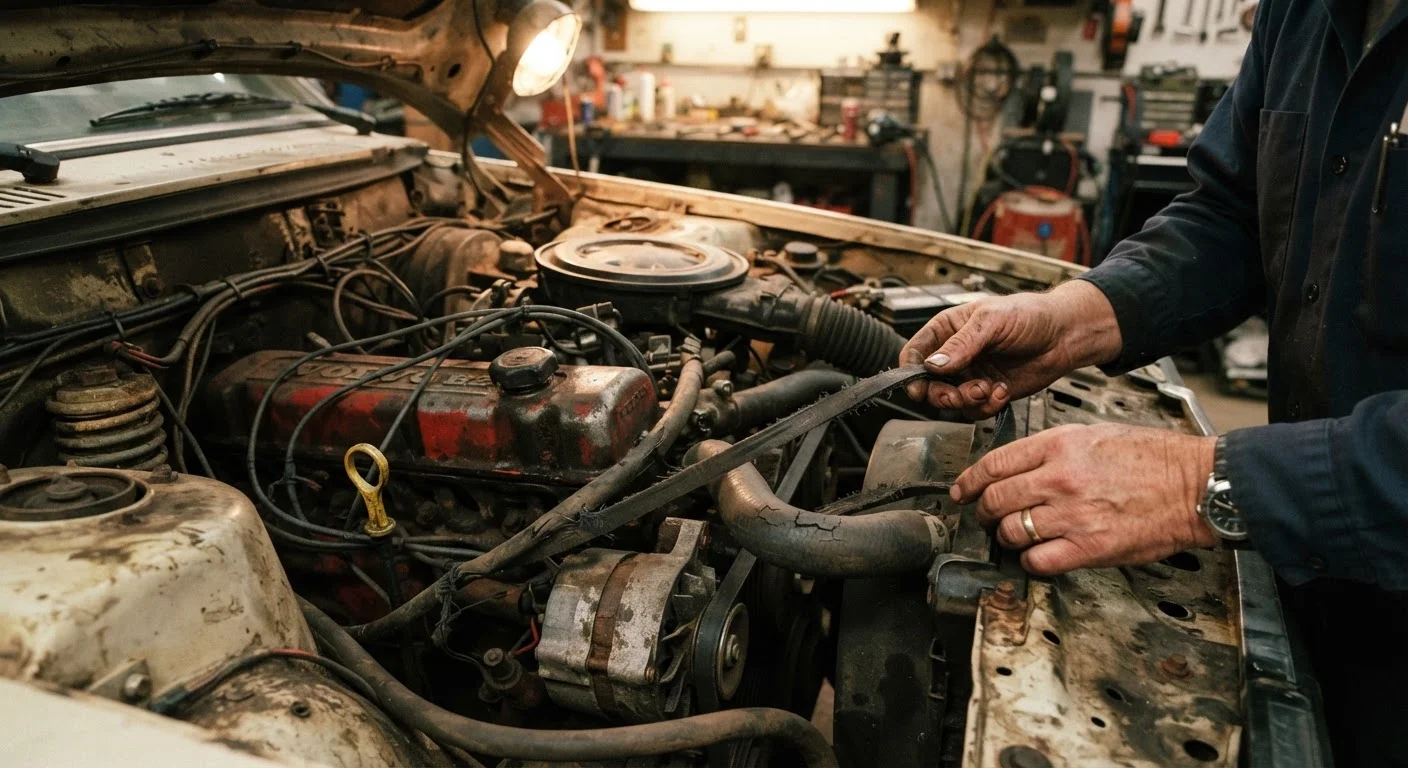
Rubber components are among the most consequential wear items in high-mileage vehicles, and they often fail without obvious visible warning until the problem is serious.
Timing belt (on vehicles that have one rather than a timing chain): This belt synchronizes the engine's internal components. Failure can cause catastrophic engine damage in many vehicle designs. Most manufacturers specify replacement between 60,000 and 105,000 miles, and if your vehicle has no documented replacement history, this should be investigated immediately. Not all engines use a timing belt - some use a metal chain that is generally more durable - so confirm which your vehicle has.
Serpentine belt: This single belt drives the alternator, power steering pump, air conditioning compressor, and water pump on most modern vehicles. Cracking, fraying, or glazing are signs it is overdue. Replacement is inexpensive compared to being stranded by a sudden break.
Coolant hoses: Radiator and heater hoses can feel firm on the outside while deteriorating internally. A mechanic can squeeze-test and visually inspect them for swelling, cracking, or softness near the clamps.
Gaskets and seals: Valve cover gaskets, oil pan gaskets, and rear main seals commonly develop seeps after extended use. Small leaks can often be managed; what matters is tracking whether a seep is stable or worsening.
When a mechanic finds a failed hose or belt on a high-mileage vehicle, ask whether adjacent components of similar age should be replaced at the same time. Labor is often the largest cost - replacing a second item while everything is already disassembled can be significantly more economical than a separate visit later.
Bundling related repairs reduces total labor hours and prevents a second breakdown caused by an adjacent component that was visibly marginal at the time of the first repair.
If you're unsure whether your engine has a timing belt or a timing chain, look up your engine code in the owner manual or ask a mechanic - the maintenance implications are entirely different, and confusing the two is a common and potentially expensive mistake.
Timing belt failure in an interference engine can destroy the engine; timing chains are generally more durable and often don't require scheduled replacement, so the distinction is consequential.
Suspension, Brakes, and Steering Components
Suspension and steering components undergo millions of load cycles over 100,000 miles. Most are designed to last well beyond that figure, but wear accelerates on vehicles driven frequently on rough roads, or where alignment and tire balance were irregularly maintained.
Shock absorbers and struts lose their damping effectiveness gradually, making the decline easy to miss. A mechanic can perform a bounce test and check for leaking fluid. Worn shocks affect handling, braking distance, and tire wear - all of which connect directly to safety.
Ball joints, tie rod ends, and bushings are the pivot and cushioning points in the suspension and steering system. When these wear, drivers may notice vague steering feel, clunking over bumps, or uneven tire wear. These components should be inspected on the vehicle lift during routine service.
Brake rotors and pads: By 100,000 miles, most vehicles have been through multiple sets of pads. However, rotors can develop thickness variation (sometimes called warping) that causes pedal pulsation. If you feel vibration when braking, have rotors measured for thickness and runout.
For tire-related checks that accompany suspension inspections, see our guide on tire pressure and tread depth.
Don't Ignore Steering or Brake Changes
Changes in steering feel, brake pedal firmness, or unusual noises over bumps should be evaluated promptly - not deferred to a future service visit. Worn suspension and brake components affect your vehicle's ability to respond in emergency situations. If something feels different, have it inspected before driving long distances.
Electrical Systems and Sensors
Modern vehicles rely on dozens of sensors and electronic modules that communicate through the engine control unit (ECU). With age and mileage, wiring insulation can crack, connectors corrode, and sensor accuracy drifts.
Battery and charging system: Most batteries have a useful life of three to five years regardless of mileage. Have the battery load-tested, not just voltage-checked. The alternator and voltage regulator should also be verified, as a weak alternator places extra strain on a marginal battery.
Oxygen sensors and mass airflow sensors: These components directly influence fuel economy and emissions. A sluggish oxygen sensor may not trigger a check-engine light immediately but can cause the engine to run less efficiently over time. If fuel economy has declined noticeably, sensor performance is worth investigating.
Ignition components: Spark plugs on modern vehicles are often rated for 60,000 to 100,000 miles. If long-life plugs haven't been replaced by 100,000 miles, they're overdue. Worn plugs stress the ignition coils, which are more expensive to replace.
Keeping a thorough service record helps you and your mechanic track which electrical services have been performed. See our related guide on maintaining your vehicle's service history for practical record-keeping advice.
Building a High-Mileage Maintenance Mindset
The most effective strategy for high-mileage vehicle ownership is shifting from reactive to proactive. Instead of waiting for a warning light or a failure, schedule a comprehensive inspection - sometimes called a multi-point inspection - at a trusted shop. This gives a mechanic the chance to assess the vehicle as a whole rather than addressing only the presenting symptom.
Consider shortening some service intervals modestly. If your owner manual specifies an oil change every 7,500 miles under normal conditions, a high-mileage vehicle used in stop-and-go traffic or extreme temperatures may benefit from changes closer to 5,000 miles. Discuss this with your mechanic based on your specific driving patterns.
Weather extremes put additional stress on aging components. Our seasonal car care guide covers what to inspect as temperatures shift - particularly relevant for older vehicles whose cooling and heating systems may already be operating with reduced margin.
Finally, if you've recently purchased a high-mileage vehicle with an unclear service history, treat it as if nothing has been done and inspect systematically from there. Our annual car ownership checklist can help you build that habit year over year.
This article provides general educational information about vehicle maintenance. It is not a substitute for a professional inspection by a qualified mechanic. Consult your vehicle's owner manual and a licensed technician for guidance specific to your make, model, and driving conditions.
“A car that hits 100,000 miles isn't old - it's entering the phase where deferred maintenance starts compounding. The vehicles that make it to 200,000 miles reliably are almost always the ones whose owners stayed ahead of the schedule, not behind it.”
— Automotive Service Excellence (ASE) Certified Technician, Master Automotive Technician, representing broadly held professional consensus
The content on this site is for informational purposes only and is not a substitute for professional advice. Always consult a qualified professional for guidance specific to your situation.