

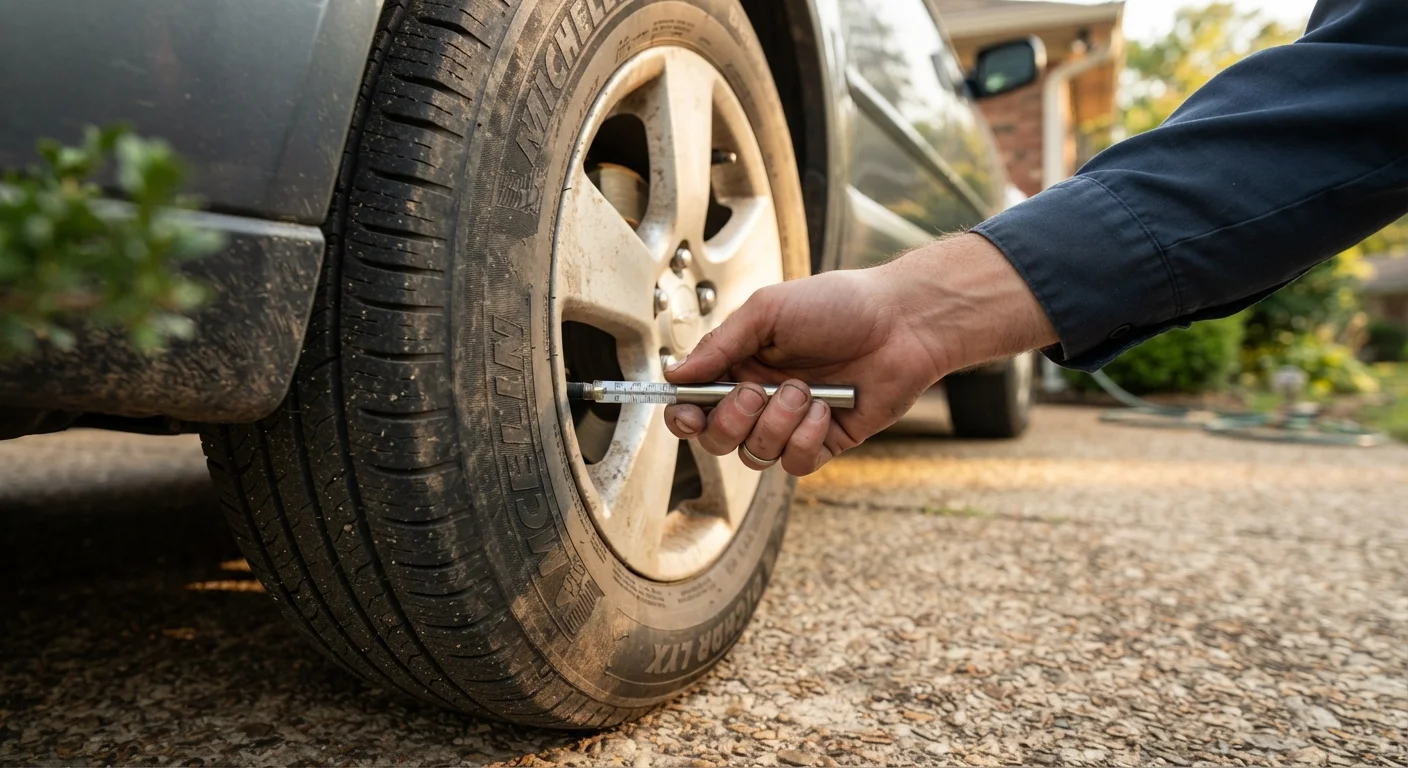
Why Tires Deserve More Attention Than They Get
Tires are your vehicle's only contact with the road. Every braking, steering, and acceleration input passes through four palm-sized patches of rubber. Despite this, tire condition is one of the most consistently neglected aspects of routine car care - often because problems develop gradually and aren't obvious until something goes wrong.
The good news: the checks that matter most take only minutes and require no mechanical skill. Understanding what to look for, and how often, is the starting point. For a broader view of where tire checks fit in your overall schedule, see your car's full maintenance schedule.
“Tires are the single most important safety component on a vehicle - and among the most under-maintained. A tire failure at highway speed is one of the leading causes of loss-of-control crashes.”
— National Highway Traffic Safety Administration, U.S. federal vehicle safety regulator
Tire Pressure: Getting It Right Every Month
Tire pressure is measured in PSI. Most passenger vehicles run between 30 and 35 PSI, but the correct number for your specific vehicle is printed on a sticker inside the driver's door jamb - not on the tire sidewall, which shows a maximum rating, not the recommended operating pressure.
Tires lose approximately 1 PSI per month under normal conditions, and an additional 1 PSI for every 10°F drop in outside temperature. That means a tire that was properly inflated in August can be noticeably underinflated by November without a single slow leak involved.
Check pressure when the tires are cold - meaning the vehicle has been parked for at least three hours or driven fewer than a mile. Heat from driving temporarily increases PSI readings and can make an underinflated tire appear fine.
Check Pressure in the Morning, Not After Driving
Tire pressure readings taken after highway driving can be 4-6 PSI higher than the true cold reading due to heat buildup. Always check pressure after the vehicle has sat for at least three hours for an accurate result. Adding or releasing air based on a hot reading can leave your tires improperly inflated.
Don't forget the spare. A flat spare is useless in an emergency, and most drivers never check it until they need it. Include it in your monthly routine.
Tread Depth: The Penny Test and Beyond
Tread depth is what channels water away from under your tires, maintaining contact with the road surface. As tread wears down, wet-weather braking distances increase significantly - tires worn to the legal minimum of 2/32 of an inch can take substantially longer to stop compared to new tires in wet conditions.
The classic penny test works: insert a penny into the tread groove with Lincoln's head pointing down. If you can see the top of Lincoln's head, the tread is at or below 2/32 inch and the tire should be replaced. A quarter used the same way - if Washington's head is fully visible - indicates you're approaching 4/32 inch, a threshold many safety experts consider the practical replacement point for wet-weather driving.
Check tread at multiple points across each tire, not just the center. Uneven wear patterns - such as wear on only the inner or outer edges - suggest alignment or inflation problems. If you notice irregular wear, it's worth having a qualified technician inspect your alignment and suspension. This is especially relevant for high-mileage vehicles, where suspension components may have more wear.
Check tire pressure monthly and before every long trip, always using a cold reading.
Pressure changes with temperature and time, and driving on underinflated tires reduces fuel efficiency, accelerates tread wear, and increases blowout risk. Cold readings are required for accuracy because heat expansion skews results.
Use the quarter test - not just the penny test - as your tread replacement indicator.
The legal minimum of 2/32 inch is not a safety target; it's a floor. Replacing tires at 4/32 inch preserves meaningful wet-weather braking performance and reduces hydroplaning risk.
Inspect tires visually each month, looking at both the tread surface and the sidewalls.
Sidewall bulges, cracks, and embedded objects can cause sudden failure if left unaddressed. Early detection prevents dangerous blowouts and gives you time to plan a non-emergency replacement.
Rotate tires according to your vehicle manufacturer's recommended interval, typically every 5,000 to 7,500 miles.
Front and rear tires wear at different rates depending on whether your vehicle is front-, rear-, or all-wheel drive. Rotation equalizes wear across all four tires, extending the full set's usable life.
Always use the PSI listed on the driver's door jamb sticker, not the number printed on the tire sidewall.
The tire sidewall shows maximum allowable pressure for the tire itself - not the optimal pressure for your vehicle's weight, handling, and comfort. Using the wrong number can cause overinflation problems or chronic underinflation.
The Checks Most Drivers Skip - and Why They Matter
Beyond pressure and tread, a few additional tire checks are easy to overlook but meaningfully affect safety and longevity.
Visual sidewall inspection: Look for bulges, cracks, or cuts on the sidewall of each tire. A sidewall bulge typically indicates internal structural damage - often from a hard impact with a pothole - and makes a tire susceptible to sudden blowout. This is a situation where a professional evaluation is warranted promptly.
Valve stem condition: The small rubber or metal stem where you add air can crack or corrode over time, causing slow leaks. Caps should be in place on all four tires to keep dirt and moisture out.
These quick checks pair well with other pre-drive habits. A full pre-trip safety walkthrough can help you build a consistent routine that catches problems before they become roadside emergencies. Just as skipping routine home maintenance quietly compounds into larger repairs - a point covered in home maintenance tasks often left off the list - skipping tire checks lets small issues escalate unnoticed.
11,000+
Tire-related crashes annually in the U.S.
The National Highway Traffic Safety Administration has attributed thousands of crashes each year to tire failures, including blowouts and tread separation.
~25%
Passenger vehicles with at least one underinflated tire
NHTSA research has found that a significant share of vehicles on the road at any given time are operating with at least one tire below recommended pressure.
The content on this site is for informational purposes only and is not a substitute for professional advice. Always consult a qualified professional for guidance specific to your situation.