

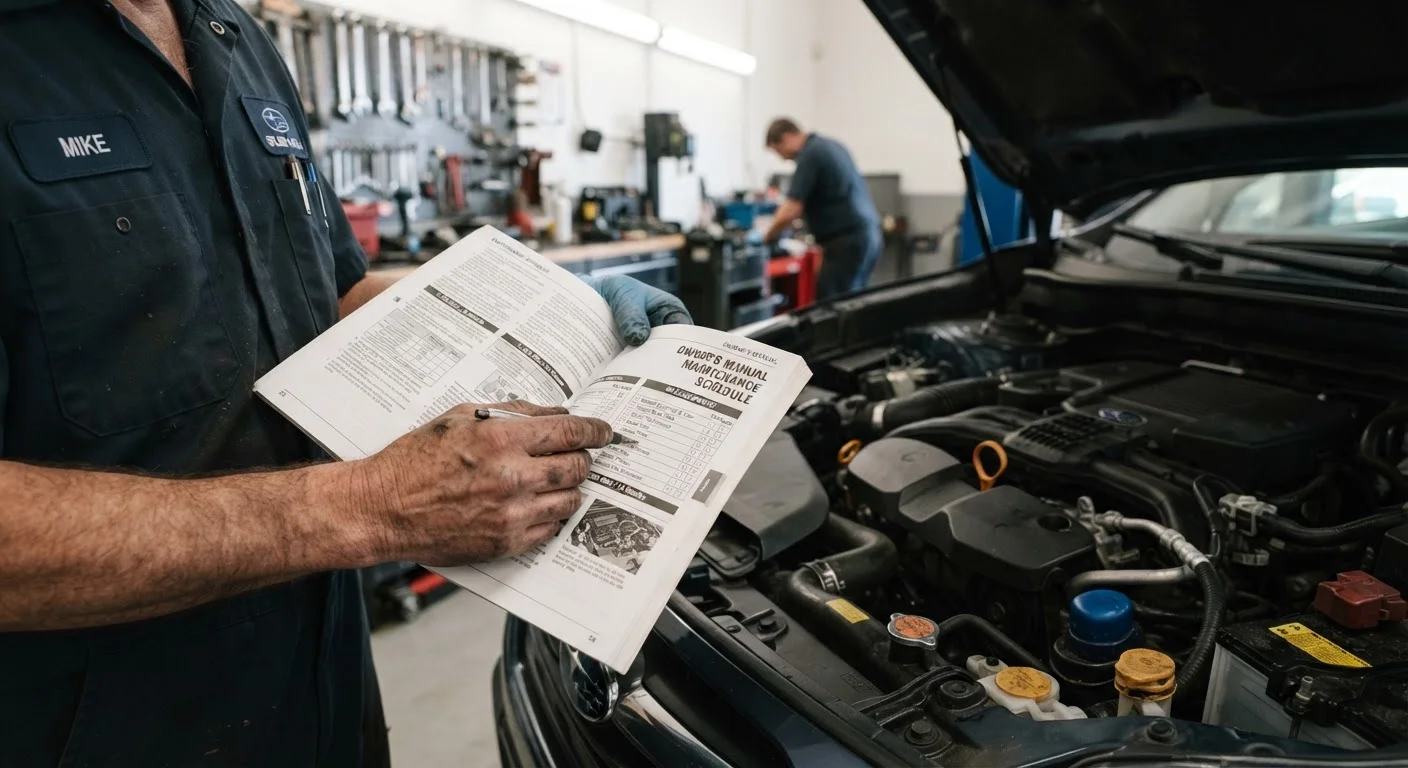
Why Your Owner's Manual Is the Starting Point
Walk into almost any quick-lube shop and you'll see generic interval recommendations posted on the wall. These aren't necessarily wrong, but they're designed for a hypothetical average vehicle - not yours. Your owner's manual contains the maintenance schedule your vehicle's engineers developed specifically for its engine, transmission, and fluid capacities. That document is where every service conversation should begin.
Manufacturers typically organize maintenance into two tracks: a normal schedule for everyday highway and suburban driving, and a severe schedule for harder use. If your daily commute involves extended idling, frequent cold starts, or unpaved roads, your car likely qualifies for the more frequent severe-duty intervals - even if it doesn't feel like demanding driving.
For a broader picture of keeping all your vehicles and property on track, see our annual car ownership checklist, which covers registrations, insurance reviews, and maintenance milestones in one place.
The Core Services and What They Actually Do
Maintenance schedules can look like a wall of unfamiliar terminology. Here's what the most common services accomplish:
- Oil and filter change: Engine oil lubricates moving parts and carries away heat and combustion byproducts. Over time it degrades and accumulates contaminants. Changing it at the manufacturer's recommended interval - not a universal rule - keeps internal engine components protected. See common oil change myths examined for a closer look at widely repeated misconceptions.
- Tire rotation: Front and rear tires wear at different rates depending on whether your vehicle is front-, rear-, or all-wheel drive. Rotating them according to schedule promotes even tread wear and extends tire life.
- Coolant flush: Coolant (antifreeze) regulates engine temperature and prevents internal corrosion. It degrades chemically over time, losing its protective properties even if the level looks adequate on the reservoir.
- Transmission fluid service: Automatic and manual transmissions rely on fluid to lubricate gears and manage heat. Neglecting this service is one of the more common contributors to expensive transmission repairs.
- Brake fluid replacement: Brake fluid is hygroscopic - it absorbs moisture from the air over time, which lowers its boiling point and can compromise braking performance. Manufacturers typically specify a replacement interval by mileage or years.
- Air filter replacement: A clogged engine air filter restricts airflow, which can reduce fuel efficiency and engine performance. Cabin air filters, a separate component, affect the air quality inside your vehicle.
Learning to check fluid levels yourself is a practical first step. The fluid checks every driver should know how to do walks through each reservoir in plain language.
5,000-10,000 mi
Typical modern oil change interval
Many current manufacturer schedules for full synthetic oil specify intervals well beyond the old 3,000-mile standard, though the exact figure varies by vehicle and oil type.
~30%
Of vehicles on the road are overdue for an oil change
Industry surveys by automotive research organizations have consistently found a significant share of vehicles in circulation have not had an oil change within their manufacturer's recommended window.
2x-4x
Cost multiplier when maintenance becomes repair
Automotive repair data suggests that allowing routine services to lapse until a component fails can multiply the eventual cost by two to four times compared to preventive maintenance.
Mileage vs. Time: Understanding Dual-Trigger Intervals
Most manufacturer schedules list service intervals as a mileage figure or a time period - whichever comes first. This dual-trigger system exists because chemical degradation in fluids happens with time, not just use. A driver who puts only 5,000 miles on a car in two years still needs oil changes and coolant checks on the time-based schedule, because the fluids age regardless of how far the car travels.
Modern vehicles often include an onboard maintenance reminder system - sometimes called an oil life monitor or maintenance minder - that calculates service needs based on driving patterns and conditions. These systems are useful prompts, but they monitor specific parameters and may not flag every service your manual requires. Use them as one input, not the only one.
Set a Reminder That Works for You
Rather than relying solely on a dashboard light, consider setting a recurring calendar reminder tied to both your mileage milestones and the time-based interval - whichever comes first. A simple note in your phone with the date and mileage of your last oil change takes seconds to create and removes any guesswork at the next service interval.
What Deferred Maintenance Actually Costs
Routine maintenance feels optional in the short term because the consequences are usually invisible until something fails. But the relationship between deferred services and repair costs is well established in automotive engineering. Contaminated oil accelerates engine wear. Low or degraded transmission fluid generates heat that damages internal components. Worn brake pads, if not replaced, eventually score the rotors - turning a straightforward pad swap into a more involved and expensive job.
Beyond mechanical risk, a spotty service history affects a vehicle's resale value. Buyers and dealers routinely ask for maintenance records, and gaps in documentation raise questions that can lower an offer. Keeping good records explains how documented maintenance protects your investment over the long term.
If your vehicle is approaching or past 100,000 miles, some services become more frequent or take on added importance. High-mileage vehicle maintenance covers what shifts after that threshold.
Seasonal and Condition-Based Adjustments
A standard mileage-based schedule is a baseline, not a ceiling. Weather and driving conditions introduce stresses that don't always line up with odometer milestones. Extreme heat accelerates coolant and belt degradation. Cold winters are hard on batteries - a component that intersects with your car's entire starting system. See how your battery, alternator, and starter work together for a clear breakdown of these interdependent components.
For a structured look at what to inspect as temperatures shift, seasonal car care guidance covers the specific checks that become important as conditions change. Think of seasonal reviews as a complement to your manufacturer schedule - not a replacement for it.
When you do bring your vehicle in for service, being able to interpret what you're being charged for is just as important as knowing when to go. Reading a repair estimate explains labor hours, parts sourcing, and shop fees in plain terms so you can ask informed questions.
“The owner's manual is the single most underused resource in automotive maintenance. Most drivers never open it, yet it contains everything the engineers who built the car want you to know about keeping it running.”
— John Nielsen, Former Managing Director of Automotive Engineering and Repair, AAA
Frequently Asked Questions
The definitive source is your vehicle's owner's manual, usually stored in the glove compartment. Most automakers also publish maintenance schedules on their official websites by entering your model year and trim level. Avoid relying solely on third-party charts, which may not reflect your specific vehicle.
Skipping services accelerates wear on components that rely on clean fluids and properly functioning parts. For example, neglecting oil changes allows contaminants to build up, increasing engine friction and potentially shortening engine life. In many cases, deferred maintenance turns a modest service bill into a significant repair.
For most modern vehicles using full synthetic oil, the 3,000-mile interval is outdated. Many manufacturers now recommend intervals of 5,000 to 10,000 miles or longer depending on oil type and engine design. Always check your owner's manual rather than following a generalized rule.
Severe driving includes frequent short trips under five miles, stop-and-go city traffic, towing or hauling heavy loads, driving in extreme heat or cold, and operating in dusty or unpaved environments. Drivers in these conditions typically need more frequent service than the standard schedule suggests.
No. Independent certified mechanics can perform virtually all scheduled maintenance. What matters is that the work is done at the correct intervals using the appropriate fluids and parts, and that you retain documentation of each service.
Temperature extremes place additional stress on fluids, batteries, tires, and belts. A battery that functions adequately in mild weather may struggle to start the engine in deep cold, for instance. Seasonal check-ins complement - but don't replace - your standard mileage-based schedule.
The content on this site is for informational purposes only and is not a substitute for professional advice. Always consult a qualified professional for guidance specific to your situation.