

Why Sign Misreading Is More Common Than You Think
Most drivers learn road signs for a licensing exam and then rarely revisit them. Over time, assumptions fill the gaps - and some of those assumptions are wrong in ways that create legal exposure or genuine safety risk. Under the MUTCD, the federal standard that governs U.S. road signs, every sign carries a precise legal meaning. Knowing the difference between what a sign looks like it says and what it actually requires can help you avoid citations and, more importantly, collisions.
Misread signs also interact with broader road-sharing issues. Our companion piece covers common errors drivers make around cyclists and pedestrians, many of which trace back to misunderstood signage.
| Federal Sign Standard | Manual on Uniform Traffic Control Devices (MUTCD) (Federal Highway Administration) |
| Regulatory Sign Color | White background with black or red text/symbols (MUTCD, current edition) |
| Warning Sign Color | Yellow (or orange in work zones), diamond shape (MUTCD, current edition) |
| Flashing Red Meaning | Treat as a stop sign - full stop required (Uniform Vehicle Code; state traffic laws) |
| Right Turn on Red Default | Permitted after full stop in most U.S. states unless posted otherwise (Varies by state; verify locally) |
Frequently Misunderstood Signs - and Their Precise Meanings
The signs below are among the most commonly misread on American roads. Each entry reflects the legal standard under federal and typical state traffic law. Always verify requirements in your specific state, as some states add or modify rules.
Yield Sign
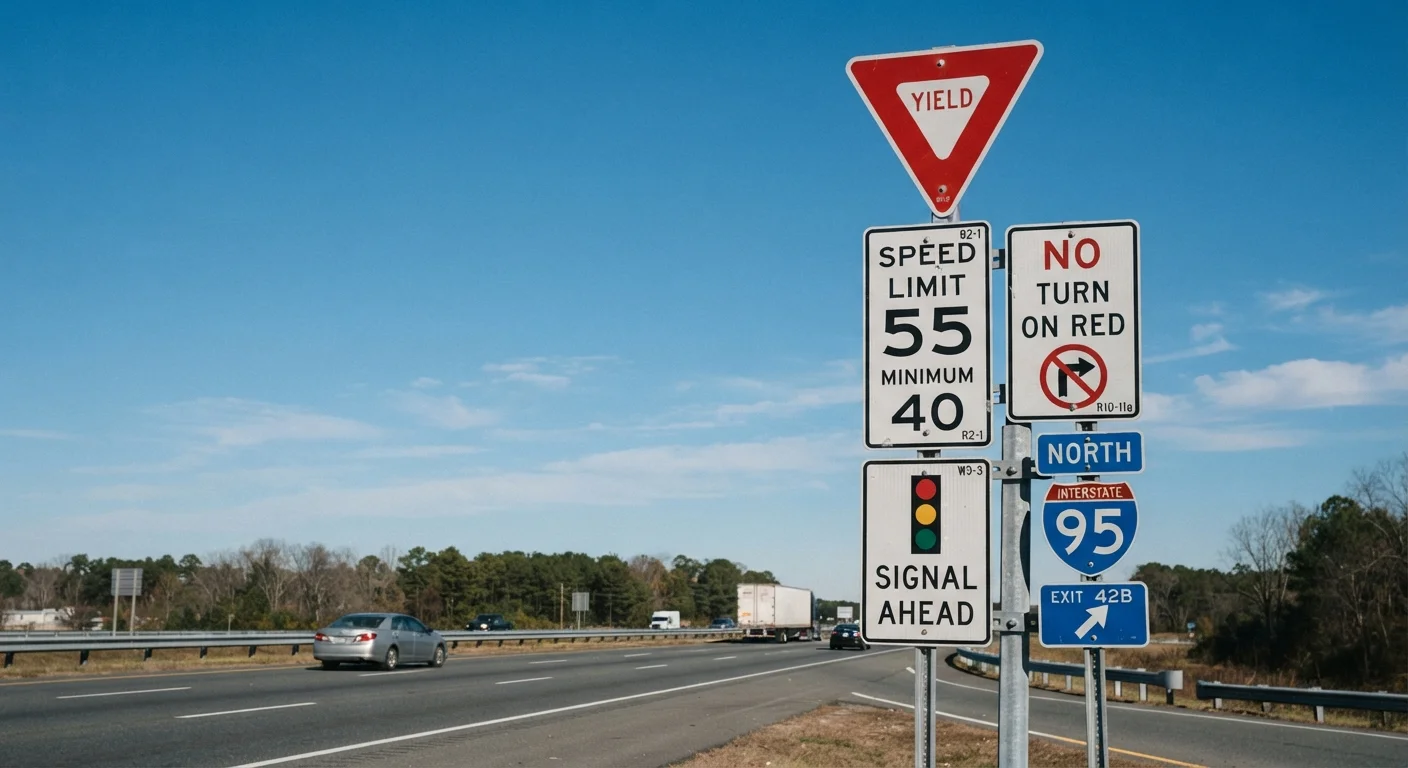
A yield sign does not mean slow down and proceed if the road looks clear. It means you must give the right-of-way to traffic already in the intersection or roadway you are entering. If doing so requires a full stop, you must stop. Treating a yield as a rolling suggestion is a common - and enforceable - error.
"No Turn on Red" vs. Default Turn-on-Red Rules
In most U.S. states, a right turn on red is permitted after a complete stop unless a sign explicitly prohibits it. The confusion runs both ways: some drivers turn on red where it is posted as forbidden; others refuse to turn where it is perfectly legal. Read the posted sign, not the habit.
Flashing Yellow vs. Flashing Red
A flashing red light is treated as a stop sign - come to a complete stop, then proceed when safe. A flashing yellow light means proceed with caution; it does not require a stop. Many drivers treat both as equivalent warnings, which can cause unnecessary rear-end collisions behind drivers who stop at flashing yellows.
"Speed Limit XX When Children Present"
This school zone variation only applies when children are visibly present in or near the roadway - not simply during school hours. However, some states define "children present" broadly, and enforcement interpretations vary. Erring on the side of the reduced speed limit is the prudent choice.
White vs. Yellow Centerlines
Yellow centerlines separate traffic moving in opposite directions. White lines separate traffic moving in the same direction. A solid yellow line on your side means passing is prohibited for you, even if the line on the other side is dashed.
Advisory Speed Signs (Yellow)
A yellow speed sign beneath a curve warning is an advisory, not a legal speed limit. It reflects the speed at which engineers determined the curve can be navigated safely in normal conditions. The statutory speed limit still applies - and adverse weather or road conditions may make the advisory speed too fast. This connects to a broader pattern explored in our piece on why drivers underestimate speed.
MUTCD
The Manual on Uniform Traffic Control Devices is the federal standard published by the Federal Highway Administration that defines the design, placement, and meaning of all traffic signs, signals, and pavement markings used on U.S. public roads.
Regulatory Sign
A sign that communicates a specific legal requirement. Failure to comply with a regulatory sign can result in a traffic citation. These signs are typically white with black or red text.
Warning Sign
A sign that alerts drivers to a potential hazard ahead, such as a curve, intersection, or pedestrian crossing. Warning signs are typically yellow (or orange in work zones) and diamond-shaped.
Advisory Speed
A suggested speed for a specific condition, such as a sharp curve, indicated on a yellow sign. It is not a legally enforceable speed limit but reflects an engineering-based recommendation for safe navigation under normal conditions.
Right-of-Way
The legal priority one road user has to proceed before another. Yield and stop signs, along with traffic signals, formally assign right-of-way at intersections and merge points.
How to Sharpen Your Sign Recognition
Reviewing your state's current driver's manual is the single most reliable way to refresh your knowledge - state DMV websites offer these as free downloads. The MUTCD itself is publicly available through the Federal Highway Administration for those who want the authoritative federal standard.
If dashboard symbols give you similar uncertainty, our reference on dashboard warning lights applies the same plain-language approach to your instrument panel.
State Laws Can Differ From Federal Defaults
The MUTCD sets a national baseline, but individual states may adopt supplemental rules that modify sign meanings or add local requirements. For example, some states have stricter school zone definitions or differ on turn-on-red rules in certain municipalities. Always consult your state's official DMV resources for the rules that apply where you drive.
Staying fluent in road signs isn't just about passing a test - it's an ongoing part of responsible driving at every experience level.
The content on this site is for informational purposes only and is not a substitute for professional advice. Always consult a qualified professional for guidance specific to your situation.