

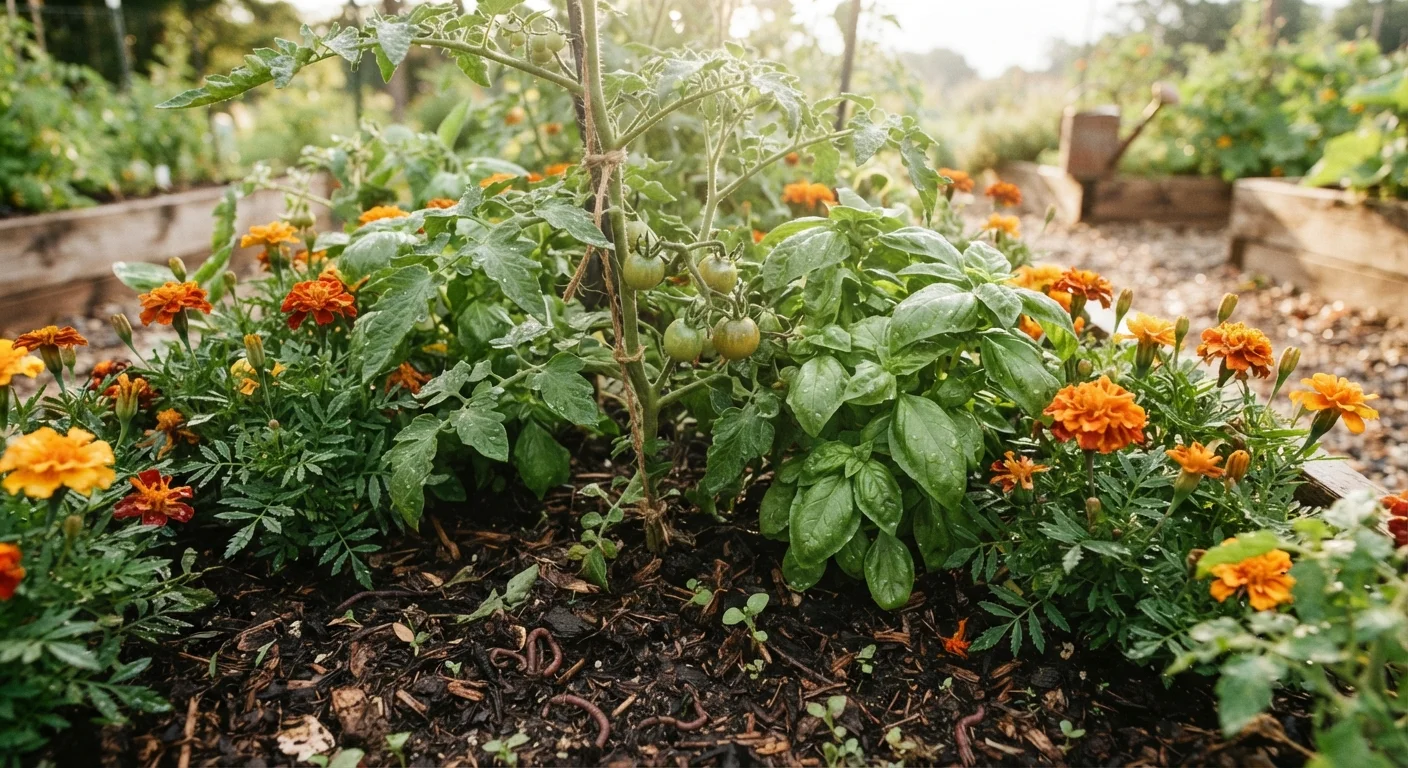
What Companion Planting Actually Claims to Do
Companion planting is the practice of growing two or more plant species near each other for mutual benefit. Claimed benefits range from pest deterrence and improved pollination to enhanced flavor and better yields. The practice draws from centuries of agricultural tradition - and from a patchwork of modern garden experiments, some rigorous, many informal.
Before you rearrange your vegetable beds, it helps to understand what the science does and doesn't support. Starting your garden on solid fundamentals matters far more than any pairing strategy, but companion planting can genuinely supplement good practice when applied thoughtfully.
Myth
Planting basil next to tomatoes makes the tomatoes taste better.
Fact
No controlled research confirms that basil improves tomato flavor; both plants simply share compatible growing conditions.
This pairing is one of the most repeated pieces of garden wisdom, but taste improvement has not been demonstrated in peer-reviewed studies. What is true: basil and tomatoes thrive under similar conditions - warm soil, full sun, consistent moisture - so they coexist well without competing. Growing them together is harmless and convenient, but attributing flavor changes to the pairing is a stretch not supported by evidence.
Myth
The 'Three Sisters' (corn, beans, squash) is just a cultural tradition with no real agronomic value.
Fact
The Three Sisters combination reflects documented, complementary functions: nitrogen fixation, vertical structure, and ground cover.
Beans are legumes that fix atmospheric nitrogen, feeding the heavy-feeding corn. Corn stalks provide a natural trellis for beans to climb. Squash's broad leaves shade the soil, reducing moisture loss and suppressing weeds. These are measurable agronomic effects, not mythology. Indigenous agricultural communities in North America refined this system over generations - modern research has confirmed the underlying plant biology that makes it work.
Myth
Planting aromatic herbs like rosemary or sage near vegetables reliably repels insect pests.
Fact
Pest repellence from herbs is inconsistent in controlled studies and depends heavily on pest species, plant density, and local conditions.
Aromatic compounds released by herbs can confuse or deter some insects in laboratory settings, but garden trials show highly variable results. Pest pressure, local insect populations, planting density, and weather all influence outcomes more than the presence of a nearby herb. Herbs are worth growing for culinary use and to support pollinators, but framing them as reliable pest shields sets expectations the evidence doesn't support.
Myth
Companion planting can replace the need for crop rotation or soil improvement.
Fact
Companion planting complements good soil and rotation practices but cannot substitute for them.
No combination of neighboring plants overcomes depleted soil, accumulated pathogens from repeated same-family crops, or chronic nutrient deficiencies. Crop rotation reduces disease and pest cycles in ways companion planting cannot replicate. If you're new to improving your growing environment, understanding soil health will deliver more reliable gains than rearranging plant neighbors.
Myth
Marigolds planted anywhere in the garden will ward off pests throughout the bed.
Fact
Marigold pest-suppression effects are localized, require specific species, and need sustained dense planting to be effective.
French marigolds (Tagetes patula) produce compounds that suppress root-knot nematodes - but only in the immediate root zone and only when planted densely for an extended period. A handful of marigolds scattered around the garden perimeter provides little measurable protection. To use marigolds effectively, plant them as a solid cover crop in a bed a full season before planting susceptible vegetables, or interplant them densely throughout the bed.
What Research Says - and Where It Goes Quiet
The strongest scientific backing for companion planting centers on a few well-studied mechanisms: nitrogen fixation, physical ground cover, and certain chemical interactions. Legumes like beans fix atmospheric nitrogen in their root nodules, enriching soil for neighboring heavy feeders like corn. That's plant physiology, not folklore.
~80%
Of nitrogen fixation in legumes occurs via root nodule bacteria
Biological nitrogen fixation by legume-bacteria partnerships is one of the most well-documented nutrient-cycling mechanisms in agricultural science.
1 full season
Minimum marigold planting needed for nematode suppression
University extension research indicates French marigolds must be densely planted for an entire growing season to meaningfully reduce soil nematode populations.
Marigolds (Tagetes species) are another standout. Research consistently shows that French marigolds produce a compound called alpha-terthienyl that suppresses root-knot nematodes - microscopic soil pests that damage plant roots. This effect is real, but requires dense planting sustained over a full season, not a single marigold tucked into a corner.
Beyond these documented examples, the evidence thins considerably. Most studies on pest-deterrent companions produce inconsistent results - what works in one microclimate, soil type, or growing season often fails to replicate elsewhere. That doesn't mean these pairings are useless, but it does mean treating them as experiments rather than guaranteed solutions. Good soil health remains the single most reliable investment you can make in plant performance.
Don't Sacrifice Space on Unproven Pairings
Garden space is finite. Dedicating large portions of your bed to companion combinations without evidence can crowd out productive plants and reduce overall yields. Test one or two pairings at a time in a small area rather than overhauling your entire layout based on folklore. Keep records so your observations over multiple seasons actually mean something.
Putting It Into Practice Without Overpromising
Approach companion planting as one layer of a broader strategy. Start with documented, low-risk pairings - the Three Sisters, marigolds near vulnerable roots, or nasturtiums as trap crops for aphids (a technique with reasonable field evidence). Track your results season to season; your own garden's data is genuinely valuable.
Avoid rearranging your entire plot around unproven claims. Space, sunlight, water, and - as described in our guide to composting at home - nutrient cycling will outweigh any pairing benefit. Container gardeners can also apply these principles selectively; see our container gardening guide for plant-combination ideas suited to pots and small spaces.
The bottom line: companion planting is a legitimate tool with a real - if sometimes overstated - scientific foundation. Use the well-supported pairs confidently, treat the rest as working hypotheses, and let your garden tell you what's actually working.
The content on this site is for informational purposes only and is not a substitute for professional advice. Always consult a qualified professional for guidance specific to your situation.