

Why Insulation Type Matters
Not all insulation works the same way or belongs in the same place. Choosing the wrong material - say, unfaced fiberglass batts in a crawl space - can trap moisture, lose R-value over time, or simply fail to do the job. This reference covers the most common residential insulation types, what each one does well, and where it belongs in your home.
Before diving into materials, one term you'll see throughout: R-value. R-value measures thermal resistance - how well a material slows heat transfer. Higher is better, and the right target depends on your climate zone and where in your home the insulation is going. The U.S. Department of Energy publishes recommended R-values by zone, which are a useful starting benchmark.
| Fiberglass batt R-value per inch | Approx. R-3.1 to R-3.4 (U.S. Department of Energy) |
| Closed-cell spray foam R-value per inch | Approx. R-6 to R-7 (U.S. Department of Energy) |
| Cellulose (blown-in) R-value per inch | Approx. R-3.2 to R-3.8 (U.S. Department of Energy) |
| XPS rigid foam R-value per inch | Approx. R-5 (U.S. Department of Energy) |
| Mineral wool batt R-value per inch | Approx. R-3.0 to R-3.3 (U.S. Department of Energy) |
For a broader picture of how insulation fits into seasonal home prep, see our winter readiness walkthrough.
The Main Insulation Types at a Glance
Here's a breakdown of the most widely used residential insulation materials and where each one belongs.
R-value
A measure of an insulation material's resistance to heat flow. Higher R-values indicate better thermal performance. Recommended R-values vary by climate zone and building location.
Vapor retarder
A material - often a foil or kraft paper facing on batts - that slows the movement of moisture vapor through walls and ceilings, helping to prevent condensation inside building cavities.
Thermal bridge
A section of a building assembly (such as a wood stud or metal framing) that conducts heat more readily than surrounding insulation, reducing the overall effective R-value of the assembly.
Closed-cell foam
A type of spray polyurethane foam whose cells are densely packed and sealed, making it resistant to moisture and air infiltration while delivering high R-value per inch.
Open-cell foam
A softer, more flexible spray foam where cells are not fully enclosed, allowing water vapor to pass through. It offers lower R-value per inch than closed-cell but expands to fill irregular cavities.
Rim joist
The horizontal framing member that sits on top of the foundation wall and caps the ends of the floor joists. It's a common air leakage point and a priority location for insulation and sealing.
Fiberglass Batts and Rolls
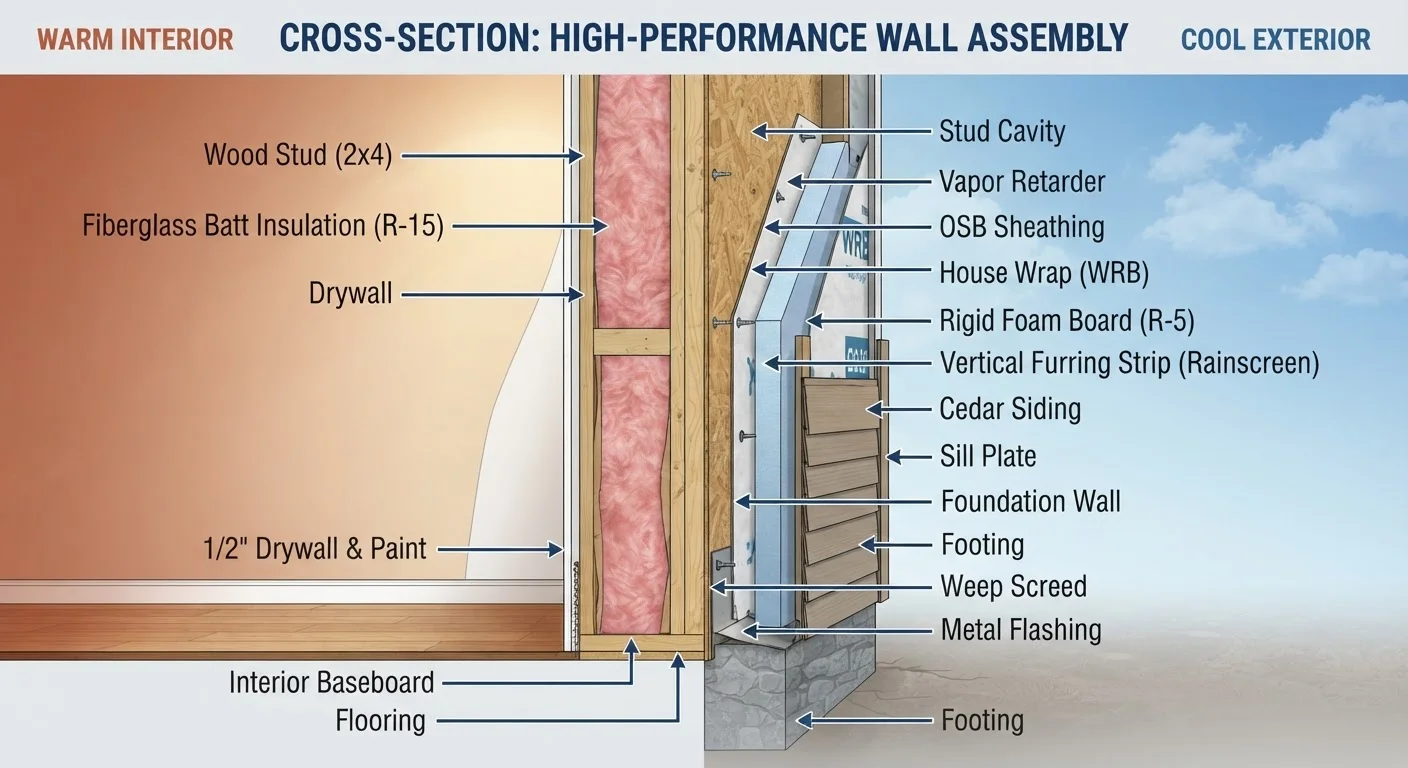
Fiberglass is the most recognizable type - those pink or yellow blankets you've seen in open walls. Batts come pre-cut to fit standard stud and joist spacing (16 or 24 inches on center). They're DIY-friendly and cost-effective for walls, floors, and attics where framing is accessible and moisture isn't a concern. Faced batts (with a paper or foil vapor retarder) are used on exterior walls; unfaced batts work for interior walls or as a second layer in an attic.
Blown-In (Loose-Fill) Insulation
Loose-fill insulation - made from fiberglass, cellulose, or mineral wool - is blown into place using a machine. It's ideal for attic floors where coverage needs to be even across irregular joists, and for retrofitting existing walls through small drilled holes without tearing out drywall. Cellulose, made from recycled paper treated with fire retardant, settles over time, so contractors typically overshoot the target depth.
Spray Foam Insulation
Spray polyurethane foam (SPF) comes in two forms. Open-cell foam is softer and vapor-permeable - useful in interior applications. Closed-cell foam is dense, waterproof, and offers among the highest R-values per inch (around R-6 to R-7). Closed-cell foam is commonly used in crawl spaces, rim joists, and below-grade walls where moisture resistance matters most. Because spray foam involves chemicals and precision application, most homeowners hire a licensed contractor for large installations.
Rigid Foam Board
Rigid boards - polyisocyanurate (polyiso), extruded polystyrene (XPS), or expanded polystyrene (EPS) - work well on basement walls, exterior sheathing, and under concrete slabs. They resist moisture, don't sag, and can be cut with a utility knife. XPS and closed-cell EPS are particularly common in below-grade applications. When used on interior surfaces, local building codes typically require covering rigid foam with a thermal barrier such as drywall. Always verify local requirements before installation.
Mineral Wool (Rock Wool / Slag Wool)
Mineral wool batts are denser than fiberglass, naturally fire-resistant, and better at blocking sound. They're a strong choice for interior partition walls where noise reduction matters, as well as for areas around mechanical equipment. Mineral wool doesn't absorb moisture and retains its shape well over time.
If drafts are undermining your insulation's effectiveness, pairing new insulation with air sealing makes a real difference - our air leak sealing guide explains where to look and what to use.
Matching Insulation to Location
The table below is a quick lookup reference for common home locations and the insulation types that generally perform best in each.
| Location | Recommended Types | Key Consideration |
|---|---|---|
| Attic floor | Blown-in, fiberglass batts | Aim for recommended R-value for your climate zone |
| Attic rafters (conditioned attic) | Closed-cell spray foam, rigid board | Creates an unvented, conditioned space |
| Exterior walls (new construction) | Fiberglass batts, mineral wool batts | Faced batt vapor retarder faces warm side |
| Exterior walls (retrofit) | Blown-in loose fill | Drilled and filled without removing drywall |
| Basement walls | Rigid foam board, closed-cell spray foam | Moisture resistance is critical; check local code for thermal barrier |
| Crawl space | Closed-cell spray foam, rigid board | Encapsulation approach seals against ground moisture |
| Rim joists | Closed-cell spray foam, cut-and-cobble rigid foam | Air sealing is as important as R-value here |
| Interior partition walls | Mineral wool batts, fiberglass batts | Prioritize sound attenuation over thermal performance |
Planning to finish your basement? Insulation choices there involve moisture management, egress considerations, and framing sequencing. Our basement finishing guide covers the full picture.
Permits and Codes Vary by Location
Insulation work - especially in basements, crawl spaces, and attics - may require a building permit or inspection in your jurisdiction. Specific requirements for vapor barriers, thermal barriers over foam, and ventilation can differ significantly by local code. Always check with your local building department before beginning any insulation project, and consider hiring a licensed contractor for work involving spray foam or below-grade applications.
Even well-insulated walls lose efficiency when air leaks around outlets, pipes, and window frames go unsealed. See our companion piece on sealing window and door drafts for targeted fixes.
The content on this site is for informational purposes only and is not a substitute for professional advice. Always consult a qualified professional for guidance specific to your situation.